Why Beagles Trail Rather Than Air-Scent
If you've ever walked a Beagle, you know the familiar sight: nose glued firmly to the ground, a little plow pushing through grass, leaves, or even pavement, completely oblivious to your calls. It can be frustrating when you just want to get from point A to point B, but your Beagle is absolutely lost in a world of scent. This intense focus on ground trails isn't just a quirky habit; it's a deeply ingrained instinct, a product of millennia of selective breeding and unique biological adaptations. This guide will explore exactly why Beagles are masters of the ground scent and why they trail rather than air-scent.
The Anatomy of a Beagle's Nose: Built for the Ground
When we talk about a Beagle's sense of smell, we're not just talking about a slightly better nose than ours. We're talking about an entirely different league of olfactory power, a biological marvel specifically designed for dissecting scent molecules from the ground up. This isn't an accident; it's the result of generations of breeding for a very specific job.
How Many Scent Receptors Does a Beagle Have?
The sheer number of olfactory receptors in a Beagle's nose is mind-boggling. While humans boast a mere 5 to 6 million, a Beagle can have upwards of 220 million. Think about that for a moment – that’s more than 40 times the sensory equipment! Each one of these microscopic receptors is a finely tuned antenna, ready to detect even the faintest whiff of a scent molecule. This incredible density means that a Beagle can pick up on odors that are simply imperceptible to us, distinguishing nuances in smell that we couldn't even begin to imagine. It's like comparing a high-definition 4K television to a blurry black-and-white static screen – the information they receive is fundamentally different in quantity and quality.
This vast array of receptors isn't just for general smell; it's particularly adept at gathering and processing molecules that have settled on surfaces. When a scent particle lands on the ground, it tends to stick, and a Beagle's close-to-the-earth sniffing style allows these millions of receptors to sweep across a broad area, collecting every possible clue. It's an information-gathering machine, optimized for the rich, complex tapestry of odors found right underfoot. The internal link The 220 Million Receptors Behind a Beagle's Nose offers even more detail on this astounding capability.
The Olfactory Bulb: A Beagle's Command Center
The nose is just the beginning; the real processing power lies in the brain. Specifically, the olfactory bulb, the part of the brain dedicated to interpreting scents, is disproportionately large in Beagles compared to their overall brain size. In humans, our olfactory bulb is relatively small, while in a Beagle, it's immense, covering a much larger percentage of their brain volume. This isn't just about size, though; it's about the complex neural networks within it, which are designed to analyze and categorize an overwhelming amount of scent data.
Imagine trying to read a phone book in a split second versus having a supercomputer instantly cross-reference every name and number for you. That's the difference between our olfactory processing and a Beagle's. Their large olfactory bulb allows them to not only detect scents but to break them down, identify their components, and track them with incredible precision. While some dogs might specialize in air-scenting, catching wafting odors from a distance, the Beagle's command center is built for deep dives into concentrated, ground-level information. This specialization means they can distinguish individual scent trails even in areas where multiple animals have passed, a crucial skill for their original purpose. You can learn more about this incredible organ in Why a Beagle Olfactory Bulb Runs So Much Larger.
Understanding Scent: Why Ground Trails are Different
To truly appreciate a Beagle's talent, we need to understand the fundamental difference between ground scent and air scent. These aren't just two ways to find something; they are distinct phenomena governed by physics and environmental factors, each requiring a specialized approach.
The Physics of Ground Scent vs. Air Scent
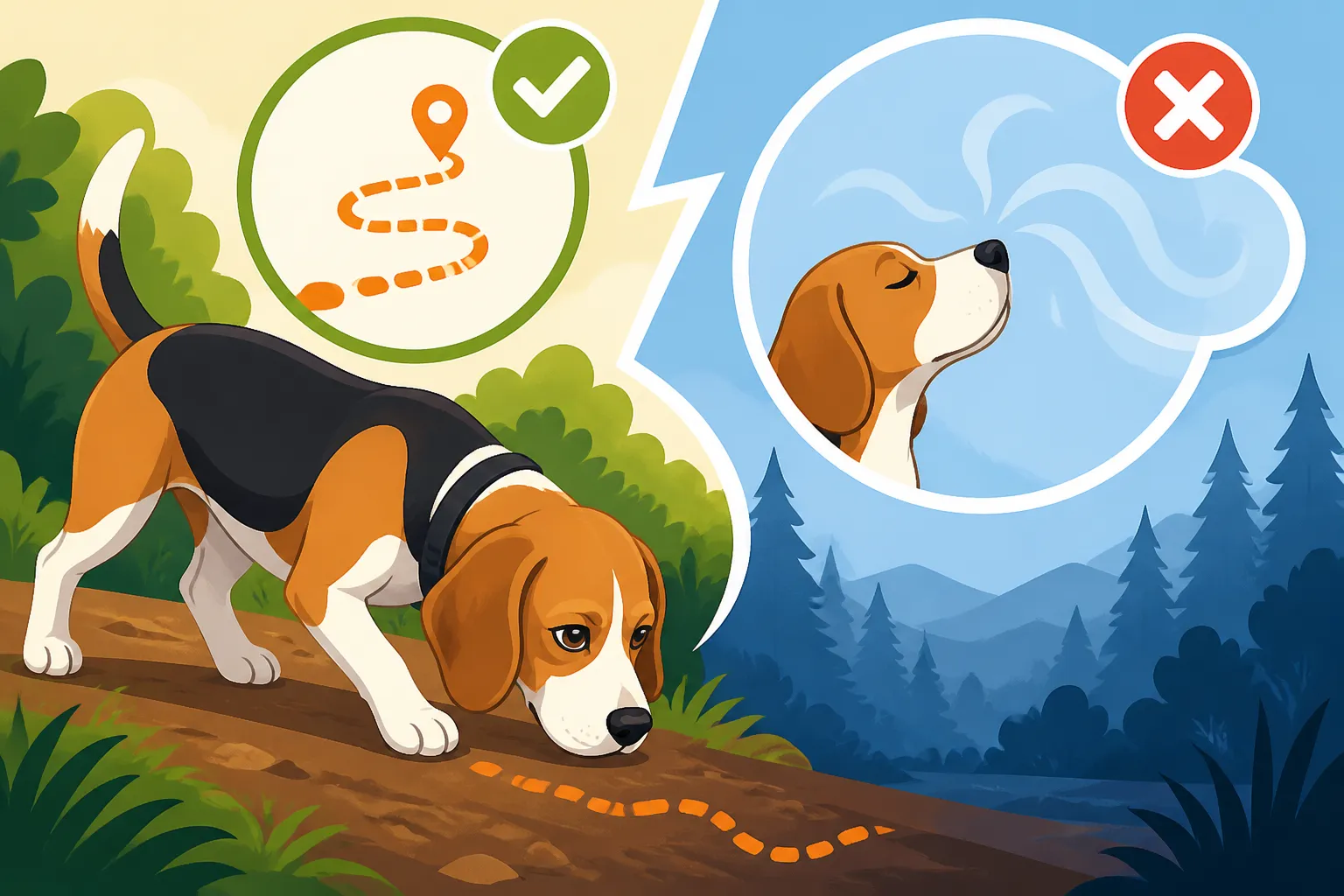
Think about dropping a handful of glitter. Some of it might catch the air currents and float away, dispersing widely. This is akin to air scent: volatile particles carried by wind, dissipating and becoming harder to pinpoint over time. Other pieces of glitter, however, will fall directly to the ground, embedding themselves in the carpet fibers, settling into cracks, or clinging to leaves. This is ground scent – molecules that have transferred directly to a surface.
Ground scent is often more stable and persistent than air scent. Factors like moisture, temperature, and the type of surface all play a role in how long a scent "holds." A cool, damp forest floor, for instance, can preserve a scent trail for hours, even days, because the moisture helps bind the scent molecules to the ground, and the lack of direct sunlight reduces evaporation. In contrast, a dry, windy day will quickly disperse air scent. Beagles are experts at detecting these ground-bound particles, often using their long ears to sweep and funnel scent towards their nostrils, further enhancing their ability to detect subtle changes. This methodical, nose-to-the-ground approach is not just a preference; it's an adaptation to the physics of how scent behaves on various terrains.
Layered Scent and a Beagle's Specialization
Imagine a forest path where a rabbit, a squirrel, and a deer have all passed at different times. For a human, this might just smell like "woods" or "animals." For a Beagle, it's a complex "layer cake" of distinct odors, each with its own signature, age, and direction. Ground scent often consists of more than just airborne particles; it includes skin cells, microscopic urine or fecal traces, disturbed vegetation, and even the unique microbial signature left by an animal's paws.
A Beagle's olfactory system is uniquely specialized to unpick these layered scents. They can discriminate between the faint, older scent of a deer and the fresh, more potent trail of a rabbit, even when these trails cross paths multiple times. This ability to "scent discriminate" allows them to stay focused on a specific target, ignoring myriad other distractions. It's a testament to their incredible processing power that they can follow one distinct thread through such a complex olfactory tapestry. This is a critical difference from air-scenting dogs, who might be more prone to getting confused by cross-contamination of air currents. For a Beagle, the ground offers a more reliable, albeit slower, roadmap to their quarry. When you see your Beagle with Why a Beagle Walks With Its Nose to the Ground, you're witnessing generations of this specialization in action.
The Evolutionary Advantage: Why Trail-Scenting Works for Beagles
The Beagle's physical attributes and behavioral tendencies aren't random; they are meticulously crafted by centuries of selective breeding. Their entire existence, from their compact size to their deep bark, points to one primary purpose: trailing small game.
Bred for the Brush: Hunting Small Game
Beagles, as we know them today, were primarily developed in England for hunting rabbits and hares. These small, wily creatures spend much of their time in dense undergrowth, brambles, and thickets. In such environments, a dog that relies on air scent would be at a distinct disadvantage. The scent might be blocked by vegetation, carried away by swirling drafts within the brush, or simply too diluted to follow reliably.
A trail-scenting Beagle, on the other hand, thrives in these conditions. With their nose pressed firmly to the ground, they can meticulously follow the twists and turns of a rabbit's path, even through the densest cover. Their short stature allows them to navigate low-lying brush easily, pushing through obstacles rather than trying to see over them. This close-quarters hunting style demanded a dog that could stick to a specific ground trail with unwavering determination. Air-scenting, while perhaps faster in open fields, simply wouldn't yield consistent results when chasing quarry hidden in the tangled landscape where rabbits make their homes. This is the very essence of What a Beagle Was Originally Bred to Hunt.
Persistence Over Speed: The Marathon, Not the Sprint
Unlike some sight hounds, which are built for explosive bursts of speed to catch prey in open terrain, Beagles are built for endurance and persistence. Their hunting style is a marathon, not a sprint. They are designed to follow a cold trail for extended periods, unraveling the story of a scent over long distances and varying terrains. This requires a steady, methodical approach, one that prioritizes accuracy and sustained effort over sheer speed.
When a Beagle is on a scent, they enter a state of deep absorption. Their world shrinks to the ground beneath their nose, and all other stimuli fade into the background. This intense focus, often perceived by owners as stubbornness, is actually the hallmark of a dedicated trail hound doing precisely what it was bred to do. They don't give up easily, meticulously piecing together the scent puzzle until they reach their goal. This unwavering commitment to the trail is why What a Beagle Experiences on a Scent Trail is so profound for them. This persistence means they may not be the fastest at finding something, but they are often the most reliable, methodically working through every possible clue until the quarry is located.
Living with a Trail-Scenting Beagle: Practical Implications
Understanding why your Beagle behaves the way it does can go a long way in managing daily life with this scent-driven breed. It changes frustration into appreciation and helps you cater to their innate needs.
The Unmistakable Beagle Walk: Nose to the Ground
If you own a Beagle, you're intimately familiar with the "Beagle walk"—a leisurely, meandering exploration where the dog's head is almost permanently lowered. Your arm might get a workout, and your patience might be tested, but for your Beagle, this isn't just a walk; it's a sensory expedition. Every blade of grass, every crack in the sidewalk, every discarded wrapper tells a story, and your Beagle is intent on reading every single page. They are literally mapping their world through scent, building a rich, detailed mental picture of their surroundings.
It can be incredibly frustrating when you're trying to walk quickly or get them to relieve themselves, and they seem to ignore every command. But for a Beagle, the call of an interesting scent is almost irresistible. It's a primal drive, more compelling than anything you might say. This is why it's so important to accept and even encourage their sniffing behavior. Allowing them time to explore with their nose not only fulfills their natural instincts but also provides mental stimulation that can be just as tiring as physical exercise. A sniff-filled walk is a happy Beagle walk. Seriously, Letting a Beagle Sniff on Every Single Walk is crucial for their well-being.
Training Challenges and Solutions
The Beagle's dedication to scent presents unique training challenges, especially when it comes to recall. When a Beagle is absorbed in a compelling trail, your voice can literally stop registering. Their brain is so engaged with the olfactory information that auditory input takes a backseat. This is not defiance; it's intense focus. That's why Beagle Recall and Why Your Voice Stops Registering is such a common complaint among Beagle owners.
To overcome this, traditional off-leash privileges are usually out of the question for Beagles unless in a truly secure, Beagle-proofed area. Instead, embrace the long line. A 30-foot or 50-foot long line allows your Beagle to explore scents safely while still giving you control. You can find durable long lines on sites like Chewy that can withstand a Beagle's pulling power. Additionally, engaging them in structured scent work activities can be incredibly rewarding. Whether it's formal nose work classes, barn hunt, or simply hiding treats around the house, giving your Beagle a "job" for its nose channels that powerful drive into acceptable and enriching behavior. This kind of work is not just fun; it's vital for their mental well-being and helps fulfill the deep-seated instincts of Scent Work as the Job a Beagle Was Built For. Always remember, Why a Beagle Should Never Be Off Leash Unfenced is a rule written in their DNA.
Choosing Gear for a Scent-Driven Hound
Because Beagles are so prone to pulling when on a scent, the right gear is essential for both their comfort and your control. A standard neck collar can put a lot of pressure on their delicate trachea, especially when they lunge suddenly after a fascinating smell. This is where a well-fitting harness becomes invaluable. Front-clip harnesses, in particular, can help redirect their pulling energy, making walks more pleasant for both of you. They redistribute pressure across the chest and shoulders, reducing strain on the neck and making it safer for your Beagle to follow those irresistible ground trails. The internal link Why a Harness Protects a Beagle's Neck provides more insight into this.
When looking for gear, consider sturdy, comfortable options available from retailers like Chewy. Beyond harnesses and long lines, puzzle feeders and snuffle mats are fantastic tools for a scent-driven Beagle. These toys make them "work" for their food, engaging their nose and brain in a constructive way. Instead of wolfing down their meal in seconds, they have to sniff, nudge, and solve to get each kibble, turning mealtime into a stimulating scent game. You can find a wide variety of these enrichment items at Chewy, tailored to different levels of difficulty, ensuring your Beagle's powerful nose gets a workout even indoors.
| Feature / Trait | Trail-Scenting Beagles | Air-Scenting Hounds (e.g., Bloodhound, German Shorthaired Pointer) |
|---|---|---|
| Primary Method | Nose close to ground, tracking settled scent molecules. | Head held high, tracking airborne scent particles. |
| Scent Persistence | Relies on stable, layered ground scent, less affected by wind. | Relies on volatile, wind-dependent air currents. |
| Terrain | Excels in dense brush, forests, undergrowth. | Excels in open fields, wider areas where air flows freely. |
| Hunting Style | Methodical, persistent, endurance-based. | Faster, covers wider areas, relies on broader scent plumes. |
| Focus | Pinpoint accuracy on specific ground trails. | General direction and larger areas of scent concentration. |
| Physical Build | Compact, low to the ground, long ears to funnel scent. | Often taller, leaner, built for speed and covering distance. |
| Common Frustration | Ignores commands when nose is down, strong pulling on leash. | Might follow air scent far afield, harder to contain. |
Disclaimer
This article is for general informational purposes only and does not constitute professional advice. Laws, prices and regulations vary by location and change over time. Consult a qualified professional for guidance on your specific situation.