Beagle Gait as Judged in the Show Ring
It can be incredibly disheartening when you’ve put so much effort into preparing your beloved Beagle for the show ring, only for the judge to mention something about their gait or movement that you hadn’t quite picked up on. You watch them trot around the ring, proud as can be, but there's a specific, often nuanced, standard that judges are looking for when it comes to how a Beagle moves. This guide will help you understand the intricacies of the Beagle gait, how it's evaluated in the show ring, and what those often-cryptic judging comments truly mean for your hound, both in competition and for their overall well-being.
The Signature Beagle Gait: What Judges Are Looking For
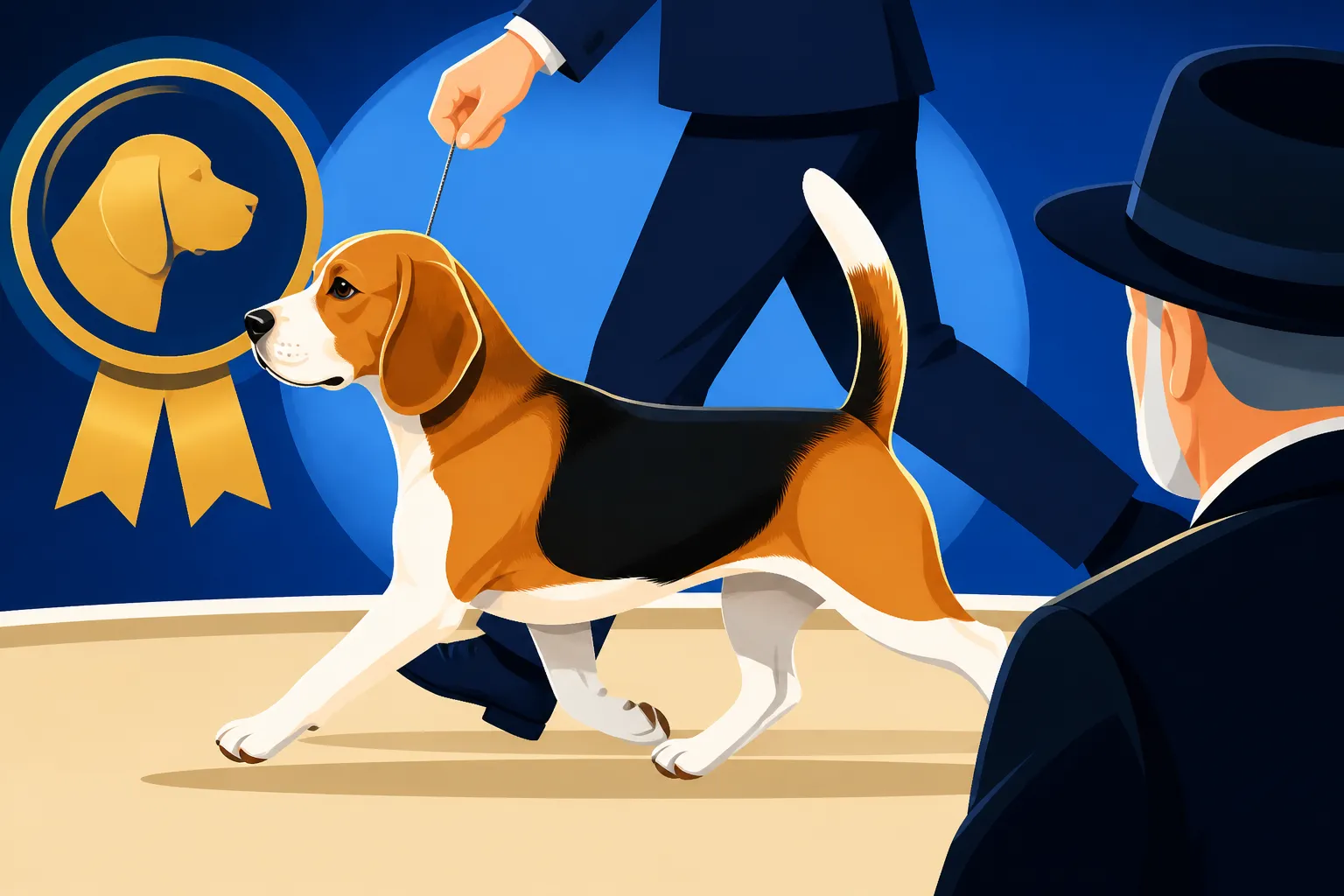
When a Beagle enters the show ring, it's not just their conformation while standing still that matters; their movement, or gait, is absolutely paramount. Judges are looking for a dog that moves with purpose, efficiency, and the characteristic "merry" demeanor that defines the breed. It's a dance of form and function, where every step should reflect the Beagle's history as an enduring scent hound.
The Breed Standard's Vision of Movement
The breed standard for the Beagle is quite clear about movement, calling for a "merry, free, straight forward action, with a long stride and an even back line." This isn't just poetic language; it outlines a specific mechanics that allows a Beagle to cover ground tirelessly, following a scent trail for hours. Imagine a Beagle traversing varied terrain, nose to the ground, but with enough agility and stamina to keep going. That's the movement pattern the standard describes.
For instance, the emphasis on "straight forward action" means that the dog's legs should move in parallel planes, neither converging too much (like a tightrope walker) nor splaying out. When viewed from the front, the forelegs should reach out smoothly, and from the rear, the hind legs should drive powerfully, moving in line with the front. Any deviation suggests an inefficiency or structural flaw that could hinder their original purpose. A good judge isn't just looking at speed; they're looking at the quality of the movement, the effortless grace that speaks to proper bone structure and muscling. This is why having good bone and proper Beagle Feet and Bone Under the Standard is so important for their overall structure and therefore their gait.
Understanding Reach, Drive, and Coordination
These three terms – reach, drive, and coordination – are fundamental to understanding a correct Beagle gait.
- Reach refers to the extension of the forelegs. A Beagle should have good reach, meaning their front paws extend forward significantly without lifting too high or paddling. This long stride is what allows them to cover ground efficiently. Think of it like a human runner taking long, smooth strides rather than short, choppy steps. Lack of reach often indicates issues in the shoulder assembly or front angulation.
- Drive is the propulsion from the hindquarters. The rear legs should push off strongly, creating the forward momentum. This drive should be powerful and sustained, coming from well-angulated hips and strong hocks. A Beagle with good drive will have a powerful, elastic spring in their step. Without sufficient drive, a Beagle can appear to be dragging their rear or using their front end to pull themselves along, which is exhausting and inefficient.
- Coordination ties it all together. A well-coordinated Beagle moves as a single, harmonious unit. The front and rear movements should be balanced, with the dog's topline remaining firm and level as they move. Their back should not roll, dip, or arch excessively. This smooth, fluid movement demonstrates that all parts of the dog's anatomy are working together effectively, allowing them to maintain that "even back line." A Beagle that isn't coordinated might show a jerky movement, or their front and rear might appear to be working independently rather than as a team. This balance is often a direct reflection of overall health and Beagle Hip Dysplasia and Everyday Joint Wear can significantly impact it.
That "Merry" Attitude in Motion
Beyond the mechanics, the breed standard also talks about a "merry" disposition. While this primarily refers to temperament – a cheerful, engaging personality – it also subtly influences how a Beagle carries itself in the ring. A truly merry Beagle will move with a certain joyful bounce, tail held gaily, often with that distinctive white tip flagging high. This isn't about being wild or uncontrolled, but about conveying an innate enthusiasm for life and work.
A judge wants to see a Beagle that is happy to be moving, showing an eagerness in its steps, rather than one that looks reluctant or dull. This "merry" aspect contributes to the overall impression and is often the icing on the cake for an otherwise structurally sound and well-moving hound. It reinforces the idea that the Beagle, whether The Beagle From English Rabbit Packs to American Homes or in the show ring, is meant to be an active, happy companion.
Identifying Common Faults in the Beagle's Movement
Even the most beautiful Beagle can fall short in the show ring if their movement isn't up to snuff. Judges are trained to spot subtle deviations from the ideal gait, and these faults can be significant enough to impact placement. Understanding these common pitfalls can help owners better prepare their dogs or simply understand why their beautiful hound might not be excelling in competition.
Front and Rear Assembly Discrepancies
One of the most frequently observed gait faults stems from issues with the front and rear assemblies – essentially, how the bones and muscles of the shoulders and hips are put together.
- Too Narrow or Too Wide: When a Beagle moves, their legs should track fairly closely to the center line of their body, especially at a trot, but not so close that they interfere with each other. If the legs are too wide apart, it suggests a lack of proper angulation or bone structure, leading to a "loose" or rolling gait. Conversely, if they are too narrow, the dog might "interfere" or "plait" their legs, crossing them over. This creates an awkward, inefficient motion and signals poor balance and structural integrity.
- Paddling or Crabbing: Paddling is when the front feet swing out in an arc rather than moving straight forward. It's often due to loose shoulders or incorrect angulation. Crabbing, on the other hand, is when a dog moves with its body slightly angled or diagonally to the direction of travel, often to avoid interfering with its own legs. It looks like the dog is moving sideways as much as forward. Neither of these motions is efficient for covering ground and indicates a structural compromise. A Beagle with a well-structured Beagle Back Problems and Intervertebral Disc Disease will track straight and true.
- Lack of Bend at the Stifle: The stifle (or knee) in the rear leg should show a good bend to absorb shock and provide propulsion. If the stifle is too straight ("posty" legs), the movement will be stiff, lacking drive and cushioning. This can put undue stress on joints over time, potentially leading to Beagle Arthritis Arriving in Middle Age earlier than expected.
Irregular Paces: Crabbing, Pacing, and Hackney Gaits
While some faults relate to how the legs move, others are about the rhythm and sequence of movement.
- Pacing: This is a distinct and inefficient gait where the dog moves both legs on one side of its body forward at the same time (e.g., right front and right rear move forward, then left front and left rear). It's often seen in long-backed breeds, but it's not desirable in a Beagle as it creates a rolling, unstable motion and is incredibly tiring. While some dogs might pace when tired or confused, a consistent pacing gait is a serious fault in the show ring.
- Hackney Gait: A hackney gait is characterized by a high, exaggerated lift of the front legs, often with a distinct flick of the wrist. It looks flashy but is entirely inefficient for a scent hound designed to work tirelessly with its nose to the ground. It consumes too much energy and suggests an incorrect front assembly. This is more commonly seen in some other breeds but is a definite fault in a Beagle.
- Choppy Gait: This is the opposite of a long, efficient stride. A choppy gait means the dog takes short, quick steps with limited reach and drive. It often indicates insufficient angulation in both front and rear, making the dog unable to extend and push off properly. Such a dog would tire quickly on a long trail.
The Impact of a Weak or Unsteady Topline
The topline, or the line of the back from the withers to the tail, should remain firm and level when the Beagle is in motion.
- Rolling or Swaying Topline: A topline that rolls, sways, or bounces excessively indicates weakness in the back muscles or poor abdominal strength. This can be caused by underlying structural issues or lack of conditioning. A strong, stable topline is crucial for a dog that needs to maneuver and maintain balance over uneven terrain.
- Roaching or Sagging: A roached back (arched over the loin) or a sagging back (dipped behind the withers) are structural faults that will be evident in movement. A roached back can restrict reach and drive, while a sagging back often indicates weakness and instability, putting stress on the spine. Judges will evaluate the Beagle Back Problems and Intervertebral Disc Disease to ensure there is no inherent weakness that would become evident in the movement. These issues, if severe, can even point to potential health concerns beyond just conformation.
How to Evaluate Your Beagle's Gait at Home
You don't need to be a professional dog show judge to start understanding and evaluating your Beagle's gait. Observing your dog's movement at home is a fantastic way to bond, understand their physical capabilities, and even catch potential health issues early. Remember, a sound gait isn't just for the show ring; it's a hallmark of good health and physical well-being.
Setting the Scene for Observation
To get a clear picture of your Beagle's movement, you need a suitable environment and a little preparation.
- Choose the Right Surface: A level, firm surface is ideal. Grass can be too soft and uneven, hiding subtle gait issues, while very slick surfaces can make your dog uncomfortable and cause them to move unnaturally. A paved driveway, a quiet street, or a short-mown grassy area that's firm underfoot works well.
- Use a Lead: For consistent observation, you'll want to move your Beagle on a lead. A standard leash and collar or a comfortable harness will work. The goal is a controlled, consistent pace, ideally a trot. Avoid allowing them to pull or lag too much, as this can distort their natural movement. Many owners find good, sturdy leashes and harnesses for their Beagles, like those available from Chewy, help with control during these assessments.
- Have a Helper (Optional but Recommended): If you can, ask a friend or family member to help. One person can move the dog, while the other stands at a distance to observe. This allows for observation from multiple angles without you having to multitask. If you’re by yourself, set up your phone to record your Beagle moving towards and away from the camera. This allows you to review the footage later, pausing and replaying to catch nuances.
What to Focus On During Your Home Assessment
When you're observing your Beagle, focus on these key aspects, trying to break down their movement into components:
-
From the Side (Profile View):
- Reach and Drive: Watch how far forward your Beagle's front legs extend and how powerfully their rear legs push off. Do their front feet land far ahead of their body? Do their rear legs extend fully behind them?
- Topline Stability: Does their back remain level and firm, or does it sway, roll, or bounce? A Beagle Agility and the Impact on Joints can also influence how their topline performs under stress, so observe how it moves if they make quick turns.
- Head and Tail Carriage: Does your Beagle carry their head naturally, or is it excessively low or high? Is their tail carried gaily, or tucked? While temperament-related, it can also signal discomfort.
- Coordination: Does the overall movement look fluid and effortless, or stiff and disjointed?
-
From the Front and Rear (Head-On and Tail-On Views):
- Leg Tracking: Do their legs move straight forward and backward, or do they paddle, weave, or cross over? You want to see the legs tracking cleanly without any inward or outward deviation.
- Foot Placement: Do their feet land squarely on the ground? Do you see any tendency for the paws to turn in or out?
- Elbows and Hocks: Are the elbows held close to the body, or do they swing out? Do the hocks (rear "ankles") remain parallel and straight, or do they turn in (cow-hocked) or out (bow-hocked)?
-
Listen to Their Feet: A healthy, sound gait often has a rhythmic, almost quiet sound. Any scuffing, dragging, or uneven thudding can indicate a problem.
By consistently observing your Beagle, you'll develop an eye for what's normal for them. Any sudden changes in gait, reluctance to Exercising a Beagle Enough to Settle It, or signs of stiffness should prompt a vet visit. Early detection of issues, especially related to Beagle Back Problems and Intervertebral Disc Disease, can make a huge difference in treatment and prognosis.
The Health Implications of a Proper Gait for Your Beagle
While a perfect gait is often seen as a requirement for success in the show ring, its importance extends far beyond trophies and ribbons. A correct, efficient gait is fundamentally tied to a Beagle's overall health, longevity, and quality of life. Understanding this connection helps us appreciate why conformation and movement matter so much.
Protecting Joints and Spine Through Sound Movement
Think of a properly built Beagle as a finely tuned machine. When all the parts – bones, joints, muscles, and ligaments – are correctly aligned and working in harmony, the stresses of movement are distributed evenly. This balance is crucial for protecting the joints and spine, which are subjected to constant impact throughout a dog's life.
- Reduced Wear and Tear: A Beagle with a sound gait will experience less abnormal wear and tear on their joints. For example, correct angulation in the hips means the joint moves smoothly within its socket, reducing friction. Faulty angulation, such as hips that are too straight or too shallow, can lead to uneven pressure and accelerated cartilage degradation, paving the way for conditions like Beagle Hip Dysplasia and Everyday Joint Wear or premature arthritis. The same applies to the elbows, stifles, and even the small joints in the feet.
- Spinal Health: The Beagle's characteristic slightly longer back can make them prone to spinal issues, particularly Beagle Disc Disease and That Slightly Long Back. A strong, level topline and well-coordinated movement help distribute weight and absorb shock evenly along the spine. Gaits that involve excessive roaching, swaying, or crabbing place unnatural twisting and compressive forces on the vertebral discs. Over time, these cumulative stresses can weaken the discs, making them more susceptible to injury and herniation. Using appropriate equipment, like a harness, rather than a collar, for walks can help Why a Harness Protects a Beagle's Neck from unnecessary strain.
- Muscular Balance: A proper gait encourages balanced muscle development. When a dog moves correctly, all muscle groups are engaged appropriately. If a dog compensates for a structural fault – for instance, shifting weight to one side due to discomfort – it can lead to overdevelopment of some muscles and underdevelopment or strain in others. This muscular imbalance can perpetuate the faulty gait and create a vicious cycle of pain and further injury.
Ensuring Lifelong Mobility and Comfort
Ultimately, a sound gait contributes directly to a Beagle's lifelong mobility and comfort. For a breed known for its boundless energy and love of exploring with its nose, being able to move freely and without pain is essential for their happiness and overall well-being.
- Active Senior Years: Beagles are known for their relatively long lifespans, often living into their teens. The foundation of a sound gait laid in puppyhood, coupled with good care, means they are more likely to enjoy active senior years. An older Beagle with healthy joints and a strong back can continue to enjoy sniff walks, gentle playtime, and maintain a good quality of life, even if their pace slows down. This is where products like joint supplements, readily available from retailers such as Chewy, can also play a supporting role, though they are no substitute for good conformation.
- Preventing Pain and Chronic Conditions: Dogs with significant gait faults or underlying structural issues are more prone to chronic pain. This pain can manifest as lameness, stiffness, reluctance to move, or even behavioral changes due to discomfort. Early attention to gait and veterinary intervention for developing issues can prevent minor problems from escalating into debilitating chronic conditions. For example, ensuring your Beagle has appropriate Ramps and Steps That Protect a Beagle Spine can prevent unnecessary jumps and jolts that exacerbate back problems.
- Quality of Life: Imagine not being able to run, jump, or play without discomfort. For a Beagle, whose joy is so tied to movement and exploration, compromised mobility can significantly diminish their quality of life. A proper gait isn't just about winning ribbons; it's about ensuring your beloved companion can live a full, active, and happy life, sniffing every interesting scent and trotting merrily beside you for years to come.
Disclaimer
This article is for general informational purposes only and does not constitute professional advice. Laws, prices and regulations vary by location and change over time. Consult a qualified professional for guidance on your specific situation.