Why a Beagle Walks With Its Nose to the Ground
If you've ever walked a Beagle, you know the feeling: your arm is practically being yanked out of its socket, and your furry friend's nose is glued to the pavement, completely oblivious to your presence. It's easy to feel frustrated, ignored, or even a little offended when your beloved companion seems more interested in a dried leaf than your carefully chosen walking route. But the truth is, your Beagle isn't being rude; it's simply being a Beagle. This guide will take a deep dive into the incredible world of your Beagle's nose, explaining why they walk with it to the ground, what they're actually "reading," and how you can work with this powerful instinct instead of constantly fighting against it.
The Phenomenal Beagle Nose: A Masterpiece of Scent Detection
To understand why a Beagle's nose is perpetually seeking out the ground, you first have to grasp just how extraordinary that nose truly is. It's not just a cute, wet button at the end of their face; it's a finely tuned, biological super-sensor, arguably the most defining characteristic of the entire breed. Beagles were quite literally bred over centuries to follow a scent trail, and every aspect of their anatomy reflects this singular purpose.
Anatomy of an Olfactory Genius
Let's talk numbers, because they really put things into perspective. Humans have around 5-6 million olfactory receptors in their noses, which allows us to smell pretty well, all things considered. A Beagle, however, boasts approximately 220 million such receptors. That's a mind-boggling difference! These aren't just more receptors; they're also arranged in a much larger surface area, folded and convoluted within their nasal passages, effectively increasing their "smelling power" exponentially. Imagine having a massive, high-definition television screen where you only have a small, fuzzy black-and-white monitor. That's the difference between your nose and your Beagle's.
Beyond the sheer number of receptors, a Beagle's nose has other remarkable features. Their large, open nostrils are designed to scoop in scent molecules efficiently. Crucially, they can also move their nostrils independently, allowing them to better pinpoint the direction of a scent. Then there's the vomeronasal organ, or Jacobson's organ, located in the roof of their mouth, which is specifically designed to detect pheromones – chemical signals from other animals. This organ is especially active when a Beagle curls its lip in what's known as the "flehmen response," literally "tasting" the air for important social information. It's like they have an extra, hidden sense entirely dedicated to understanding the social landscape of their world.
How a Beagle Processes the World Through Scent
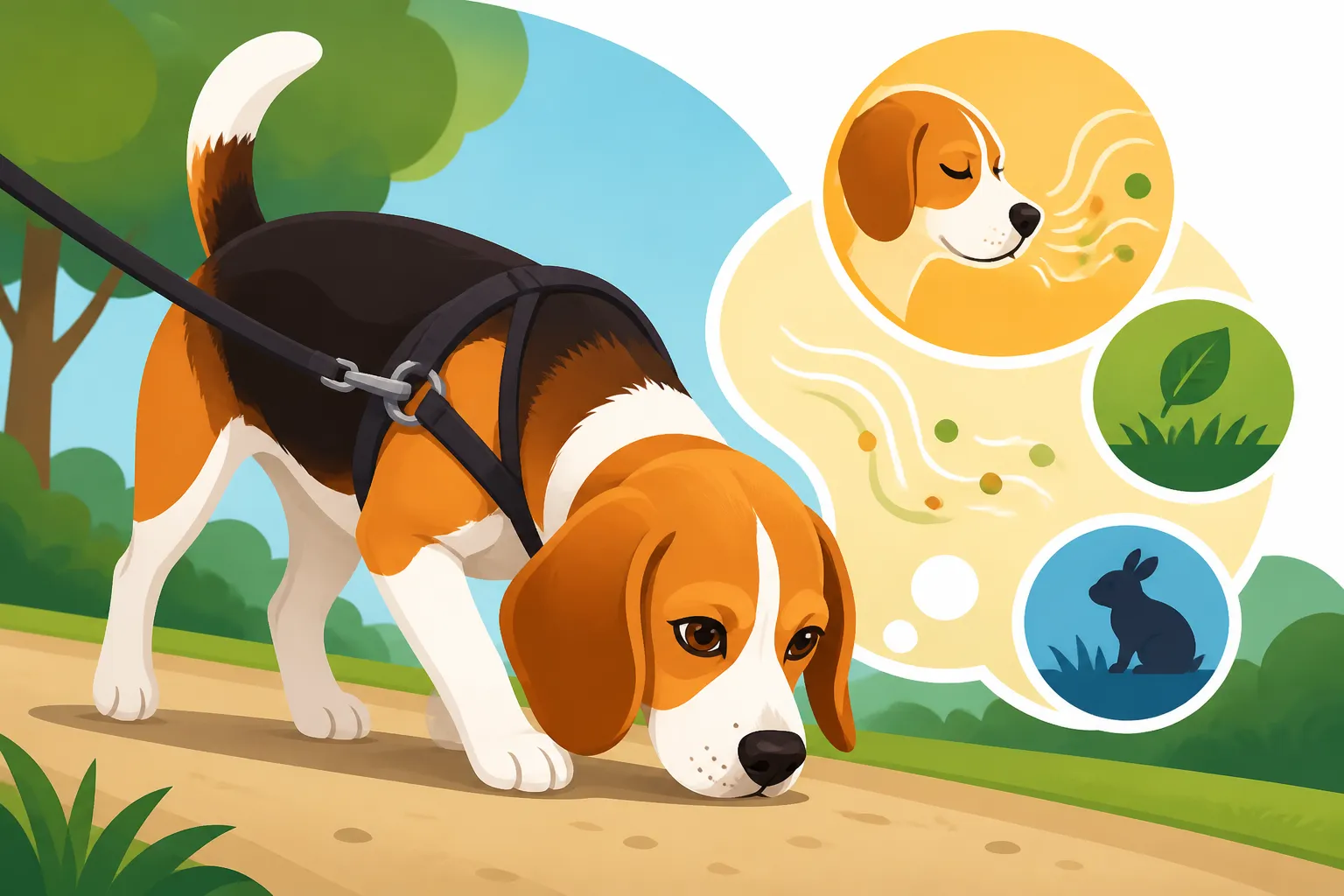
When your Beagle's nose hits the ground, it's not just detecting a single smell; it's interpreting a complex tapestry of odors. Think of it less as a simple "sniff" and more as reading a multi-layered newspaper. Each molecule is a word, each cluster of molecules a sentence, and the entire ground surface a daily chronicle of local events. They can discern the passage of another dog, the direction it was going, how long ago it passed, its sex, its emotional state, and even its health status. All of this information is picked up through their damp nose, which helps trap scent particles, and then processed by a brain region disproportionately large and dedicated to olfaction – their olfactory bulb. The 220 Million Receptors Behind a Beagle's Nose is a fascinating read if you want to dive even deeper into this incredible sense.
This ability allows a Beagle to construct a detailed mental map of their environment based purely on scent. They can differentiate between the faint odor of a squirrel that ran across the path an hour ago and the fresh scent of a rabbit that just darted into the bushes. While our human eyes might pick out a visual trail, a Beagle is following an invisible, aromatic path. This intense focus means that when they are "on a scent," their other senses, including hearing your voice, might as well be turned down to zero. It's not defiance; it's absolute, instinctual immersion.
Instinct Meets Environment: Why the Ground is So Enticing
The reason your Beagle's nose is glued to the ground isn't just about their superior biology; it's deeply rooted in their historical purpose and how they experience their daily lives. For a Beagle, the ground isn't just dirt; it's a living, breathing informational superhighway, constantly updated and endlessly fascinating.
The Hunter's Legacy: Trailing Game
Beagles were originally bred in England centuries ago for a very specific job: hunting small game, primarily rabbits and hare. They weren't bred to air-scent, like some pointing breeds that pick up airborne scent to locate game; instead, they are trailing hounds. This means their instinct is to keep their nose firmly on the ground, meticulously following the scent trail left by their quarry. Their low stature allowed them to navigate dense underbrush and keep their noses close to the ground where the scent was strongest and most persistent. Their short legs meant they didn't outrun the hunters who followed them on foot.
This deep-seated genetic programming is why, even today, your pet Beagle will instinctively drop its head and lock onto a scent. It's not a learned behavior as much as it is an inherent drive. When they follow a trail, they are performing the job they were literally bred for, a job that has been passed down through countless generations. This instinct is incredibly powerful and, frankly, far more compelling to them than any verbal command you might issue when they're in full "trail mode." Understanding this helps shift frustration into appreciation for their incredible heritage. If you've ever wondered What a Beagle Was Originally Bred to Hunt, you'll find it was all about that nose.
A World of Information in Every Scent
Beyond the ingrained hunting instinct, the ground holds a wealth of fascinating, vital, and ever-changing information for your Beagle. Every blade of grass, every patch of soil, every lamppost, and every discarded wrapper tells a story. For us, a park might just be green space; for a Beagle, it's a community bulletin board, an active crime scene investigation, and a dating app all rolled into one.
Consider the sheer amount of data they gather. Other dogs leave urine and feces, each containing a unique scent profile that reveals their sex, reproductive status, health, and recent activities. Wildlife, like squirrels, rabbits, and even insects, leaves behind countless scent markers. Humans drop food, shed skin cells, and leave residual odors from their shoes or hands. All of this creates an intricate mosaic of smells that is constantly being refreshed. For your Beagle, ignoring these scent messages would be like us walking through a busy city street with our eyes closed. It's their primary way of understanding the world, connecting with their environment, and satisfying their innate curiosity. They are literally reading the world, one sniff at a time. This constant intake of information is actually incredibly enriching and stimulating for them, often tiring them out more effectively than a fast-paced, un-sniffed jog.
Living with a Ground-Scenting Pro: Practical Strategies
Since you can't turn off your Beagle's nose, the best approach is to learn how to live with, manage, and even celebrate this incredible trait. It's all about providing appropriate outlets for their instinct and developing strategies for those times when you need their attention to be elsewhere.
Embracing the Sniff: Enriching Your Beagle's Life
One of the most valuable things you can do for your Beagle is to lean into their natural desire to sniff. Structured "sniff walks" where you let them set the pace and explore scents freely can be incredibly enriching and mentally tiring for them. Designate certain walks or portions of walks as "nose time," where you let them lead and investigate to their heart's content. This isn't just a walk; it's a mental workout. Consider finding a safe, fenced area where you can let them explore on a long line, allowing them to follow a scent without the risk of them bolting into danger.
Beyond walks, bring scent work into your home! Puzzle feeders are fantastic for this, making them "work" for their meals by solving a simple challenge, engaging their nose and brain. Snuffle mats, which are fabric mats with many folds and pockets, allow you to hide treats, encouraging them to use their nose indoors. Many brands offer great options for these types of enrichment toys. You can find a wide variety of these products on platforms like Amazon, making it easy to turn mealtime into a fun scent game. Think about scattering their kibble in the grass in your yard or around the house, turning a mundane meal into a treasure hunt. This not only satisfies their sniffing drive but also slows down their eating, which can be beneficial for fast eaters. You can learn more about this in Snuffle Mats and Scatter Feeding for a Beagle.
Managing Walks and Maintaining Connection
While embracing the sniff is great, there will be times when you need your Beagle to walk politely beside you. This is where proper equipment and consistent training come into play. A well-fitting harness, particularly a front-clip harness, can be a game-changer. These harnesses redirect pulling pressure to your dog's chest, making it harder for them to pull you forward and giving you more control without causing discomfort or strain on their neck. Regular collars often don't stand a chance against a Beagle determined to follow a scent, as they can put immense pressure on their delicate trachea.
During walks, try to intersperse structured "heel" time with free-sniffing time. This teaches your Beagle that there's a time for polite walking and a time for exploration. High-value treats are your best friend here. When you ask for their attention and they give it to you, reward them generously. Keeping a long line (15-30 feet) can also offer a sense of freedom in open, safe areas while maintaining a physical connection and preventing them from disappearing on a fascinating scent trail. Remember, The Long Line Length a Beagle Actually Needs might surprise you.
Training Around the Distraction
Training a Beagle requires immense patience and an understanding of their deep drive. Traditional recall, where they come when called, can be incredibly challenging when their nose has taken over. This is why building a super-strong "emergency recall" is crucial, using a unique word or whistle that is only used for this command and always paired with the highest-value reward imaginable (think cooked chicken or cheese, not just a dry biscuit). This command should be practiced in low-distraction environments first, gradually increasing the difficulty. Beagle Recall That Works Before the Nose Wins offers great advice on this.
It's also about building impulse control and focus. Engage them in short, fun training sessions throughout the day, focusing on eye contact and "check-ins." Make yourself more interesting than the ground, at least occasionally! Many owners find that structured training programs, such as those offered by various reputable trainers (like BAXTER & Bella), can provide excellent guidance and a step-by-step curriculum to help build focus and responsiveness even amidst tantalizing distractions. Consistency is key, and every successful check-in or moment of attention you get is a step in the right direction.
Here's a quick comparison of how Beagles and humans use their primary senses to interact with the world:
| Aspect | Human Experience | Beagle Experience |
|---|---|---|
| Primary Way of Knowing | Vision (sight) | Olfaction (smell) |
| Olfactory Receptors | ~5-6 million | ~220 million |
| Nostril Function | Primarily for breathing; limited independent movement | Independent movement to pinpoint scent; scoops odors |
| Information Gathering | Visual cues, facial expressions, written language | Scent trails, pheromones, "smell-scapes" |
| "Reading the World" | Observing, listening, reading text | Sniffing every surface, processing air currents |
| Prioritization | Visual and auditory input often override others | Olfactory input frequently overrides all others |
When to Worry: Signs Your Beagle's Nose Habits Signal a Problem
While a Beagle's intense ground-sniffing is completely normal, there are rare occasions when it might signal something more. It's important to be able to distinguish between natural, healthy scent exploration and a behavior that might require a vet visit or professional intervention.
Excessive Sniffing and Health Concerns
Most of the time, a Beagle's ground-sniffing is harmless and even beneficial for their mental well-being. However, if you notice a sudden, dramatic increase in sniffing, especially if it's accompanied by other unusual behaviors, it's worth a closer look. For example, if your Beagle starts obsessively licking or chewing at specific spots on the ground after sniffing, it could indicate allergies or skin irritations that they're trying to alleviate. Beagle Skin Allergies and Constant Itching can be a real nuisance for them.
If the sniffing seems less like exploration and more like a frantic search, combined with other signs such as sudden changes in appetite, lethargy, vomiting, or diarrhea, it's time to contact your veterinarian. They might have ingested something irritating or even toxic, or be experiencing an internal discomfort they're trying to self-soothe through obsessive behavior. A significant change in behavior, including the intensity or nature of their sniffing, should always prompt a call to your vet, especially if it's alongside any of the Beagle Emergency Signs That Cannot Wait Until Morning.
Compulsive Behavior vs. Natural Instinct
It's a fine line sometimes between a strong natural instinct and a developing compulsive behavior. Normal scent-trailing involves active exploration, moving from one interesting scent to the next, often with purpose. Compulsive sniffing, on the other hand, might look repetitive, aimless, or disproportionate to the environment. For instance, if your Beagle fixates on one tiny spot for an unusually long time, ignoring all other stimuli, or if the sniffing seems to escalate into a frantic or anxious state, it could be a sign of underlying stress, anxiety, or even a neurological issue.
Environmental stress, lack of adequate mental and physical stimulation, or even pain can sometimes manifest as compulsive behaviors. If you suspect your Beagle's sniffing has crossed the line from normal exploration to an obsessive habit, consulting with your veterinarian is the first step. They can rule out any medical causes. If medical causes are eliminated, a certified professional dog trainer or veterinary behaviorist can help you develop strategies to manage and redirect these behaviors, ensuring your Beagle's powerful nose remains a source of joy and enrichment, not a source of stress.
Disclaimer
This article is for general informational purposes only and does not constitute professional advice. Laws, prices and regulations vary by location and change over time. Consult a qualified professional for guidance on your specific situation.