Why a Beagle Nose Beats Ours Ten Thousand Times Over
Anyone who has ever lived with a Beagle knows the moment: your beloved hound is nose-down, utterly absorbed in a scent trail, and your voice might as well be the wind. It’s frustrating, bewildering, and sometimes downright scary. But it's not stubbornness; it's a testament to a biological marvel. This guide will dive deep into why your Beagle's nose operates on a level that leaves our human senses in the dust, explaining the incredible science behind their unparalleled olfactory abilities.
The Marvelous Anatomy of a Beagle's Nose
When we talk about a Beagle's nose, we're not just talking about a cute, wet snout. We're talking about a highly specialized sensory organ, honed over centuries of selective breeding for scent-trailing. The sheer biological advantage they possess over humans is staggering, starting right from the structural differences. Their entire head, in a way, is a sophisticated scent-detection machine.
Millions More Receptors Than We Have
One of the most mind-boggling differences between a human nose and a Beagle's is the sheer number of olfactory receptors. Where a typical human might boast around 6 million of these specialized cells that detect scent molecules, a Beagle comes equipped with a truly astounding 220 million. Imagine trying to identify a single grain of sand on a vast beach, and then imagine having hundreds of times more magnifying power to do it. That's essentially the difference in detection capability. These receptors line the turbinates, complex bony scrolls inside their nasal passages, which are far more intricate and expansive than ours. This vast surface area allows them to capture and identify a much wider range of scents, and detect even the faintest whispers of an odor.
This incredible density of receptors means a Beagle can pick up scents we can't even fathom. They aren't just smelling a dog; they're smelling that specific dog, its age, its gender, its emotional state, and what it had for breakfast, all from a faint trace left hours ago. For us, a walk in the park is a visual experience; for a Beagle, it's an overwhelming tapestry of scent information, rich with stories we'll never perceive.
A Brain Wired for Scent
It's not just the nose itself; the brain plays a critical role. A Beagle's olfactory bulb, the part of the brain responsible for processing scent information, is disproportionately large compared to its overall brain size, especially when contrasted with humans. Think of it like a supercomputer dedicated almost entirely to one task: analyzing and interpreting scents. This isn't just about detecting a smell; it's about storing it, recalling it, understanding its nuances, and making decisions based on it.
This extensive brainpower means that a Beagle can piece together a narrative from scent alone. A faint whiff of rabbit might not just be "rabbit"; it might be "rabbit that ran this way, roughly an hour ago, was slightly injured, and there was another one following." This deep processing is why when your Beagle is on a hot trail, it seems like nothing else exists in their world. Their brain has entered a hyper-focused state, prioritizing the scent information above all else, including your desperate pleas to "come!" The entire neurological architecture is set up to follow that invisible thread.
The Mechanics of Advanced Scent Detection
Beyond the sheer number of receptors and brain dedication, Beagles employ several fascinating physical mechanisms that further elevate their sniffing prowess. These aren't just passive functions; they are active, dynamic processes that make their noses incredibly efficient tracking tools.
Independent Nostril Operation and the Wet Nose
Have you ever watched a Beagle meticulously sniff the ground, moving its head from side to side? This isn't just random exploration. Beagles, like many scent hounds, can use their nostrils semi-independently. This allows them to effectively "stereo-smell," determining the direction of a scent by comparing the intensity of odor molecules entering each nostril. It's like having two separate, highly sensitive radar dishes scanning the environment simultaneously, allowing them to pinpoint the source of a smell with incredible accuracy. This is a crucial aspect of What a Beagle Experiences on a Scent Trail.
Furthermore, that iconic wet nose isn't just for show. The thin layer of mucus on a Beagle's nose helps trap scent molecules from the air, making them stick to the surface before they're inhaled. It acts like a tiny, self-cleaning flytrap for odors, constantly replenishing its sticky surface to maximize scent absorption. When they lick their noses, they're not just grooming; they're also transferring those trapped scent molecules to the roof of their mouth, where another specialized organ comes into play.
The Vomeronasal Organ: A Secret Weapon
Deep inside a Beagle's nasal cavity, above the roof of the mouth, lies the vomeronasal organ, also known as Jacobson's organ. This unique sensory organ is a hidden superpower for Beagles. Unlike the primary olfactory system, which detects general odors, the vomeronasal organ specializes in detecting pheromones and other non-volatile chemical signals. These are usually scent molecules that are too heavy to become airborne easily, often found in urine, feces, or skin secretions.
When a Beagle sniffs intensely, especially at another dog's marking post or when investigating something particularly interesting on the ground, they might perform a behavior called the "Flehmen response" – though less pronounced than in some other animals like horses. This slightly open-mouthed, curled-lip expression helps them draw air and scent molecules directly to the vomeronasal organ. This organ is not connected to the parts of the brain that process conscious smells; instead, it sends signals directly to the part of the brain involved in instinctual behaviors, like mating, social recognition, and even fear responses. It's how they get a deeper, more primal understanding of their environment and other animals, often completely outside our human comprehension of "smell."
Understanding the Beagle's Scent-Driven World
To truly appreciate why a Beagle's nose is so dominant, we need to understand how it shapes their perception of the world and, by extension, their behavior. Their life is largely dictated by the invisible pathways of scent that crisscross our seemingly ordinary environments.
The Persistence of Scent and Their Hunting Instinct
Beagles were bred for centuries to hunt small game, primarily rabbits and hare. Their job wasn't to chase by sight, but to methodically follow a cold trail, often hours after the prey had passed. This meant developing an incredible ability to discern faint, aged scents from fresher, more distracting ones. A rabbit might have run across a busy park path hours ago, but for a Beagle, that scent can still be clear as day, a detailed map leading them onward. Why a Beagle Walks With Its Nose to the Ground becomes an entire mission when they find something worth pursuing.
This ingrained hunting instinct, coupled with their superior scenting ability, is why recall can be such a challenge. Once they lock onto a scent, their genetic programming takes over. The drive to follow that trail, to unravel its story, is deeply satisfying to them, far more compelling than any treat or verbal command you might offer in that moment. It's not a matter of disobedience; it's a matter of biological imperative. Understanding this deep-seated drive is key to managing a Beagle.
The Overwhelming Sensory Input
Imagine walking into a concert hall where every instrument is playing a different, incredibly complex symphony at the same time, and you're trying to pick out a single violin. That's a bit like what a Beagle's world is like, but with scent. Every blade of grass, every patch of sidewalk, every gust of wind carries a multitude of odors. They're constantly processing layers upon layers of information: the faint residual scent of a squirrel from yesterday, the fresh urine mark of a neighborhood dog, the smell of a discarded french fry, the distant scent of rain coming, and the subtle changes in air pressure.
This constant influx of sensory data can be both a blessing and a challenge. It provides immense enrichment and mental stimulation for them, which is why Sniffing Walks and Why They Tire a Beagle Out are so effective. But it also means they can easily become overwhelmed or fixated on a particular scent, making it difficult to redirect their attention. Their world is vibrant with information we cannot access, and sometimes, that means they're literally in a different world than we are.
Living with a Scent-Driven Beagle: Practical Adjustments
Given their extraordinary olfactory capabilities, it's clear that owning a Beagle requires some specific adjustments and an understanding of their unique needs. You can't fight biology, but you can learn to work with it.
Secure Containment is Non-Negotiable
Because their nose leads the way, often to places you don't want them to go, secure containment is paramount for a Beagle. A faint whiff of a rabbit or another intriguing smell can send them off on an adventure, completely deaf to your calls. A truly solid fence, one they cannot dig under or jump over, is essential. For walks, a long line is an indispensable tool, allowing them freedom to explore scents safely while still keeping them connected to you. Long Lines Instead of Off-Leash for a Beagle is a mantra for Beagle owners.
| Olfactory Feature | Human (Approx.) | Beagle (Approx.) | Impact on Behavior (Beagle) |
|---|---|---|---|
| Olfactory Receptors | 6 million | 220 million | Detects faint, layered, and complex scents. |
| Olfactory Bulb Size | Small relative to brain | Large relative to brain | Extensive processing and memory for scents. |
| Nostril Independence | Limited | High | "Stereo-smelling" for directional tracking. |
| Vomeronasal Organ | Vestigial/Absent | Functional & Specialized | Detects pheromones, influencing instinctual actions. |
| Brain Priority for Scent | Low | Very High | Scent overrides other sensory input and commands. |
Even with a fence, remember that a motivated Beagle can become an escape artist. They'll test every weak point, and a sudden intriguing smell from beyond the boundary can be a powerful motivator. This is why many owners also consider GPS Collars as a Backup for Beagle Recall, adding an extra layer of security.
Channeling the Scent Drive
Instead of constantly battling their powerful nose, the smartest approach is to embrace it and channel that natural instinct into constructive activities. Scent work, nose work, or tracking classes are absolutely perfect for Beagles. These activities tap into their core drive, providing immense mental and physical stimulation. A half-hour of focused nose work can tire a Beagle out more effectively than an hour of mindless fetching. It gives them a job, and Beagles, like all hounds, thrive when they have a purpose.
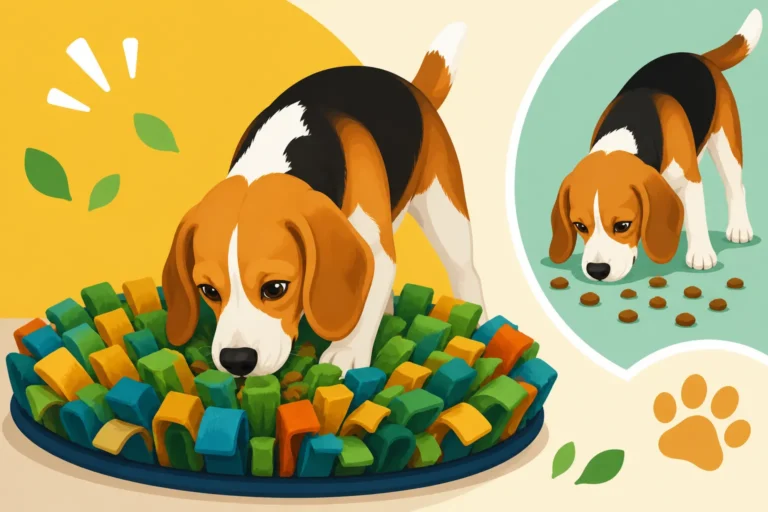
You can start simple, even at home. Hiding treats in puzzle toys from Amazon or scattering their kibble in a snuffle mat for Puzzle Feeders That Genuinely Slow a Beagle allows them to use their nose to "hunt" for their food. This satisfies that deep-seated foraging drive. Scent Work as the Job a Beagle Was Built For can transform a restless, destructive Beagle into a happy, fulfilled companion.
Training with Scent in Mind
Training a Beagle requires immense patience and an understanding that sometimes, their nose will simply win. High-value treats are almost always necessary because you need something incredibly enticing to break through the scent-induced trance. Consider Training a Beagle With Its Own Meal Instead of Treats by making their entire meal part of a reward system for paying attention.
Focus on building strong foundation behaviors like "leave it" and "drop it" from puppyhood, using increasingly tempting items. Beagle Clicker Training From the First Day can be very effective, as it provides a clear marker for correct behavior, especially when their mind is partially elsewhere. Understand that while they might know what you want, the pull of an amazing scent can be overwhelming. Consistency, positive reinforcement, and a good sense of humor are your best allies when living with a Beagle and their extraordinary nose.
Disclaimer
This article is for general informational purposes only and does not constitute professional advice. Laws, prices and regulations vary by location and change over time. Consult a qualified professional for guidance on your specific situation.