How a Beagle Gets Underneath a Fence
It’s a tale as old as time for Beagle owners: you step outside, perhaps to call them in for dinner, and find your otherwise perfectly secure fence line now boasts a suspicious divot. Your heart sinks. That little escape artist, the one with the nose to the ground and a brain dedicated to adventure, has done it again. This guide is here to unravel the mystery of how Beagles manage to tunnel their way to freedom and, more importantly, equip you with the knowledge and tools to keep your cherished companion safely within bounds.
The Deep-Rooted Instincts Driving a Beagle to Dig
Let's be real, Beagles aren't digging just to spite us. Their digging, like so many of their behaviors, is deeply ingrained in their history and genetics. Understanding these powerful drives is the first step to mitigating their escape attempts. It's not about being "bad"; it's about being a Beagle.
The Irresistible Call of Scent
Imagine living in a world where every breeze tells a story, every patch of grass is a newspaper, and every mole tunnel leads to a potential treasure. That's a Beagle's reality. With up to 220 million scent receptors, their noses are simply unparalleled. When a compelling scent—be it a rabbit that recently passed through, a squirrel's buried nut stash, or even a promising patch of damp earth—crosses their path near the fence line, it becomes an obsession. They don't just smell it; they feel compelled to investigate. Digging is often the most direct route to follow that tantalizing trail, even if it's underground.
This isn't just curiosity; it's instinct. For centuries, Beagles were bred to follow scent trails, often for miles, ignoring all else in their pursuit. Your fence, no matter how sturdy it looks to you, is just another obstacle in the hunt. They aren't trying to leave you; they're trying to get to something fascinating on the other side. This intense focus explains why traditional deterrents often fail; a Beagle in pursuit of a smell is in a world all its own. This dedication to scent is also why a Beagle should never be off leash unfenced, as their recall often falls apart once a strong scent is detected.
Boredom and Pent-Up Energy
Sometimes, the motivation isn't a thrilling scent, but simply a lack of stimulation. A Beagle left alone in a yard for hours with nothing to do can quickly get bored. And what does a bored Beagle do? They find their own entertainment, which often involves digging. They're intelligent, active dogs that need mental and physical exercise. If they're not getting enough Sniffing Walks and Why They Tire a Beagle Out or engaging playtime, that pent-up energy has to go somewhere.
Think about it from their perspective: the yard might be big, but it can feel like a cage if there's no interaction, no new toys, no training games. Digging provides physical exertion, a problem-solving challenge, and sometimes, the rewarding discovery of cool earth or even a juicy grub. It's a self-reinforcing behavior. If your Beagle's escape attempts seem more frequent when they've been left alone for extended periods, or if they lack other forms of enrichment, boredom could be a major contributor. Providing interactive toys or even starting a fun activity like scent work classes can make a huge difference.
Anxiety-Driven Escapes
While Beagles are generally cheerful dogs, they are also a pack breed. This means they thrive on companionship and can sometimes struggle with separation anxiety. A lonely Beagle, distressed by your absence, might resort to desperate measures to get back to you or find comfort. Digging is one such frantic attempt to escape their perceived confinement. This isn't just "missing you"; it's a genuine panic response.
Signs of anxiety-driven digging might include destructive behavior near exits, excessive barking or Beagle Howling the Moment You Leave, pacing, or inappropriate urination when you're gone. If your Beagle exhibits these symptoms, the digging isn't the primary problem, but a symptom of a deeper emotional struggle. Addressing Beagle Separation Anxiety in a Pack Breed requires a holistic approach, often involving gradual desensitization, counter-conditioning, and sometimes, professional help. Simply reinforcing the fence won't solve the underlying distress.
Common Fence Weaknesses That Beagles Exploit
You might think your fence is perfectly adequate, but Beagles are master evaluators of structural integrity. They don't need a huge gap; a small vulnerability is all they need to start working their way out.
The Undermining Effect: Gaps and Soft Spots
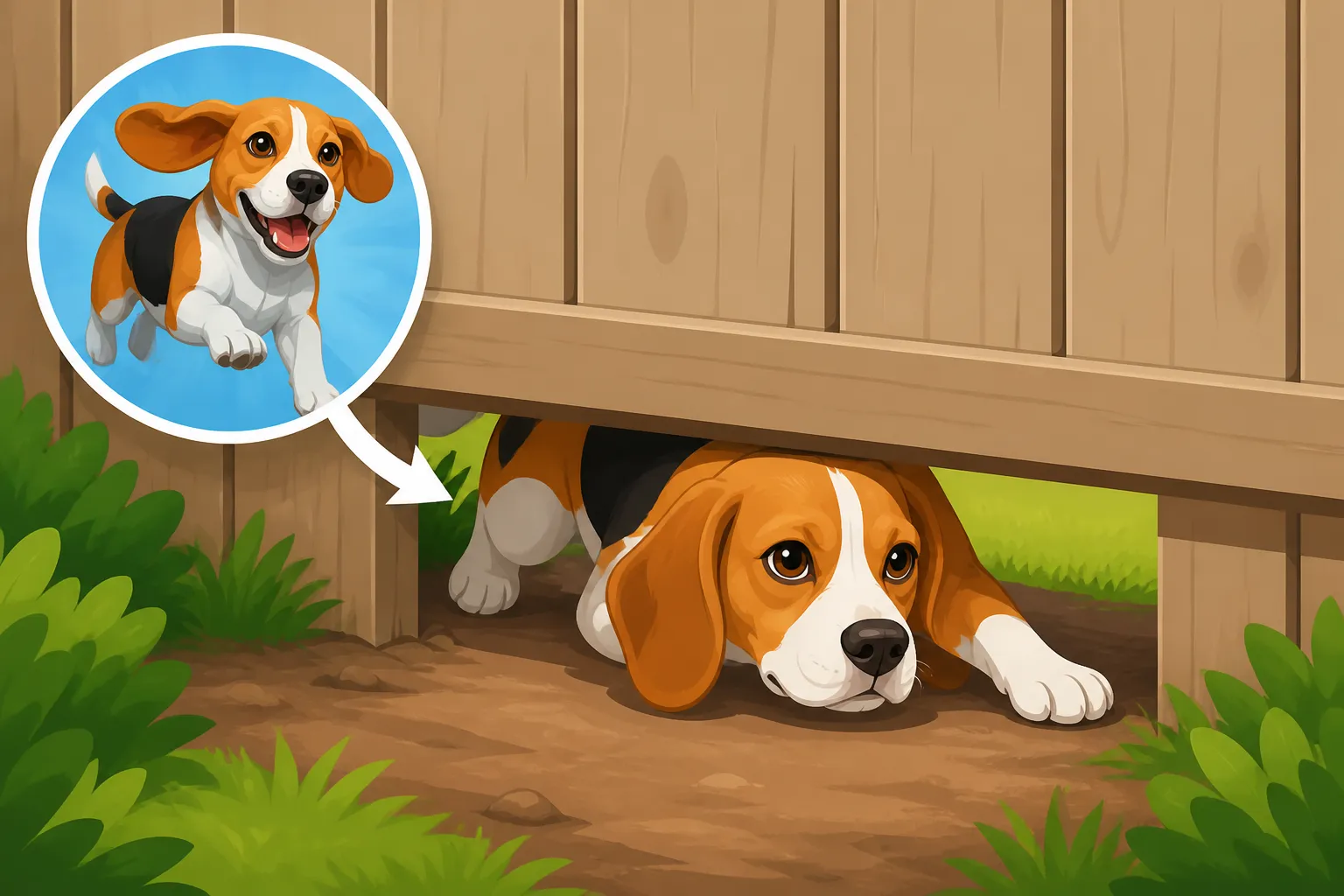
The most obvious way a Beagle gets under a fence is by literally digging under it. Many fences are installed with the bottom edge simply resting on the ground, or buried only a few inches deep. For a determined Beagle, this is an open invitation. They'll start at the weakest point—perhaps where the soil is soft, or where there's already a slight gap—and patiently excavate. Once they create enough space for their head, the rest of their flexible, lean body can often follow with surprising ease. They are built low to the ground, which makes this maneuver even easier.
Consider a wooden privacy fence, for instance. The posts might be set in concrete, but the panels between them often have a small space at the bottom. Or perhaps the ground isn't perfectly level, creating natural dips and hollows where digging is easiest. Even chain-link fences, with their woven structure, can be lifted or pushed if the bottom isn't securely anchored. It's often the subtle shifts in terrain or slight imperfections in installation that create the ideal launchpad for a Beagle's escape attempt.
The "Bridge" Effect: Objects Near the Fence Line
Sometimes, it's not about digging under but getting over (or through a weak spot at ground level) with a little help. Anything placed too close to the fence can become a Beagle's stepping stone or leverage point. A discarded dog house, a pile of firewood, a sturdy bush, a compost heap, or even outdoor furniture can provide just enough height for them to get a pawhold and push themselves up or over a surprisingly tall fence.
Even seemingly innocent objects like a garden hose left coiled near the fence, or a large rock, can be moved or used by a clever Beagle. They are highly motivated when there's something they want, and they're not above using their environment to their advantage. A fence might be 6 feet tall, but if a Beagle can hop on a sturdy planter just 2 feet away, that effectively reduces the barrier to a mere 4 feet, often within jumping or climbing range for a determined hound. Regularly inspecting the perimeter and removing potential aids is crucial.
Old Age and Wear and Tear
Fences, like everything else, degrade over time. Wooden fences can rot at the base, creating weak spots that are easy to dig through or push apart. Chain link fences can rust, and the bottom wire can become brittle, making it easy for a Beagle to bend or break. Even buried wire can shift or surface with ground movement and weather cycles. What was once a perfectly secure barrier might, after a few years of harsh weather and enthusiastic Beagle inspections, become a sieve.
Many owners assume their fence is still as good as the day it was installed. However, diligent Beagles will constantly test boundaries. A small crack in a wooden panel, a loose post, or a section where the mesh has come undone on a chain-link fence can quickly be identified and exploited. A proactive approach means regular inspections, not just for digging holes, but for the structural integrity of the entire fence line.
Fortifying Your Fence Against the Master Digger
Now that we understand the 'why' and the 'how,' let's talk about the 'what to do.' Securing your yard for a Beagle means thinking like a Beagle, and planning for their relentless persistence.
Physical Barriers at the Base
The most effective way to stop a digging Beagle is to create a physical barrier they simply cannot dig through. This often involves extending the fence below ground.
Here are a few popular methods:
- L-Footers: This is a common and highly effective strategy. You extend a section of fencing (like chicken wire or hardware cloth) horizontally inward from the bottom of your existing fence. Dig a shallow trench about 12-18 inches deep and wide, lay the wire flat on the trench bottom, attach it to the bottom of your fence, and then backfill with soil. When your Beagle tries to dig down, they hit the horizontal wire and are deterred. It's frustrating for them because they can't get past it. Many owners find hardware cloth works best for this as it's more rigid.
- Buried Mesh or Concrete: For more extreme cases, burying a section of heavy-gauge wire mesh or even pouring a narrow concrete footer directly under the fence line can be a permanent solution. Digging a trench, installing the wire vertically or pouring concrete, and then reburying it makes an impenetrable underground wall. This can be more labor-intensive but offers superior security.
- Large Rocks or Pavers: While not as foolproof as buried wire, strategically placing large, heavy rocks or paving stones along the inside base of the fence can deter casual digging. The sheer weight makes it harder for them to move, and it creates an uncomfortable surface for them to try and dig through. However, a truly determined Beagle might just start digging a few inches away.
This table compares common physical digging barriers:
| Barrier Type | Description | Pros | Cons |
|---|---|---|---|
| L-Footer (Wire) | Wire mesh (e.g., chicken wire, hardware cloth) laid horizontally inward 12-18" from fence base, buried. | Highly effective, relatively inexpensive | Installation can be labor-intensive if done right, requires digging |
| Buried Wire/Mesh | Heavy-gauge wire mesh buried vertically 18-24" directly under the fence line. | Very effective, invisible once installed | More labor-intensive and costly than L-footer, professional help may be needed |
| Concrete Footer | Narrow concrete trench poured directly under the fence line. | Extremely durable, permanent solution | Most expensive, most labor-intensive, difficult to reverse |
| Large Rocks/Pavers | Heavy rocks or paving stones placed along the inside base of the fence. | Easiest to install, movable if needed | Less effective for determined diggers, can be pushed aside |
When planning, remember to inspect your entire fence line, paying special attention to corners, gates, and any areas where the ground slopes or is naturally softer. These are prime targets for a Beagle's excavations. On Amazon, you can find rolls of galvanized hardware cloth that are perfect for creating an L-footer.
Addressing the Root Cause: Enrichment and Training
Physical barriers are essential, but they don't address the underlying reasons why your Beagle is digging. For a truly "Beagle-proof" yard, you need to combine structural integrity with behavioral solutions.
- Increase Exercise and Mental Stimulation: A tired Beagle is a good Beagle. Ensure your dog gets at least one good, long sniff-walk daily where they can truly engage their nose. Beyond walks, incorporate puzzle toys, training sessions, or even structured play like fetch. Indoor games for a rainy Beagle week are also critical. A Beagle with a fulfilling routine is less likely to invent their own "jobs" like digging. Brands like BAXTER & Bella offer excellent online resources and courses that can help you with structured training and engagement strategies.
- Manage Scent Temptations: If you know your yard attracts rabbits or squirrels, try to deter them. Fill in old burrows, keep compost bins secure, and consider planting things that might deter local wildlife (though a Beagle's nose often overcomes many deterrents!). Sometimes, a strong scent from a neighboring yard is the trigger; while you can't control your neighbors, understanding the trigger helps.
- Address Separation Anxiety: If digging is linked to separation anxiety, a more comprehensive approach is needed. This might involve gradually increasing alone time, leaving high-value chew toys when you leave, or using calming aids. For severe cases, consulting a certified professional dog trainer or a veterinary behaviorist can provide tailored strategies. Simply punishing digging will not alleviate their distress and may even worsen it.
Regular Inspections and Maintenance
A one-time fix won't last forever. Beagles are persistent, and they'll eventually find a new weak spot if you don't stay vigilant. Make it a habit to walk your fence line regularly, especially after heavy rain, which can soften the soil and create new opportunities for digging.
Look for:
- Freshly dug holes or signs of recent excavation.
- Loose fence posts or panels.
- Gaps forming under the fence due to erosion or ground settling.
- Objects accumulating near the fence that could serve as leverage.
- Any signs of wear and tear on your existing barriers.
Promptly repair any damage you find. Patching a small hole as soon as it appears is much easier than fixing a full-blown escape route. This ongoing maintenance is part of the lifetime bill for a Beagle that reaches fifteen, and it's essential for their safety.
What to Do When Your Beagle Gets Loose (Because It Can Happen)
Even with the best precautions, Beagles are escape artists for a reason. Accidents happen. A gate might be left ajar, a small hole missed during inspection, or a truly irresistible scent might drive them to an unprecedented act of ingenuity. Knowing what to do in that stressful moment is crucial.
Immediate Action Steps
The moment you realize your Beagle is gone, time is of the essence.
- Call Their Name Calmly: Panic won't help. Call your Beagle's name in a cheerful, inviting tone. Often, they haven't gone far and might just be engrossed in a new smell.
- Grab High-Value Treats and a Leash: Beagles are highly food-motivated. A bag of their absolute favorite, smelly treats can be a powerful lure. If they respond to their name, getting them on a leash immediately is key. The Treats a Beagle Will Work Hardest For are often the secret weapon here.
- Check Immediate Surroundings: Most Beagles will follow a scent line, often sticking to familiar paths, though their noses can take them miles. Check your immediate yard perimeter, then expand to the nearest streets, parks, and wooded areas.
- Alert Neighbors: Your neighbors might have seen your Beagle or even brought them inside. Share a photo and your contact information.
- Use a GPS Collar: This is where technology really shines. Many Beagle owners swear by GPS collars. If your Beagle is wearing one, you can track their location in real-time, significantly reducing search time and stress. Products available on Amazon offer various GPS tracking capabilities designed for active dogs. Having a Beagle GPS Collars and Tracking Tags in place before an escape can be a literal lifesaver.
Long-Term Prevention After an Escape
Once your Beagle is safely back, it’s time for a thorough investigation.
- Identify the Escape Point: Don't just assume. Carefully examine your entire fence line, looking for the exact spot they got out. Was it a new hole? A loose gate latch? A section of fence that collapsed?
- Reinforce the Weakness: Once identified, address that specific weak spot with a robust solution. If they dug under, install an L-footer. If they pushed through a gate, reinforce the latch.
- Review Your Routine: Was the escape due to boredom? A lack of exercise? Increased anxiety? Re-evaluate your Beagle's daily schedule and enrichment to prevent recurrence. Sometimes, a change in work schedule or even new neighborhood construction can trigger anxiety that leads to escape attempts.
- Microchip and ID Tags: Ensure your Beagle is microchipped and that your contact information is up-to-date with the registry. Always have them wear a collar with current ID tags. This provides crucial identification if they are found by someone else.
Beagles are wonderful, joyful companions, but their strong instincts require us to be ever-vigilant and a step ahead. By understanding why they dig and how they escape, and by implementing smart, proactive solutions, you can keep your beloved hound safe, secure, and happily contained in your yard.
Disclaimer
This article is for general informational purposes only and does not constitute professional advice. Laws, prices and regulations vary by location and change over time. Consult a qualified professional for guidance on your specific situation.