Beagle Tracking and Nose Work Titles
It's a common story: you bring home your adorable Beagle, full of love and boundless energy, only to realize that their nose is truly the boss of their brain. Many of us find ourselves pulled down the street, our arm feeling like it's getting a workout, as our beloved hound zeroes in on some invisible scent. This deeply ingrained drive, while sometimes challenging, is also a magnificent gift, and this guide is all about helping you tap into that incredible natural talent by exploring the exciting world of Beagle tracking and nose work titles.
Understanding the Beagle's Scenting Superpower
Let's face it, a Beagle isn't just a dog with a nose; it's a nose with a dog attached. Their entire being is hardwired for scent, a legacy from centuries of being bred to follow a trail. This isn't just a cute quirk; it's a fundamental part of who they are, and understanding it is the first step to truly connecting with your Beagle and channeling that energy into something positive and rewarding for both of you.
The Anatomy of a Beagle's Nose
When we talk about a Beagle's nose, we're really talking about a marvel of natural engineering. Your Beagle possesses an incredible olfactory system, far surpassing human capabilities. They have around 220 million scent receptors, compared to our mere 5 million. This isn't just about quantity; it's also about quality and complexity. Their moist, spongy nose, with those distinctive wide nostrils, is designed to capture scent particles efficiently. They can even move their nostrils independently, allowing them to determine the direction of a scent more accurately.
Beyond the number of receptors, it's how their brain processes this information. The portion of a Beagle's brain dedicated to analyzing scent is proportionately much larger than ours, allowing them to not only detect faint odors but also to differentiate between a multitude of smells, picking out individual notes from a complex symphony of scents. This is why they can tell the difference between a squirrel that ran by five minutes ago and one that was there an hour ago. It's a truly sophisticated system that we, as humans, can barely comprehend. You can learn more about The 220 Million Receptors Behind a Beagle's Nose.
Instinctive Drive: Why Beagles Track
Beagles weren't just randomly given powerful noses; they were selectively bred for generations to utilize them for a very specific purpose: hunting small game, particularly rabbits and hares. Their job was to put their nose to the ground, follow a scent trail relentlessly, and "bay" (their distinctive vocalization) to alert the hunter to the game's location. This means that the drive to track isn't just a learned behavior; it's deeply ingrained, an instinct that feels incredibly satisfying for them to fulfill.
When a Beagle catches a scent, their world narrows. Everything else fades into the background as their ancient instincts take over. This is why your perfectly trained Beagle might suddenly develop "selective hearing" when they hit a fresh rabbit trail on a walk. They're not being disobedient; they're simply being a Beagle, responding to a primal call that's louder than any command. Understanding this helps us approach their training and exercise with empathy and strategy.
Channeling the Energy: A Natural Fit
Given this intense genetic predisposition, it makes perfect sense that scent work and tracking activities are an ideal outlet for Beagles. Instead of fighting against their nature, these activities embrace and celebrate it. They provide a constructive "job" for that powerful nose and an immense amount of mental stimulation, which is often more tiring for a Beagle than physical exercise alone. Think about it: a Beagle on a regular walk might get some exercise, but a Beagle on a "sniffing walk" where they can explore scents is truly engaged and fulfilled.
Providing a structured way for your Beagle to use their nose can dramatically improve their overall well-being. It can reduce problem behaviors stemming from boredom or unfulfilled instinct, such as destructive chewing or excessive barking. When a Beagle gets to work its nose, it's a happy, tired, and content Beagle. It fosters a deeper bond between you and your dog, built on mutual understanding and shared activity. These activities aren't just for "working dogs"; they're for any Beagle whose owner wants to help them live their best, most enriched life.
Introduction to Nose Work and Tracking
While both nose work and tracking capitalize on a Beagle's extraordinary sense of smell, they are distinct disciplines with different goals and methodologies. Understanding these differences will help you choose which path might be a better fit for you and your Beagle, or perhaps inspire you to try both!
What is Scent Work?
Scent work, often referred to as "nose work" or "container/vehicle/interior/exterior searches," is a dog sport inspired by the training of detection dogs (like those in The USDA Beagle Brigade at the Airport). The primary goal in scent work is for the dog to locate a specific target odor hidden in various environments and then alert their handler to its presence. These target odors are typically essential oils (like birch, anise, or clove) in diluted form, mimicking substances detection dogs might seek.
The beauty of scent work is its accessibility. You don't need acres of open land; it can be done in your living room, backyard, a park, or even a parking lot. It's a fantastic confidence builder for shy dogs and a superb mental workout for all dogs, especially Beagles who thrive on using their nose. The emphasis is on the dog's ability to find the scent, with the handler learning to read their dog's subtle cues. It's truly a partnership, where the dog is the expert and the human is the supporter. Getting a Beagle Started in Nose Work Classes is a great way to explore this fun activity.
What is Tracking?
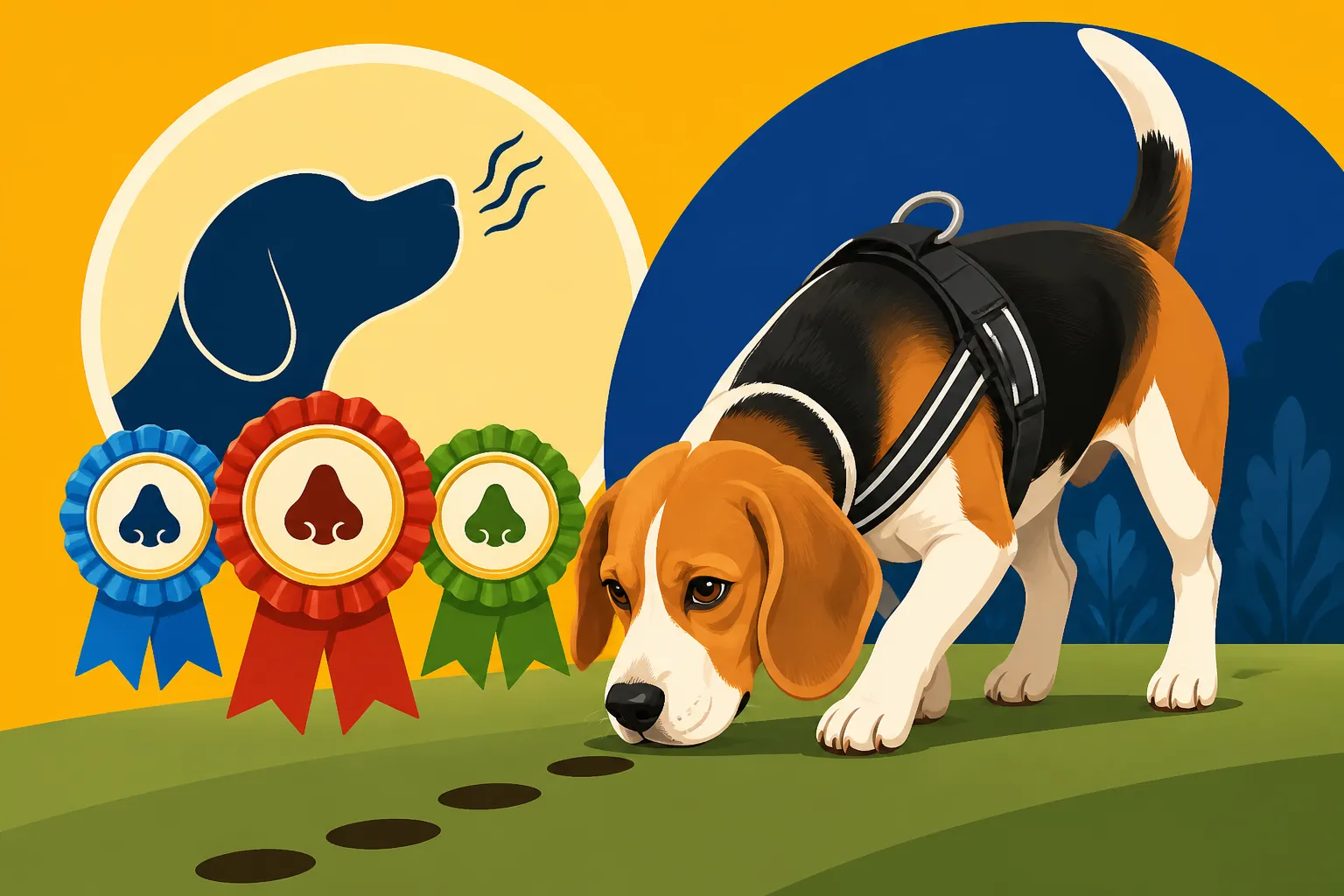
Tracking, on the other hand, is closer to what a Beagle was originally bred to do: follow a specific ground disturbance or scent trail left by a person. In tracking, the dog follows a track layer's path over a variety of terrains, often starting in open fields and progressing to more complex environments. The dog typically wears a harness and is attached to a long line, with the handler following behind, allowing the dog to guide them.
The goal isn't just to find an object at the end of the track (though there often is one, like a glove or wallet), but to accurately follow the actual path of the track layer. This requires intense focus and discrimination, as the dog must distinguish the track layer's scent from other environmental odors and disturbances. Tracking builds incredible teamwork and trust, as the handler learns to interpret their Beagle's subtle changes in body language that indicate they are on or off the track.
Key Differences and Similarities
While both rely on scent, here's a quick breakdown of their main distinctions and commonalities:
| Feature | Scent Work (Nose Work) | Tracking |
|---|---|---|
| Primary Scent | Specific target odors (e.g., essential oils) | Human ground scent, disturbed vegetation, track layer's body odor |
| Environment | Varied: containers, vehicles, interiors, exteriors | Primarily outdoor: fields, woods, urban settings, following a distinct path |
| Goal | Locate source of target odor, indicate to handler | Follow a specific ground trail, often to a lost article |
| Equipment | Harness, leash, odors, hide containers | Tracking harness, long line (15-40 ft), flags (for practice), articles |
| Handler Role | Observant, reads dog's cues, encourages independent search | Follows dog's lead, trusts dog's nose, reads subtle changes in behavior |
| Dog's Focus | Pinpointing odor source | Staying on a specific trail |
| Accessibility | Highly accessible, can be done anywhere, less physical for handler | Requires more outdoor space, more physically demanding for handler (walking fields) |
Similarities:
- Utilize the dog's nose: Both are fundamentally about a dog's olfactory prowess.
- Mental stimulation: Both provide immense mental engagement, leading to a tired and satisfied dog.
- Builds confidence: Excellent for shy dogs or those needing a "job."
- Strengthens bond: Require strong teamwork and communication between dog and handler.
- Low impact: Generally gentle on a dog's body, suitable for many ages and physical conditions.
Getting Started: Training Fundamentals
Diving into scent work or tracking with your Beagle doesn't require a special degree or fancy equipment to begin. It's about tapping into their natural drives and making it a fun, rewarding experience. The initial steps are often surprisingly simple, focusing on building enthusiasm and understanding.
Building the Foundation: Play and Positive Reinforcement
Before you even think about official odors or tracks, the most important thing is to build a strong foundation of positive association. For Beagles, this almost always revolves around their intense food drive. Start with simple "find it" games using high-value treats. Hide a treat under a cup or behind a couch cushion and encourage your Beagle to sniff it out. When they find it, lavish them with praise and more treats. This teaches them that using their nose leads to wonderful things! The Treats a Beagle Will Work Hardest For can be a real game-changer here.
The key is to keep it fun and stress-free. Avoid any pressure or punishment. Your Beagle should associate scent work with joy and success. Many owners find online courses, such as those offered by BAXTER & Bella, incredibly helpful for structuring these initial games and using positive reinforcement effectively. They often provide step-by-step guidance on how to make these early experiences engaging and confidence-building for your dog, even for a Beagle Puppy Sleep and Waking at Three that still needs basic manners.
Introducing Target Odors (Nose Work)
Once your Beagle understands the concept of "find it," you can introduce a target odor for scent work. Typically, this starts with one essential oil, such as birch. You'll need some cotton swabs, a small, airtight container for the odor, and a tin or small vessel to hide the swab in during searches. The goal is to create a clear association: this smell means treat.
You might start by simply placing the scented swab right next to a pile of irresistible treats. As your Beagle eats the treats, they're inhaling the target odor. Repeat this several times. Then, you can graduate to hiding the scented swab (safely enclosed) in an easy-to-find container, like a cardboard box, with treats nearby. When your Beagle shows interest in the container with the odor, reward them immediately. The idea is to make the odor a predictor of something wonderful. Eventually, your Beagle will seek out the odor itself, knowing that finding it leads to a reward.
Laying Basic Tracks (Tracking)
For tracking, you're tapping into your Beagle's natural ability to follow a ground disturbance and human scent. You'll need a tracking harness (different from a regular walking harness), a long line (15-30 feet is a good starting point), and some high-value treats or a favorite toy. Start in a quiet, open area with short grass where distractions are minimal.
The first step is very simple: have a friend walk a short, straight line (maybe 10-20 feet) and drop a highly desirable toy or a handful of treats at the end. Let your Beagle watch them do this. Then, bring your Beagle to the start of the path, put them in their tracking harness, and encourage them to follow the fresh track. Use an encouraging, calm voice. As they follow the path and find the reward, praise them enthusiastically. The initial tracks should be so easy that success is guaranteed. Over time, you'll gradually increase the length, age, and complexity of the tracks, always ensuring your Beagle feels successful. This is essentially Getting a Beagle Started in Nose Work Classes in a different form, focusing on the ground.
Beyond the Basics: Preparing for Titles
Once your Beagle has a solid understanding of the fundamentals and genuinely enjoys their scenting "job," you can start to refine their skills and prepare for the possibility of earning titles. This involves increasing complexity, building endurance, and solidifying their understanding of the tasks.
Advancing Your Nose Work Skills
As your Beagle progresses in nose work, you'll gradually introduce more challenging elements. This includes:
- Adding more target odors: Introduce new scents one at a time, ensuring your Beagle clearly understands each one.
- Increasing the difficulty of hides: Place odors in less accessible spots, higher up, in smaller containers, or in more complex environments (e.g., outside in varying weather, in unfamiliar buildings, under vehicles).
- Lengthening search times and areas: Expand the size of the search area and expect your Beagle to maintain focus for longer periods.
- Refining the alert: Encourage your Beagle to develop a consistent, clear alert signal when they find the odor. This might be a freeze, a nose poke, sitting, or pawing – whatever is natural for your dog and easily recognizable by you.
- Working without food at the source: Eventually, your Beagle will be motivated by the act of finding the odor, not just the food right there. You'll reward them from your hand after they alert at the hide.
This process involves a lot of practice, patience, and learning to read your Beagle's subtle body language. It's incredible to see them transform from a curious sniff to a confident, methodical searcher. Training courses, either in-person or online, can provide excellent structured progression and expert feedback. Many comprehensive online platforms, like the BAXTER & Bella family of courses, offer specific modules for advancing nose work skills, helping you navigate these complex steps.
Refining Tracking Techniques
For tracking, advancement involves making the tracks more challenging in several ways:
- Aging the track: Instead of a fresh track laid moments before, allow the track to sit for increasing amounts of time (e.g., 15 minutes, an hour, several hours) before your Beagle starts.
- Adding turns and angles: Introduce gradual turns, then sharper angles, and eventually more complex patterns.
- Varying terrain: Practice tracking over different surfaces – short grass, tall grass, dirt, gravel, concrete, mowed paths, wooded areas. Each surface presents unique scenting challenges.
- Introducing distractions: Practice in areas with more ambient human and animal scent, or where other activities are occurring in the distance.
- Longer tracks and multiple articles: Increase the length of the track significantly and have the track layer drop multiple "articles" (e.g., a glove, a wallet, keys) along the way that your Beagle must indicate.
Tracking is a slower, more methodical process than some other dog sports. It demands immense trust and patience from both dog and handler. The handler must learn to trust their Beagle's nose implicitly, even when they themselves can't perceive any scent. It's a testament to the powerful connection that develops when a Beagle is allowed to fulfill its deep-seated instinct to follow a trail, as discussed in What a Beagle Experiences on a Scent Trail.
Proofing and Generalization
Whether you're doing nose work or tracking, "proofing" is a critical step in preparing for titles. This means practicing in a wide variety of environments and under different conditions to ensure your Beagle can perform reliably, even when things aren't ideal.
- New locations: Don't always practice in your backyard. Take your Beagle to parks, schoolyards, abandoned buildings, busy parking lots (safely on leash, of course), and friends' houses. The more novel environments they experience, the better they'll generalize their skills.
- Weather conditions: Practice in wind, rain, heat, and cold. Scent behaves differently in various atmospheric conditions, and your Beagle needs exposure to this.
- Distractions: Gradually introduce controlled distractions, such as other people moving nearby (but not interfering), distant sounds, or other dogs. The goal isn't to make it impossible but to build their ability to focus through minor disturbances.
- Different handlers: While you'll primarily be the handler, having different people lay tracks or set hides (for tracking and nose work, respectively) can help your Beagle generalize the task beyond just your specific presence.
Proofing builds resilience and confidence. It helps ensure that when you step into a trial environment, which will always be new and potentially distracting, your Beagle is well-prepared to perform their best. This is also where you discover how Why a Beagle Will Follow a Scent for Miles even in challenging conditions.
Navigating the Title System: Organizations and Levels
Once you and your Beagle are ready to showcase your hard-earned skills, there are several reputable organizations that offer official scent work and tracking titles. Each has its own set of rules, odors, and progression levels, providing a structured path for you and your dog.
AKC Scent Work and Tracking Titles
The American Kennel Club (AKC) offers both Scent Work and Tracking titles, providing a comprehensive path for dog and handler teams.
AKC Scent Work:
AKC Scent Work is a rapidly growing sport that allows dogs to use their natural hunting instincts to locate hidden target odors. The titles progress through several levels:
- Novice (SWN, SWA, SWE, SWM): Focuses on single-blind hides (handler doesn't know exact location) in easy-to-search areas, using a single target odor (birch). There are four components: Container, Interior, Exterior, and Buried (optional). Earning three passes in any component or one pass in each of the four components earns a Novice Scent Work title.
- Advanced (SBN, SBA, SBE, SBM): Introduces two target odors (birch and anise), more difficult hide placements, and larger search areas.
- Excellent (SEN, SEA, SEE, SEM): Requires finding three target odors (birch, anise, and clove), even more complex hides, and larger, more challenging search areas.
- Master (SMN, SMA, SME, SMM): The highest level, with multiple hides, complex placements, and extremely challenging search environments.
- Detective (SD): A non-regular title demonstrating extraordinary scent detection skills, requiring passing advanced versions of all four elements at the Master level on the same day.
AKC also offers specialty titles like "Element Specialty" (e.g., Scent Work Container Novice – SCN) and "Handler Discrimination" where the dog finds the handler's specific scent. The great thing about AKC Scent Work is its structure and the widespread availability of trials.
AKC Tracking:
AKC Tracking offers titles that reflect traditional scent trailing, mirroring a Beagle's historical role. These are generally seen as more physically demanding for the handler due to the nature of following long tracks in various terrains.
- Tracking Dog (TD): The entry-level title, requiring the dog to follow a 440-500 yard track that is 30 minutes to 2 hours old, with three to five turns, and find a lost article.
- Tracking Dog Excellent (TDX): A more advanced title, requiring a longer track (800-1000 yards), 3 to 5 hours old, with five to seven turns, and two distinct obstacles (e.g., changes in cover, human cross-tracks) to challenge the dog's discrimination.
- Variable Surface Tracking Dog (VST): The most advanced AKC tracking title, where the dog must track over at least three different surfaces (e.g., grass, concrete, gravel, asphalt, dirt) and navigate urban challenges.
- Tracking Championship (CT): Achieved by earning TD, TDX, and VST titles, demonstrating mastery across all levels and types of tracking.
Beagle Tracking Titles and How to Earn Them is a goal many Beagle owners aspire to.
NACSW (National Association of Canine Scent Work) Titles
The National Association of Canine Scent Work (NACSW) is the original governing body for the sport of K9 Nose Work, developing a sport that closely mimics professional detection work. Their titling structure is also progressive:
- Odor Recognition Test (ORT): Before competing, dogs must pass an ORT for each target odor (birch, anise, clove). This confirms the dog recognizes the specific scent.
- Nose Work 1 (NW1): The first level of competition, dogs must successfully locate a hidden target odor (birch) in four different elements: container, interior, exterior, and vehicle searches. The emphasis is on the dog working independently and the handler trusting their dog.
- Nose Work 2 (NW2): Introduces two target odors (birch and anise) and more complex search scenarios.
- Nose Work 3 (NW3): The highest level, requiring all three target odors (birch, anise, clove) and significantly challenging search areas, including "unknown" number of hides where the dog must indicate all hides in an area, not knowing how many there are.
NACSW's philosophy strongly emphasizes the dog's natural abilities and joy in the search, often with less pressure on the handler than some other dog sports. Their trials are highly sought after and provide a wonderful community for scent work enthusiasts.
Other Organizations and Their Offerings
Beyond AKC and NACSW, other organizations offer scent-based sports and titles that may appeal to Beagle owners:
- UKC (United Kennel Club) Nosework: Similar to AKC and NACSW, UKC offers a tiered system for Nosework titles, including Container, Interior, Exterior, and Vehicle searches. They also offer a "Precision Nosework" program.
- SDDA (Sporting Detection Dog Association – Canada): For those in Canada, SDDA provides a comprehensive scent detection sport with similar progression through levels and elements.
- Barn Hunt Association (BHA): While not traditional tracking or nose work, Barn Hunt is an increasingly popular sport that taps into a Beagle's natural prey drive and scenting ability. Dogs are tasked with finding live rats (safely enclosed in aerated tubes) hidden in a straw or hay bale maze. It's fast-paced, exciting, and an incredible mental and physical workout. This is a fantastic option for Beagles who absolutely adore hunting, offering something a little different from essential oils or ground tracking, providing real Barn Hunt and Scent Games in a Beagle's Backyard opportunities.
- CGC (Canine Good Citizen) Urban/Advanced (AKC): While not a scent work title, these advanced obedience titles often involve navigating urban environments with distractions, which can benefit a Beagle by teaching focus and manners in stimulating places, complementing any scent work training.
Each organization offers a unique flavor and community. It's worth researching the rules and requirements for each to see which aligns best with your goals and your Beagle's personality.
Benefits Beyond the Ribbons: Why Nose Work Matters for Beagles
While earning titles is a wonderful accomplishment and a lot of fun, the true value of engaging your Beagle in nose work and tracking goes far beyond any ribbon or certificate. These activities offer profound benefits for your Beagle's mental, emotional, and physical well-being, strengthening your bond in countless ways.
Mental Stimulation and Enrichment
A bored Beagle is often a mischievous Beagle. Their sharp minds and incredible noses are designed for problem-solving, and if those needs aren't met, they'll find their own "jobs" – which often include counter-surfing, digging up your prize-winning petunias, or vocalizing endlessly. Scent work and tracking provide unparalleled mental stimulation, channeling that boundless energy and intelligence into a constructive outlet.
Think of it like this: for a Beagle, a scent puzzle is like a complex Sudoku or crossword for a human. It engages their brain deeply, requires focus and concentration, and offers immense satisfaction upon completion. A session of nose work or tracking can be far more tiring and fulfilling for your Beagle than a purely physical walk. It helps prevent boredom-related behaviors and keeps their minds sharp and engaged throughout their lives, making for a happier, more well-adjusted companion. It truly gives them Why a Beagle Needs a Job and Not Just a Walk.
Building Confidence and Partnership
For many Beagles, especially those who might be a bit shy, insecure, or easily overwhelmed, scent work can be a game-changer for building confidence. In nose work, the dog is the expert. The handler's role is to trust their dog, observe, and encourage, not to direct their every move. This empowers the dog, allowing them to make choices and succeed independently, which boosts their self-esteem immensely. Seeing your Beagle light up when they find a hidden odor, knowing they solved the puzzle, is incredibly rewarding.
This shared activity also deeply strengthens the bond between you and your Beagle. When you're working together on a track or a search, you're communicating in a unique way. You learn to read your Beagle's subtle cues – a slight head turn, a change in breathing, a tail wag – that tell you they're on scent. Your Beagle learns to trust that you understand and support their efforts. This silent language and mutual respect build an unbreakable partnership, a true understanding that transcends verbal commands. It helps them overcome things like Beagle anxiety in a pack breed by giving them purpose.
Physical Exercise and Longevity
While often touted for mental stimulation, scent work and tracking also provide valuable physical exercise. Tracking involves covering distances, often over varied terrain, which is great for stamina and joint health. Even nose work, which might seem less physically demanding, involves movement, searching, and navigating environments. It gets your Beagle off the couch and actively moving, which is crucial for maintaining a healthy weight and preventing obesity.
Keeping a Beagle at a healthy weight is absolutely vital for their long-term health, particularly for protecting their back and joints, and preventing issues like Beagle Obesity Treated as a Health Problem. The low-impact nature of most scent games means they're suitable for Beagles of almost any age, from energetic puppies (with appropriate limitations) to Senior Beagle Care After the Age of Ten who may not be able to do strenuous running but can still enjoy a good sniff. Regular, appropriate exercise, both mental and physical, contributes significantly to a Beagle's overall health and can even contribute to a longer, happier lifespan.
In short, whether you aspire to titles or simply want to enrich your Beagle's life, engaging their incredible nose through scent work or tracking is one of the most fulfilling gifts you can give them. It's a journey of discovery, partnership, and immense joy for both ends of the leash.
Disclaimer
This article is for general informational purposes only and does not constitute professional advice. Laws, prices and regulations vary by location and change over time. Consult a qualified professional for guidance on your specific situation.