Guarding Behavior in a Beagle Bred to Eat Fast
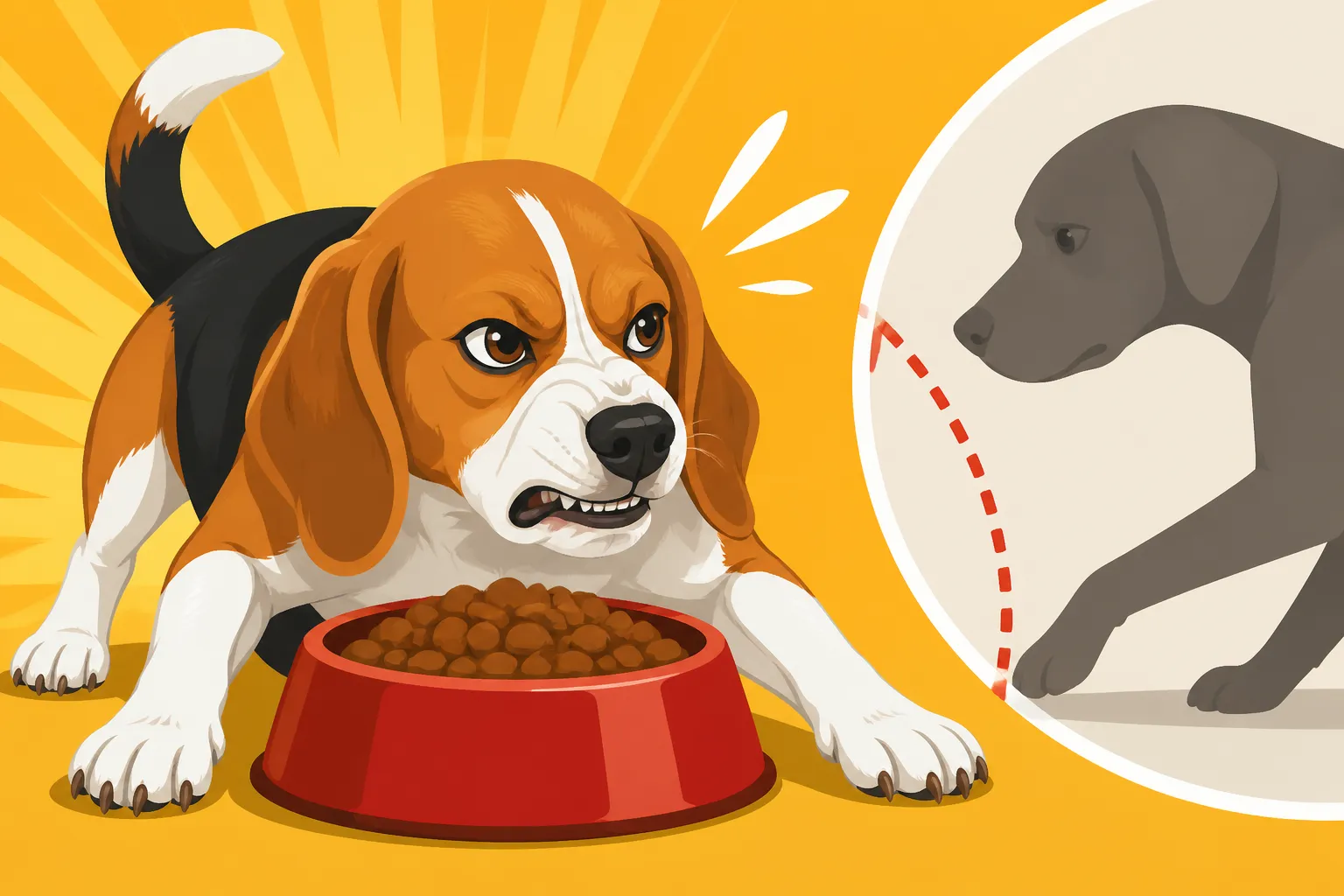
You walk into the kitchen to grab a glass of water, only to notice your Beagle freeze over their dinner bowl, eyes wide, body stiff as a board, and a low, rumble of a growl echoing through the room. It is a distressing, frustrating moment that leaves many dog owners feeling shocked and betrayed by their otherwise sweet, floppy-eared companion. This guide unpacks the biological roots of Beagle resource guarding, breaks down subtle body language triggers, and provides clear, humane steps to turn mealtime tension into a calm, safe routine for your entire household.
The Evolutionary Root of Food Guarding in Beagles
To understand why your Beagle suddenly guards their food bowl like a dragon hoarding treasure, you have to look back at what this breed was built to do. Long before they moved onto our living room sofas, Beagles were bred to live, work, and hunt in large packs. In a traditional kennel pack, dozens of hounds were fed together out of large troughs. Dinner was not a peaceful, individual affair served in a ceramic bowl; it was a high-stakes competition where the fastest eater survived and the hesitant hound went hungry.
Pack Hunting and Scarcity Mentality
That history created a deep, hardwired drive around food that remains fully intact in modern pet Beagles. When a hound was raised in a working pack, securing a piece of prey or grabbing a share of communal food was a matter of basic survival. There was no guarantee that another meal was coming later that evening, so holding onto what you had was a fundamental necessity.
When you bring a Beagle puppy into a cozy modern home, that internal pack programming does not magically shut off. Even if your puppy has never missed a meal in their life, their DNA is telling them that food is a limited, highly contested resource. When a human walks toward their bowl, the Beagle’s instinct does not interpret the human as a loving caregiver; it interprets the movement as a potential competitor coming to clear out the trough.
Genetically Wire-Toasted Speed Eating
Alongside the instinct to guard comes the drive to inhale food at breakneck speed. Most Beagles eat as though they are participating in a timed competition, gulping down kibble without chewing a single piece. This speed-eating behavior directly feeds into resource guarding. Because the dog feels an urgency to finish before someone else takes the food, their nervous system is already operating at an elevated state of arousal during mealtime.
This heightened state makes it much easier for a dog to cross the threshold from nervous fast-eating into defensive posturing. If you notice your dog gulping down their dinner so fast that they cough or choke, you are seeing that ancient pack mentality in action. Recognizing this helps us reframe the behavior not as malice or “dominance,” but as a fear-based panic response rooted in survival instincts.
Distinguishing Normal Instinct from Maladaptive Resource Guarding
It is entirely normal for any dog to value high-value items, such as a fresh marrow bone or a dropped slice of bacon. Natural possessiveness becomes maladaptive resource guarding when the dog’s protective reaction is disproportionate to the actual threat, or when it extends to everyday situations, such as a human walking three feet away from a bowl of dry kibble.
If your dog simply moves their head over their chew toy when you walk past, that is a mild, manageable level of possession. However, when a dog stiffens, shows the whites of their eyes, growls, or snaps at family members who are simply moving through the room, the instinct has crossed into dangerous territory. Addressing this requires a clear understanding of Beagle Resource Guarding at the Food Bowl so you can intervene before someone gets hurt.
RESOURCE GUARDING SEVERITY & PROGRESSION CHART
| Stage | Physical Cues | Behavioral Meaning |
|---|---|---|
| Mild Possession | Eats faster when approached, | “I notice you, and I am |
| covers item with paws | keeping my eye on my food” | |
| Moderate Guarding | Body freeze, hard glare, whale | “Stop moving closer, or I |
| eye, low silent tension | will have to defend this” | |
| Severe Guarding | Deep growl, lip lift, air snap, | “Back away immediately; I |
| lunging or biting | am ready to escalate” |
Recognizing Early Warning Signs of Beagle Resource Guarding
Resource guarding almost never appears out of nowhere. Long before a Beagle lunges or snaps, they communicate their discomfort through subtle physical changes. The challenge for many owners is that hound body language can be remarkably quiet right up until the moment it becomes loud. Learning to read these quiet warnings is the single best way to prevent dangerous escalations in your kitchen.
Subtle Body Language Cues Before the Growl
The very first indicator that a Beagle is feeling anxious about their resource is a sudden change in eating tempo or a subtle physical freeze. You might notice that as you walk into the room, your dog stops chewing for a split second, or their head drops an inch lower over the bowl. Their muscles around the neck and shoulders will visibly tighten, transforming a loose, happy hound into a rigid statue.
Another clear sign to watch for is “whale eye,” where the dog keeps their head fixed down over their food while moving their eyes to follow your movement, revealing the white portion (sclera) of their eye. You may also see subtle lip curling, rapid licking of the lips right after you step away, or ears pinned back tight against the head. These are explicit pleas for space, signaling that your dog feels threatened.
Escalation: From Freeze to Snap
If those subtle warning signals are ignored—or worse, if the dog is scolded for sending them—the Beagle is forced to escalate up the ladder of aggression. When a dog learns that a body freeze or a quiet look does not stop the human from approaching, they jump straight to vocal warnings. This starts with a low, rumbling growl that vibrates through their chest.
If the human continues to advance, the dog may lift their top lip to display teeth, snap at the air near the person’s hand, or make direct physical contact. It is vital to realize that a snap or a bite is not a sudden, unprovoked attack; it is the final result of a communication chain where all early, subtle warning signs were missed or dismissed.
High-Value Items That Trigger Deep Defensive Instincts
While standard dry kibble can easily trigger guarding in a food-motivated hound, certain items elevate the dog’s defensive drive to extreme levels. Knowing which items spark the highest intensity allows you to manage the environment before a confrontation occurs.
Items that most frequently trigger severe resource guarding include:
- Rawhide, bully sticks, and real animal bones
- High-value stolen counter items like butter sticks, raw meat, or bread loaves
- Trash bag contents harvested during Beagle Counter Surfing and Trash Raiding
- Scented human items, such as dirty socks or used tissues
- Interactive puzzle toys stuffed with peanut butter or wet food
Understanding this hierarchy helps you predict when your dog will feel the strongest urge to protect their prize. A dog that is completely relaxed around their daily kibble bowl might become fiercely protective when they manage to pull a chicken bone out of an open trash can.
Practical Management Strategies for the Home
The absolute first step in addressing resource guarding is implementing strict environmental management. Behavior modification takes time, consistency, and patience, but safety must be established immediately. Management means structuring your home so your Beagle never feels the need to guard, completely removing the triggers that lead to tense standoffs.
Creating Safe, Stress-Free Mealtime Zones
If your Beagle feels exposed or vulnerable while eating, their guarding instincts will naturally intensify. Feeding your dog in high-traffic areas of the house—such as right beside the kitchen island, near the back door, or in a hallway where family members constantly walk past—is a recipe for disaster.
Instead, establish a dedicated, low-traffic mealtime zone. A quiet laundry room, a spare bathroom, or inside an open crate tucked in a corner can work remarkably well. If you are working on Crate Training a Beagle Bred to Sleep in a Pack, using the crate as a designated feeding sanctuary can make the dog feel safe, enclosed, and unthreatened. Once the food bowl goes down, close the door or step completely out of the space, allowing your dog to eat in absolute peace without worrying about people or other pets walking by.
Slowing Down the Vacuum-Cleaner Bite
Because rapid eating exacerbates food insecurity, slowing your Beagle down is a cornerstone of effective management. If your dog empties their bowl in forty-five seconds, their adrenaline spikes, keeping them in a heightened state of arousal.
Rather than using standard open dishes, introduce specialized feeding tools:
- Maze-Style Slow Feeder Bowls: These plastic or silicone bowls feature physical ridges that force the dog to navigate around obstacles, turning a forty-five-second frenzy into a five-minute meal. You can easily find dozens of varieties on sites like Amazon.
- Interactive Puzzle Toys: Rubber toys that require the dog to lick or bounce the item to release kibble help ground their nervous system through natural licking and foraging behaviors.
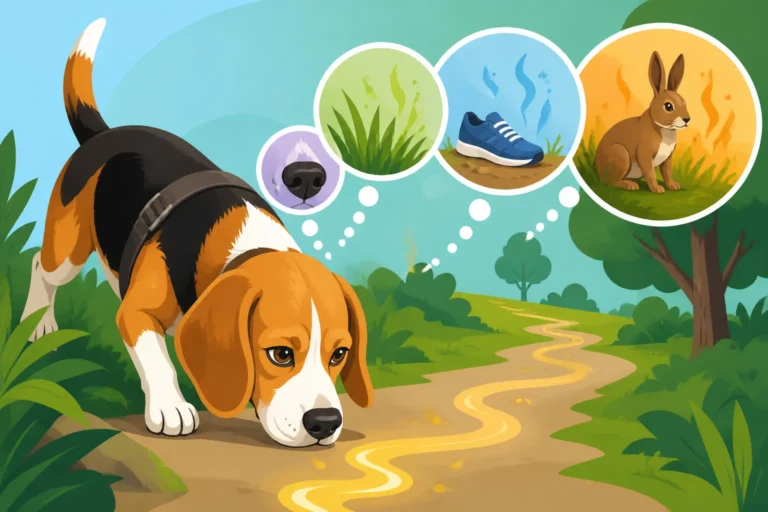
- Snuffle Mats: Fabric mats with dense fleece strips allow you to hide dry kibble, forcing the dog to use their scenting ability rather than raw speed. Exploring Snuffle Mats and Scatter Feeding for a Beagle is a wonderful way to satisfy their natural hound instincts while slowing down their intake.
By shifting your Beagle’s eating style from gulper to puzzle-solver, you naturally lower their stress levels around food.
Management Tools and Environment Setup
Managing a guarding dog extends beyond mealtime. It involves looking around your home and identifying every potential flashpoint before your dog does. If your Beagle is prone to stealing items off low tables, clear those surfaces off entirely. Keep trash cans locked inside cabinets or secured with heavy-duty latches.
If you have kids or other pets in the house, establish a strict rule: whenever the Beagle is eating or working on a chew, nobody touches, approaches, or speaks to the dog. Using physical barriers like baby gates or exercise pens allows your Beagle to enjoy high-value chews safely without creating anxiety for the human family members.
BEAGLE FEEDING METHOD COMPARISON
| Feeding Method | Average Duration | Stress Level | Guarding Risk |
|---|---|---|---|
| Open Bowl | 30 to 60 Seconds | High (Frenzy) | High |
| Slow Feeder Bowl | 5 to 10 Minutes | Moderate | Moderate |
| Snuffle Mat | 10 to 15 Minutes | Low (Calming) | Low |
| Frozen Puzzle Toy | 15 to 30 Minutes | Low (Enriching) | Very Low |
Step-by-Step Behavioral Modification: Counter-Conditioning and Desensitization
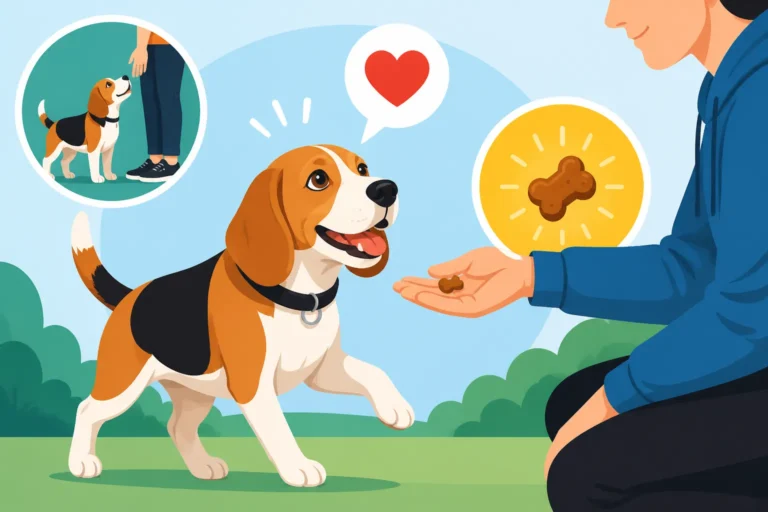
While management prevents reactions, counter-conditioning and desensitization actively change how your dog feels about human presence around their food. The objective is to rewire your Beagle’s emotional response: instead of thinking, “Here comes a human to steal my food,” they should think, “Here comes a human, which means something even better is about to drop into my bowl!”
The Trade Up Method for Guarded Items
The single most important rule when dealing with a possessive dog is to never forcibly take an item away from them unless it is a life-threatening emergency. Reaching into a guarding dog’s mouth or snatching a bone away validates their worst fears—it proves that humans do steal their treasures. This practically guarantees the behavior will worsen next time.
Instead, always practice the “Trade Up” method:
- Identify a treat that is significantly higher in value than whatever the dog currently holds (e.g., warm baked chicken, small cheese cubes, or freeze-dried liver).
- Walk near the dog, remaining outside their reaction threshold (where they notice you but remain relaxed).
- Toss a few high-value treats onto the floor several feet away from the object they are holding.
- Wait for the dog to willingly drop the guarded item to eat the scattered treats.
- While the dog is occupied eating the high-value treats away from the object, safely retrieve the guarded item, or simply let them finish and return to their toy.
By practicing this consistently, your dog learns that human approach leads to an addition of good things, not a subtraction of their treasures.
Re-Educating the Beagle Mindset Around Human Proximity
To systematically reduce bowl guarding, you can execute a basic counter-conditioning protocol over several weeks. Work on this only when your dog is calm, and progress slowly through the stages.
- Step 1 (Distance Drops): While your Beagle is eating their normal kibble, walk past them at a distance where they remain completely relaxed (e.g., six to eight feet away). Toss a piece of high-value meat straight into or near their bowl as you pass, without stopping or making direct eye contact. Continue walking away.
- Step 2 (Closing the Distance): Over multiple days, as your dog starts looking up with a wagging tail expecting a treat when you walk by, gradually close the distance. Walk four feet away, toss the high-value treat, and keep moving.
- Step 3 (Pausing at the Bowl): Once your dog shows zero tension when you walk close, walk up to the bowl, pause for one second, drop an incredible treat directly into the bowl, and immediately step back.
Through this exercise, your arrival at the bowl transitions from a source of panic to a welcome event. If you want structured online video guidance on these protocols, platforms like BAXTER & Bella offer excellent, positive-reinforcement step-by-step modules for working through resource issues at home.
Training Drop It and Leave It Without Conflict
Teaching solid cue-based behaviors outside of mealtime gives you reliable tools when accidental situations occur. Master these cues as fun games using low-value toys first before trying them with real food.
Start by practicing Teaching Drop It Before a Beagle Swallows using two identical, medium-value toys. Tug gently with one toy, then stop moving it completely, making it boring, while bringing out the second toy and making it wiggle enticingly. The moment your Beagle drops the first toy to grab the second, mark the behavior with a verbal cue like “Yes!” or “Drop.”
Similarly, working on Beagle Leave It Training With Real Food Down teaches impulse control. Cover a low-value treat with your hand on the floor. Let your Beagle sniff and lick your closed hand. The second they back their nose away, click or mark, open your hand, and reward them with a different, higher-value treat from your opposite hand. They quickly realize that turning away from a restricted resource earns them a jackpot.
Common Pitfalls and What Never to Do With a Guarding Beagle
When owners feel challenged by a dog’s growling or guarding, traditional advice often points toward harsh, outdated techniques. Unfortunately, applying confrontational methods to resource guarding is like throwing gasoline on a quiet fire.
The Danger of Alpha-Rolls and Physical Punishment
Old-school training advice frequently suggests “showing the dog who is boss” by physically taking their food away, alpha-rolling them onto their back, or yelling when they growl. Do not do this. Physical confrontation does not teach a dog trust; it teaches them that humans are dangerous, unpredictable bullies.
If you punish a dog for growling, you might successfully suppress the growl itself. However, you have not fixed the underlying anxiety or fear. Instead, you have created a dog that skips the growl next time and moves straight to a surprise bite. Growling is a valuable communication safety line; never punish your dog for warning you that they are stressed.
Why Hand-Feeding Meal Kibble Can Backfire
A common recommendation for food-guarding dogs is to force them to eat their entire meal hand-by-hand out of your palm. While intended to build bond, this approach can easily backfire with a highly anxious Beagle.
Forcing a dog that harbors deep food insecurity to take every piece of kibble directly out of a human hand puts them in a constant state of conflict. They want the food desperately, but the forced close contact makes them uneasy. For many dogs, this raises their stress baseline, causing them to explode with guarding behaviors the moment the food is finally put into a traditional bowl. Hand-feeding can be useful during low-pressure training games, but it should not be used to replace calm, independent meal times.
When to Bring in Professional Behavioral Support
Resource guarding can range from mild possessiveness to dangerous aggression. If your Beagle has made direct contact, broken skin, or displays fierce guarding over every item they touch, do not try to resolve the situation alone.
Reach out to a certified professional, such as a Certified Applied Animal Behaviorist (CAAB) or a Certified Professional Dog Trainer (CPDT-KA) who utilizes force-free, positive reinforcement techniques. Structured training programs like BAXTER & Bella can provide foundational education, but hands-on assessment from a local behavioral consultant ensures that your home setup and safety measures are customized to your specific hound.
Managing a Beagle’s appetite is a long-term commitment. A dog that is constantly hungry is far more likely to scavenge, hunt for crumbs, and guard whatever treasures they manage to lock down. Keeping your hound active, well-stimulated through scent games, and clear of Beagle Scavenging on Every Walk habits will lower their overall obsession with finding hidden food. Furthermore, keeping a close eye on their physical health ensures that intense hunger isn’t being driven by an underlying medical issue or heading toward Beagle Obesity Treated as a Health Problem.
With consistent management, clear communication, and reward-based counter-conditioning, you can replace mealtime stress with trust and safety, ensuring your sweet, merry Beagle feels totally secure in your home.
Disclaimer
This article is for general informational purposes only and does not constitute professional advice. Laws, prices and regulations vary by location and change over time. Consult a qualified professional for guidance on your specific situation.