Why an Overweight Beagle Still Looks Normal
It's a common, heartbreaking scenario: you look at your beloved Beagle, and they seem perfectly fine, maybe even a little stout, but "normal." You probably think that their sturdy build and happy-go-lucky nature means they're just robust, maybe a little cuddly. But here's the tough truth: many Beagle owners unwittingly overlook excess weight in their furry friends because Beagles are experts at hiding it. This guide is going to peel back the layers of their deceptive physique, help you understand why your seemingly "normal" Beagle might actually be overweight, and equip you with the tools to assess their true body condition.
The Beagle's Deceptive Body Shape and Coat
Beagles have a way of carrying extra pounds that can fool even the most attentive owner. Their very design, honed over centuries as scent hounds, makes them naturally stocky and muscular, which can easily camouflage creeping weight gain. It's not your fault for missing it; they're built to make it hard to tell!
How Their Compact Build Hides Extra Pounds
Think about the classic Beagle silhouette: a deep chest, strong bone structure, and relatively short legs. They're bred for endurance and ground-level scent work, not for the svelte, tucked-up appearance of a sighthound. This compact, powerful build means that a few extra pounds can settle around their midsection without creating the dramatic sagging belly or prominent fat rolls you might see in other breeds. Their frame is inherently solid, giving them a "fuller" look even at an ideal weight.
When you look at a Beagle, their deep chest can make their abdomen appear tucked up even when it's not, simply because their rib cage is so pronounced. This contributes to the illusion of a more athletic build than they might actually possess if they're carrying extra weight. It's like trying to spot a balloon hidden behind a sturdy tree trunk – the balloon is there, but the trunk is doing a great job of obscuring it. This robust construction, while fantastic for their original purpose as hunting dogs, can be a real trap for modern pet owners trying to maintain a healthy weight.
The Dense Double Coat as a Camouflage
Adding to the deception is the Beagle's wonderfully thick, short, yet dense double coat. This coat, perfect for protecting them from brambles and weather while out in the field, acts like a perfectly tailored, plush winter coat that smooths over any lumps and bumps beneath. Where a short-haired, lean breed might show every slight bulge or dip, a Beagle's coat fluffs out, effectively blurring the lines of their physique.
You might notice that you can't easily see your Beagle's waistline or the definition of their ribs, but you might attribute that to their natural build or simply their fur. This is exactly what the coat is designed to do – provide insulation and protection – but it inadvertently makes it much harder to visually assess their body condition. It can take a significant amount of weight gain before their waist entirely disappears or their shape becomes overtly barrel-like, because the coat fills in the subtle changes that would be obvious on a thinner-coated dog. Many owners are surprised when a vet feels their Beagle and points out a lack of rib definition, despite the dog appearing perfectly normal on the surface.
Why a Beagle's Weight is Often Underestimated
It's not just their physical attributes that make weight assessment tricky; it's also our perception of Beagles and some common habits that contribute to the problem. We love our Beagles, and sometimes that love translates into practices that aren't always in their best interest health-wise.
The "Merry" Perception vs. Reality
Beagles are often described as "merry hounds," full of life, energy, and an insatiable curiosity. This happy, robust image can lead us to believe they're naturally sturdy and can handle a bit more food or a few extra treats without consequence. We see them as active, always sniffing, always on the go, and we might think, "Oh, they'll just run it off!" This perception, while largely true of their personality, doesn't always align with the reality of their caloric needs, especially as they get older or if their exercise isn't consistent.
A Beagle's enthusiasm for food is legendary. They live to eat, and they are incredibly persuasive with those soulful eyes and insistent nudges. It's easy to confuse their boundless food drive with a need for more calories, when in fact, their joyful demeanor doesn't automatically mean they're burning off everything they consume. Their energy levels can sometimes be overestimated too; a busy sniffer isn't necessarily a high-intensity athlete, and sniffing burns far fewer calories than a vigorous run. This "merry" façade can be a silent conspirator in weight gain, as owners might inadvertently overfeed them, believing their active nature will compensate.
Common Feeding Habits That Contribute to Overweight Beagles
Let's be honest, those big, pleading Beagle eyes are hard to resist! Many owners fall into habits that, while seemingly harmless, really pack on the pounds. The biggest culprit is often free-feeding, where a bowl of kibble is left out all day for the dog to graze from. For a breed as food-motivated as a Beagle, this is a recipe for disaster. They rarely self-regulate their intake, and an always-available food source means constant snacking.
Another major contributor is the sheer volume of treats and table scraps. Every little piece of cheese, every crust from a sandwich, every extra cookie adds up quickly, often pushing a Beagle far beyond their daily caloric needs. Owners often forget to factor these "extras" into their dog's daily intake, focusing only on the main meals. Even small training treats, used frequently, can contribute significantly. When you consider that a tiny piece of cheese might be the equivalent of a human eating a donut for a Beagle, you start to understand the scale of the problem. Many of us also scoop kibble with a generic cup, which can be inconsistent; weighing food is always more accurate. For reliable portion control, using brands that offer precise daily recommendations or pre-portioned meals can be a lifesaver. Companies like Ollie, for instance, tailor meals to your dog's specific needs, which can help manage weight. Even regular kibble from brands found on Chewy or Amazon can be precisely measured once you know the correct amount.
The Role of Breed Standards and Ideal Weight
The official breed standard for Beagles typically focuses on height (13 inches and under, or over 13 inches but not exceeding 15 inches at the shoulder) rather than a specific weight. While there might be a general weight range associated with these heights, it's broad. This lack of a strict weight guideline can sometimes lead owners to believe that a heavier Beagle is simply "large for the breed" rather than actually overweight. What one person considers a "sturdy" 15-inch Beagle, another might correctly identify as carrying too many pounds.
This ambiguity means that relying solely on a number on the scale can be misleading. A 28-pound Beagle might be perfectly lean and muscular if they are at the top end of the 15-inch variety, while a 28-pound Beagle of the 13-inch variety would likely be significantly overweight. It emphasizes the need to go beyond the numbers and truly understand Body Condition Scoring a Beagle Under a Thick Coat, which assesses their physique rather than just their mass. A good breeder will always prioritize a healthy weight and condition for their dogs, irrespective of exact numbers, focusing on overall fitness and well-being.
Learning to Accurately Assess Your Beagle's Body Condition
Since visual inspection alone can be deceiving, mastering a hands-on approach to assessing your Beagle's body condition is crucial. It’s a skill every Beagle owner should develop, and it's much easier than you might think once you know what to feel for.
The Importance of Body Condition Scoring (BCS)
Body Condition Scoring (BCS) is a universally recognized system used by veterinarians to assess a pet's fat reserves. It typically uses a 5-point or 9-point scale, with 1 being emaciated and 9 being morbidly obese. An ideal score is usually 4-5 out of 9, or 2-3 out of 5. For Beagles, this system is invaluable because it provides a more objective measure than simply looking at them. It helps you understand if your Beagle's "normal" appearance is genuinely healthy or just a clever disguise for extra weight.
Learning BCS empowers you to have informed conversations with your vet and to make necessary adjustments to your Beagle's diet and exercise routine. It moves beyond subjective opinions like "they look a bit chunky" to a quantifiable assessment that directly impacts their health. Regularly performing a BCS check at home allows you to catch subtle weight gain early, before it progresses into significant obesity and the associated health issues. Think of it as your Beagle's personal health radar – the earlier you detect a problem, the easier it is to correct.
Hands-On Assessment: Feel, Don't Just Look
This is where the rubber meets the road! You need to get hands-on with your Beagle. Don't be shy; they probably love the extra attention anyway. The key areas to feel are their ribs, their waist, and their spine.
- Ribs: Gently run your fingers along your Beagle's sides, just behind their front legs. You should be able to easily feel their ribs, almost like feeling the knuckles on your hand, with just a thin layer of fat and skin over them. If you have to press hard to feel them, or if you can't feel them at all, your Beagle is likely carrying too much weight. Conversely, if the ribs are visibly prominent and sharp without pressing, they might be underweight.
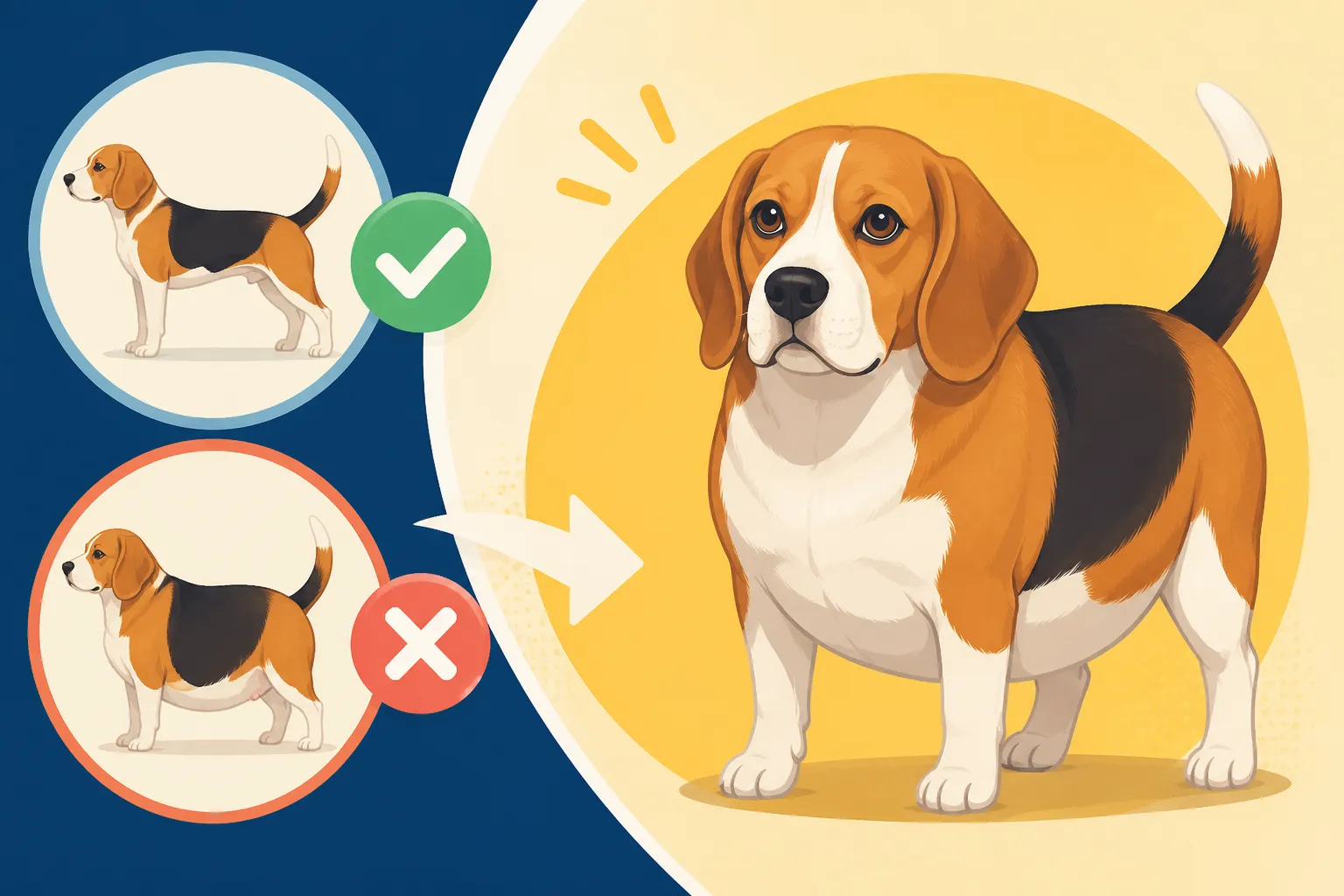
- Waist: Stand directly above your Beagle while they are standing. Look down at their back. You should see a gentle indentation or "tuck" behind their ribs, where the waist narrows before flaring out slightly over their hips. If their sides are straight like a sausage or bulge out, they don't have a discernible waist, indicating extra fat.
- Abdominal Tuck: View your Beagle from the side. The line of their belly, from the chest to the hind legs, should slope upwards. An overweight Beagle will have a relatively straight or even sagging belly line.
Practicing this regularly will make you much more attuned to your Beagle's ideal body shape. Don't forget to refer to resources that provide guidance on Feeling for a Beagle's Ribs and Waistline for more detailed instruction. It’s an easy, quick check that can tell you far more than a simple glance.
Visual Cues You Might Be Missing
Even with a dense coat, there are subtle visual cues that, once you know what to look for, can hint at an overweight Beagle. It's about retraining your eye. First, pay attention to their movement. Does your Beagle seem a little less spry than they used to be? Are they slower to get up, or do they tire more easily on walks? Sometimes, reduced activity is a symptom of carrying extra weight, not just a sign of aging.
Secondly, observe their overall posture. An overweight Beagle might stand with legs slightly wider apart, or they might appear to have less "lift" to their steps. Their gait might be a bit more ponderous. You might also notice that their tail doesn't wag quite as freely, or that the base of their tail feels thicker than it should. Finally, a less obvious sign can be their facial structure. While Beagles have soft, expressive faces, excess fat can sometimes accumulate around their jowls or neck, making their face appear rounder and less defined. Look for these combined signals, and pair them with your hands-on assessment for the most accurate picture.
| Body Condition Score | Visual Description | Palpable Ribs | Waist/Abdominal Tuck | Overall Assessment |
|---|---|---|---|---|
| Ideal (4-5/9) | Well-proportioned, defined waist. | Easily felt with slight fat cover, like knuckles. | Clearly visible abdominal tuck from side. | Healthy, lean, and athletic. |
| Overweight (6-7/9) | Rounded shape, minimal waist definition. | Felt with difficulty, moderate fat cover. | Little to no abdominal tuck, back broad. | Early weight gain, need for intervention. |
| Obese (8-9/9) | Barrel-shaped, no waist, sagging belly. | Cannot feel ribs or requires firm pressure. | Abdomen sagged or distended, no tuck. | Significant health risk, urgent intervention needed. |
The Health Risks of Overlooked Beagle Obesity
Ignoring those extra pounds isn't just about aesthetics; it has serious implications for your Beagle's health and quality of life. An overweight Beagle is at risk for a host of medical problems, some of which can drastically shorten their lifespan and require expensive, lifelong management. Beagle Obesity Treated as a Health Problem really highlights how critical this issue is.
Increased Risk of Joint and Back Problems
Those extra pounds put significant strain on your Beagle's joints and spine. Imagine carrying a heavy backpack all day, every day – that's what it feels like for an overweight dog. This constant stress can accelerate the development of conditions like arthritis, making existing issues worse. Beagles, with their somewhat longer backs, are already prone to certain spinal conditions, and excess weight compounds this risk significantly.
Conditions such as Beagle Hip Dysplasia and Everyday Joint Wear and Beagle Disc Disease and That Slightly Long Back are made far worse by obesity. The increased pressure on intervertebral discs can lead to painful ruptures or herniations, which might require extensive veterinary care, including surgery. Even small increases in weight can drastically How Extra Weight Raises Beagle Disc Pressure. An overweight Beagle might struggle to jump on the couch or climb stairs, limiting their enjoyment and leading to chronic pain. Preventing obesity is one of the best ways to protect their musculoskeletal system as they age.
Metabolic and Systemic Health Issues
Beyond joint problems, obesity in Beagles opens the door to a cascade of metabolic and systemic health issues. Excess fat isn't just inert tissue; it's metabolically active, producing hormones and inflammatory substances that negatively impact the entire body. This can lead to insulin resistance, increasing the risk of Beagle Diabetes and Blood Sugar Control. Managing diabetes in dogs is a lifelong commitment involving daily insulin injections and strict dietary control.
Overweight Beagles are also more prone to Beagle Hypothyroidism and the Weight It Puts On, though it's important to remember that hypothyroidism causes weight gain, not the other way around. However, obesity can exacerbate the symptoms and make diagnosis more complex. Other issues include heart disease, as the heart has to work harder to pump blood through a larger body, and respiratory problems, as fat can accumulate around the lungs and diaphragm. Even skin problems can arise due to folds of fat, leading to infections.
Reduced Quality of Life and Lifespan
Ultimately, an overweight Beagle simply cannot enjoy life to its fullest. Their natural inclination to sniff, explore, and play is hampered by their physical limitations. They might become lethargic, less interested in walks, and generally more sedentary, creating a vicious cycle where less activity leads to more weight gain. This reduction in physical activity often correlates with a decline in mental stimulation, leading to boredom or even behavioral issues.
The accumulated health problems associated with obesity can also significantly shorten a Beagle's life. While the average Beagle Lifespan and the Twelve to Fifteen Year Range is quite good, an overweight Beagle is unlikely to reach the higher end of that spectrum. The strain on their organs, the chronic pain from joint issues, and the increased risk of various diseases all contribute to a reduced lifespan. Ensuring your Beagle maintains a healthy weight is one of the most impactful ways you can contribute to their longevity and overall happiness.
Taking Action: Helping Your Beagle Achieve a Healthy Weight
It’s never too late to start making changes. If you’ve realized your Beagle is carrying extra weight, don't despair! With consistency and commitment, you can help them achieve a healthy weight and enjoy a much better quality of life.
Adjusting Their Diet and Portion Control
The first and most critical step is to tackle their diet. This means saying goodbye to free-feeding and implementing strict portion control. Start by consulting your veterinarian to determine The Daily Calorie Target for a Twenty Pound Beagle or whatever their ideal weight might be. They can help you calculate an appropriate daily calorie intake based on your Beagle's target weight, age, and activity level.
Once you have that number, measure everything. Invest in a kitchen scale to weigh out their kibble rather than using cups, as cup measurements can be surprisingly inaccurate. Split their daily allowance into two meals. Be extremely mindful of treats; choose low-calorie options like small pieces of carrot, green beans, or specially formulated diet treats. If you use treats for training, deduct those calories from their daily meal allowance. Brands available on Amazon or Chewy often have a good selection of low-calorie training treats. If you're considering a fresh food diet, companies like Ollie provide portion-controlled meals tailored to your dog’s specific needs, which can be very effective for weight management. Remember, consistency is key, and every family member needs to be on board with the new feeding regimen.
Incorporating Appropriate Exercise
While diet is paramount, exercise plays a vital supporting role. Beagles need regular physical activity to burn calories, maintain muscle mass, and stay mentally stimulated. They are not couch potatoes by nature! Aim for at least 60-90 minutes of moderate exercise daily, broken into several sessions. This isn't just about running; for a Beagle, scent walks are incredibly enriching and tiring. Allowing them to sniff and follow trails engages their powerful nose and mind, providing excellent mental and physical exertion. You can learn more about Exercise That Actually Burns Beagle Calories to understand which activities are most beneficial.
Beyond leash walks, consider activities like fetch in a securely fenced yard, puzzle toys that make them work for their food, or even enrolling in a beginner scent work class. If your Beagle enjoys swimming, it's a fantastic low-impact exercise. Just remember to build up activity levels gradually, especially if your Beagle has been sedentary, to avoid injury. And when they're on the move, consider using Ramps and Steps That Protect a Beagle Spine to prevent unnecessary strain on their joints from jumping.
Regular Vet Check-ups and Monitoring
Your veterinarian is your most valuable partner in this weight loss journey. Schedule regular check-ups to monitor your Beagle's progress and ensure they are losing weight safely and effectively. Your vet can provide accurate body condition scoring, rule out any underlying medical conditions that might be contributing to weight gain (like hypothyroidism), and adjust their dietary recommendations as needed.
They might also suggest specific prescription weight loss foods or supplements if necessary. Don't hesitate to ask for advice on creating an exercise plan that's appropriate for your Beagle's current fitness level. Consistent veterinary oversight ensures that your Beagle's weight loss is healthy and sustainable, leading to a happier, longer life.
Disclaimer
This article is for general informational purposes only and does not constitute professional advice. Laws, prices and regulations vary by location and change over time. Consult a qualified professional for guidance on your specific situation.