Daily Calories for a 13-Inch Against a 15-Inch Beagle
It’s a common frustration for Beagle parents: you want to feed your beloved hound exactly what they need, but figuring out the right amount of food, especially when you factor in their boundless energy and seemingly bottomless stomachs, can feel like a guessing game. It’s not just about tossing kibble in a bowl; feeding a Beagle properly is a delicate balance, particularly when you consider that there are actually two recognized size varieties. Underfeeding can lead to nutrient deficiencies and a lack of energy, while overfeeding, a more common pitfall for this food-motivated breed, can pave the way for a host of serious health issues. This guide is here to walk you through the nuances of daily calorie requirements for both 13-inch and 15-inch Beagles, helping you ensure your furry friend maintains a healthy weight and vibrant life.
Understanding Beagle Calorie Needs: It's Not One-Size-Fits-All
When you look at a Beagle, whether they're darting through the yard or curled up for a nap, it's easy to assume their energy needs are all pretty much the same. But just like with people, every Beagle is an individual, and their dietary requirements, especially their calorie intake, are far from a one-size-fits-all situation. Ignoring these individual differences is often where the problems start, leading to either a Beagle that’s a little too thin and lacking stamina, or, more commonly, one that’s carrying extra pounds that put a strain on their joints and overall health.
Why Beagle Size Matters for Diet Planning
You might know that Beagles come in two main size varieties: the 13-inch and the 15-inch. This isn't just a minor distinction for the show ring; it has tangible implications for their metabolic rate and, consequently, how many calories they need each day. A 13-inch Beagle, by definition, is measured at the shoulder and stands no more than 13 inches tall, typically weighing in the range of 18-22 pounds. A 15-inch Beagle, conversely, stands over 13 inches but no more than 15 inches at the shoulder, with a weight often between 22-30 pounds.
It stands to reason that a larger dog, even within the same breed, generally requires more fuel to power its body. More body mass means more cells needing energy, more muscle to move, and a larger internal engine to keep everything running smoothly. So, when you're staring at the back of a dog food bag, those general guidelines often don't account for these specific Beagle varieties, leaving you to do some educated guesswork. Understanding which category your Beagle falls into is the very first step in tailoring their nutrition plan, and it's a step many owners unfortunately overlook, leading to unintended weight fluctuations.
The Importance of a Calorie Baseline
Before you even think about adjusting for activity or life stage, you need a solid baseline estimate for your Beagle's calorie needs. This isn't just a random number; it's typically calculated using a formula called the Resting Energy Requirement (RER) or Maintenance Energy Requirement (MER), which takes into account a dog's ideal body weight. For the average pet owner, doing these complex calculations can be daunting, but understanding the concept is key. The baseline represents the number of calories needed to maintain basic bodily functions and a healthy weight at a moderate activity level.
Without this baseline, any adjustments you make for, say, a super active weekend hike or a lazy Sunday afternoon, become meaningless. It's like trying to navigate without a map – you might get somewhere, but it won't be efficient or necessarily where you wanted to go. This baseline is your starting point, your reference number, and it's crucial for understanding daily calories for a twenty pound Beagle versus one that's closer to thirty. From here, we can begin to fine-tune things, but without it, you're essentially flying blind in the world of canine nutrition.
The 13-Inch Beagle: Calorie Considerations for the Smaller Variety
For those of us with the daintier, though no less boisterous, 13-inch Beagle, it’s easy to be fooled by their seemingly endless energy. They can run and play with the best of them, making you think they need a mountain of food. But their smaller frame actually means their metabolic furnace, while efficient, doesn't demand the same caloric output as their larger cousins. It’s a common mistake to overfeed this variety, often because their pleading eyes are just as effective as any other Beagle’s!
Typical Calorie Ranges for the Smaller Frame
A 13-inch Beagle typically weighs between 18 and 22 pounds. For an adult, healthy 13-inch Beagle maintaining an ideal weight with a moderate activity level (think a couple of good walks a day and some playtime), their daily calorie needs will generally fall into a specific range. It’s important to remember these are guidelines, not rigid rules written in stone. Factors like their individual metabolism, whether they’re spayed or neutered, and even the time of year can subtly shift these needs.
Generally speaking, a healthy adult 13-inch Beagle might need somewhere in the ballpark of 550 to 750 calories per day. This range gives you a starting point. If your Beagle is closer to the 18-pound mark and fairly laid back, they’ll be at the lower end. If they’re a solid 22 pounds and always on the go, they’ll need a bit more. The key is to monitor their body condition – you should be able to easily feel their ribs without seeing them protruding, and they should have a discernible waist when viewed from above. Don't underestimate how quickly those extra calories can add up in a smaller dog.
Adjusting for Activity Levels in the 13-Inch Beagle
Even within the 13-inch variety, activity levels vary wildly from one Beagle to the next. You might have a Beagle who prefers leisurely strolls and long naps on the couch, or one who’s a perpetual motion machine, always ready for a game of fetch, a lengthy sniffari, or even participating in Beagle Agility and the Impact on Joints. Naturally, a more active Beagle will burn more calories and thus require a higher intake to maintain their energy and weight.
If your 13-inch Beagle is a couch potato with minimal exercise, you’ll likely need to aim for the lower end of that 550-750 calorie range, or even slightly below if you notice weight creeping on. Conversely, a Beagle who regularly enjoys vigorous play, long hikes, or structured training sessions might need calories closer to the higher end, or even a bit more. It's not just about the length of the walk; it's the intensity. A half-hour brisk jog is going to burn more calories than a half-hour sniff-and-amble. Always observe your dog's energy levels and adjust their food slowly, in small increments, to avoid sudden changes that can upset their digestive system or cause rapid weight gain or loss. Think of it as a dynamic process; what works one month might need slight tweaking the next.
The 15-Inch Beagle: Adjusting Calories for the Larger Variety
Moving up to the 15-inch Beagle, we’re looking at a dog with a bit more stature and, often, a proportionally greater appetite. These Beagles typically fall into a higher weight bracket, meaning their baseline caloric needs will naturally be elevated compared to their smaller counterparts. It’s easy to think a couple of extra kibbles won’t hurt, but for a breed prone to weight gain, understanding these distinctions is crucial for preventing Beagle Obesity and the Diseases It Brings On.
Expected Calorie Requirements for the Standard Size
For a healthy, adult 15-inch Beagle, who generally weighs between 22 and 30 pounds, the daily calorie requirements will be higher than the 13-inch variety. Assuming a moderate activity level, a 15-inch Beagle might need anywhere from 700 to 1,000 calories per day to maintain their ideal weight. Again, this is a broad spectrum, and your individual Beagle might fall anywhere within it, or even slightly outside it, depending on their unique metabolism and muscle mass.
A 22-pound 15-inch Beagle, for instance, will have different needs than a sturdy 30-pound one. It’s important not to just eyeball their food portion; using a kitchen scale to measure their meals can provide invaluable accuracy, a practice we’ll delve into later. Remember, a Beagle’s incredible food drive can make it feel like they're always hungry, but that doesn't mean their body genuinely requires more fuel. Sticking to appropriate portion sizes, measured against their ideal weight, is paramount to their long-term health.
Accounting for a More Robust Lifestyle
While all Beagles are inherently active, the 15-inch variety might sometimes have a slightly more robust build or participate in activities that demand more energy. For example, some 15-inch Beagles are still actively involved in field trials or sustained hunting activities, which burn significantly more calories than typical suburban walks. Even pet Beagles in this size category might enjoy longer, more vigorous hikes or extended play sessions at the dog park.
If your 15-inch Beagle is a true athlete, regularly engaging in activities that elevate their heart rate and involve sustained effort, their caloric needs could easily exceed the 1,000-calorie mark. Conversely, a less active 15-inch Beagle who spends most of their time indoors will need to be on the lower end of the spectrum to avoid unwanted weight gain. It's a continuous process of observation and adjustment. If your Beagle is losing weight despite eating adequately, they might need more. If they're gaining, it's time to gently dial back their portions. Pay close attention to Exercise That Actually Burns Beagle Calories and balance it with their food intake.
Beyond Size: Other Factors Influencing Your Beagle's Daily Calories
While the distinction between 13-inch and 15-inch Beagles gives us a crucial starting point for calorie estimation, it's just that – a starting point. A Beagle's caloric needs are a dynamic calculation, influenced by a multitude of factors that change throughout their life. It's why relying solely on general guidelines printed on a bag of kibble can often lead us astray. Truly understanding your Beagle's nutritional requirements means looking at the bigger picture.
Age, Spay/Neuter Status, and Health Conditions
Think about how much a human baby eats compared to a teenager, and then an adult, and then a senior. Dogs are no different. Puppies, especially during their rapid growth phases, require significantly more calories per pound of body weight than an adult dog because they're literally building bone and muscle from the ground up. Conversely, Senior Beagle Care After the Age of Ten often involves a reduction in caloric intake as their metabolism slows down and their activity decreases. A senior Beagle might be less inclined to run and jump, meaning fewer calories are burned, and an unchanged diet will quickly lead to weight gain.
Another huge factor is whether your Beagle has been spayed or neutered. This common procedure can significantly alter a dog's metabolism, often leading to a reduction in energy needs. Many vets recommend reducing a dog's caloric intake by 10-20% after spaying or neutering to prevent weight gain. It's one of the most common reasons pet owners suddenly find their Beagle putting on pounds, even if their diet hasn't ostensibly changed. Beyond these, certain health conditions, like Beagle Hypothyroidism and the Weight It Puts On, can drastically impact metabolism and calorie requirements, often necessitating a specific prescription diet and careful monitoring from your veterinarian.
Activity Level and Energy Output
We've touched on this already, but it bears repeating: a Beagle's activity level is perhaps the most significant variable outside of their size and age when determining calorie needs. A Beagle bred for the show ring who enjoys two short walks a day will have vastly different energy requirements than a field-bred Beagle who spends hours tracking scents or participating in scent work competitions. Why a Scent Walk Tires a Beagle Faster Than Running is a perfect example of how different types of activity burn calories differently.
It's easy to overestimate how much exercise our Beagles actually get, or to underestimate the caloric density of their food. A Beagle who lives a relatively sedentary life, perhaps due to age or owner's schedule, will need fewer calories than one who's constantly on the go. Even within a single day, a Beagle's energy output can fluctuate. If you have a particularly active weekend with long hikes, your Beagle might naturally need a little more fuel, but if the following week is rainy and restricts outdoor play, their intake should be adjusted down accordingly. It’s about being observant and responsive to their daily life.
The Impact of Treats and Chews on Total Intake
This is where many well-intentioned Beagle parents unwittingly sabotage their efforts to manage their dog's weight. Beagles are notoriously food-motivated, and those soulful eyes are hard to resist when they're begging for a treat. However, every single treat, chew, and table scrap contributes to their total daily calorie intake. Many commercial treats, especially those larger dental chews or training-specific goodies, can pack a surprising caloric punch.
It's not uncommon for treats to account for 10-20% of a Beagle's daily calories, or even more. If you're feeding 700 calories of kibble and then adding another 200 calories in treats, you've suddenly bumped their intake significantly. The ideal is for treats to make up no more than 10% of their total daily calories. When you are doing a lot of training, consider using small, low-calorie treats, or even pieces of their regular kibble. For larger, longer-lasting chews, consider them a meal replacement rather than an addition. Always read the labels on treat packaging and factor those calories into your Beagle’s daily budget. For example, if you're shopping on Chewy for treats, you'll find nutritional information readily available to help you make informed choices. This practice is critical for Fitting Beagle Treats Inside a Daily Calorie Budget.
Practical Strategies for Accurate Feeding and Weight Management
Knowing the theoretical calorie ranges is one thing; consistently providing the right amount of food to your always-hungry Beagle is another challenge entirely. Many owners struggle with this, often because they're using imprecise methods or aren't regularly assessing their dog's physical condition. But with a few simple, actionable strategies, you can take control of your Beagle's diet and ensure they maintain a healthy weight.
Measuring Food by Weight Versus Volume
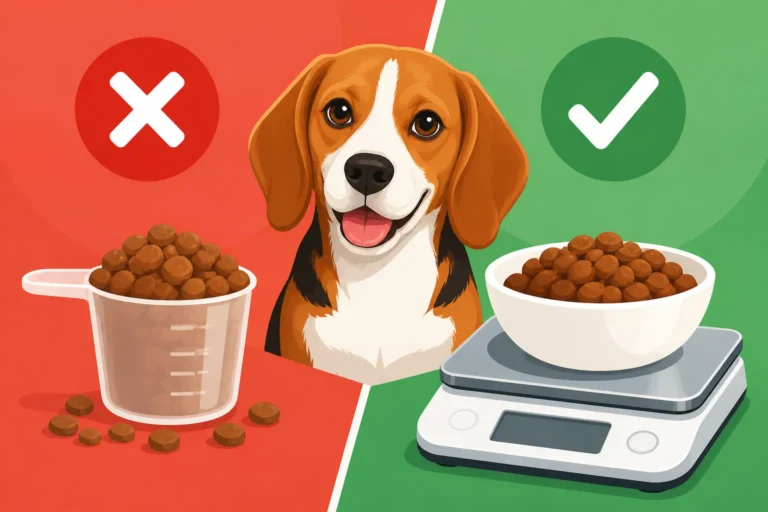
This is perhaps the single most impactful change you can make to improve feeding accuracy. Most dog food bags recommend feeding a certain number of "cups" per day. However, a "cup" can vary wildly depending on how tightly packed the kibble is, the shape of the measuring cup, and even the type of food. A standard 8-ounce measuring cup designed for cooking might not be the same volume as the scoop that came with your dog food, and even if it is, the density of different kibbles means a "cup" of one brand might weigh significantly more than a "cup" of another. This imprecision can lead to hundreds of extra, or fewer, calories over a week.
The solution is simple: measure by weight. Invest in an inexpensive kitchen scale (you can find many options on Amazon) and use it to weigh out your Beagle's daily portion in grams or ounces. Most dog food manufacturers provide feeding guidelines by weight on their packaging, or you can calculate it by knowing the calorie density (calories per cup/gram) of your specific food. For example, if your Beagle needs 700 calories a day and your food has 350 calories per cup, you'd feed two cups. But if that 'cup' actually weighs 100g, you'd then know to always feed 200g. This removes all guesswork and ensures consistency. Measuring Beagle Food Instead of Free Feeding is a game-changer for weight management.
Choosing the Right Food Type for Your Beagle
The market is flooded with dog food options, and navigating them can be overwhelming. From traditional kibble to wet food, fresh-cooked meals, and even raw diets, each has its pros and cons, and more importantly, different calorie densities. For a Beagle prone to overeating, a food that is lower in calories but still high in fiber can help them feel full without packing on pounds. Conversely, a very active Beagle might need a more calorie-dense food to meet their energy demands without consuming huge volumes.
When selecting a food, always consider its nutritional balance, appropriate protein and fat content for your Beagle's age and activity level, and its calorie count. Some brands, like Ollie, offer fresh food delivery services that portion meals specifically for your dog's needs, taking some of the guesswork out of the equation. If your Beagle has specific dietary sensitivities or allergies, working with your vet to select a novel protein or limited ingredient diet from a reliable source like Chewy can be beneficial. Remember, "premium" doesn't always mean "low calorie," so always check the nutritional analysis panel on the bag.
Monitoring Weight and Body Condition Score
The scale in your bathroom isn't just for you; it's a vital tool for your Beagle's health. Regular weight checks, ideally once a month, can help you catch weight fluctuations early before they become significant problems. However, the number on the scale doesn't tell the whole story, especially for a muscular breed like a Beagle. This is where the Body Condition Score (BCS) comes in.
The BCS is a visual and tactile assessment that helps you determine if your Beagle is at an ideal weight, too thin, or overweight. It’s usually scored on a 1 to 9 scale, with 5 being ideal. An ideal BCS means you can easily feel your Beagle's ribs with slight pressure (like feeling the knuckles on your hand), they have a visible waist when viewed from above, and an abdominal tuck when viewed from the side. If you can't easily feel their ribs, or they have no waist, it's a strong indicator they're overweight, even if the scale says they're within the "normal" range for their size. Learning to accurately Body Condition Scoring a Beagle Under a Thick Coat is a crucial skill for every Beagle owner.
| Beagle Variety | Ideal Weight Range (lbs) | Typical Daily Calorie Range (Moderate Activity) | Key Considerations |
|---|---|---|---|
| 13-inch Beagle | 18 – 22 | 550 – 750 kcal | Smaller frame, prone to overfeeding. Adjust carefully for activity. |
| 15-inch Beagle | 22 – 30 | 700 – 1000 kcal | Larger frame, still prone to obesity. Higher energy needs for active dogs. |
Note: These are general guidelines. Individual needs vary greatly based on age, activity, spay/neuter status, and health. Always consult your veterinarian.
The Risks of Imbalance: Overfeeding, Underfeeding, and Their Consequences
It might seem like a small thing, a few extra kibbles here, a couple of treats there, but the cumulative effect of an imbalanced diet can have profound and lasting consequences on your Beagle’s health and longevity. As responsible pet parents, understanding these risks isn't about fear-mongering; it's about making informed choices that contribute to a long, happy, and healthy life for our Beagles.
The Health Dangers of Beagle Obesity
Beagles are notorious for their love of food, which, coupled with their often-enthusiastic begging, makes them incredibly susceptible to obesity. And while a "chubby" Beagle might look cute, the reality is far from it. Obesity is a serious health condition that can significantly shorten a Beagle's Beagle Lifespan and the Twelve to Fifteen Year Range and drastically reduce their quality of life. It’s not just about looking heavy; it's about the internal damage it causes.
Excess weight puts immense strain on your Beagle’s joints, exacerbating or accelerating conditions like Beagle Hip Dysplasia and Everyday Joint Wear or Beagle Arthritis Arriving in Middle Age. It contributes to Beagle Disc Disease and That Slightly Long Back by adding pressure to their spine. Beyond musculoskeletal issues, obesity is a major risk factor for a host of other serious health problems, including Beagle Diabetes and Blood Sugar Control, heart disease, certain types of cancer, and reduced liver function. Overweight Beagles also struggle more in hot weather, have a harder time breathing, and are at higher risk during anesthesia for any necessary medical procedures. It's a vicious cycle where decreased mobility leads to less exercise, which in turn leads to more weight gain. Recognizing Why an Overweight Beagle Still Looks Normal can be tough, but it's crucial for prevention.
Recognizing Signs of Underfeeding and Nutritional Deficiencies
While obesity is the more common concern for Beagles, underfeeding and nutritional deficiencies are equally detrimental to their health, though often less discussed in the context of this food-driven breed. It’s certainly less common for a pet Beagle to be severely underfed in a loving home, but it can happen, especially if owners drastically cut calories in an attempt to manage weight without proper guidance, or if a dog has an underlying health issue affecting nutrient absorption.
A Beagle who isn't receiving enough calories or nutrients might exhibit several concerning signs. The most obvious is weight loss, often accompanied by a visible protrusion of ribs, hips, and spine. Their coat might appear dull and dry, losing its characteristic luster. You might notice a significant drop in energy levels, with your normally spirited Beagle becoming lethargic, withdrawn, or unwilling to play. Muscle wasting can also occur, particularly noticeable around the head and hindquarters. For a Beagle Vomiting After Eating Something Outside, or experiencing chronic diarrhea, nutrient absorption can be compromised, leading to deficiencies even if they're consuming adequate calories. If you suspect your Beagle is not thriving or is losing weight unexpectedly, it’s imperative to consult your veterinarian immediately to rule out any underlying medical conditions and adjust their diet appropriately.
Disclaimer
This article is for general informational purposes only and does not constitute professional advice. Laws, prices and regulations vary by location and change over time. Consult a qualified professional for guidance on your specific situation.