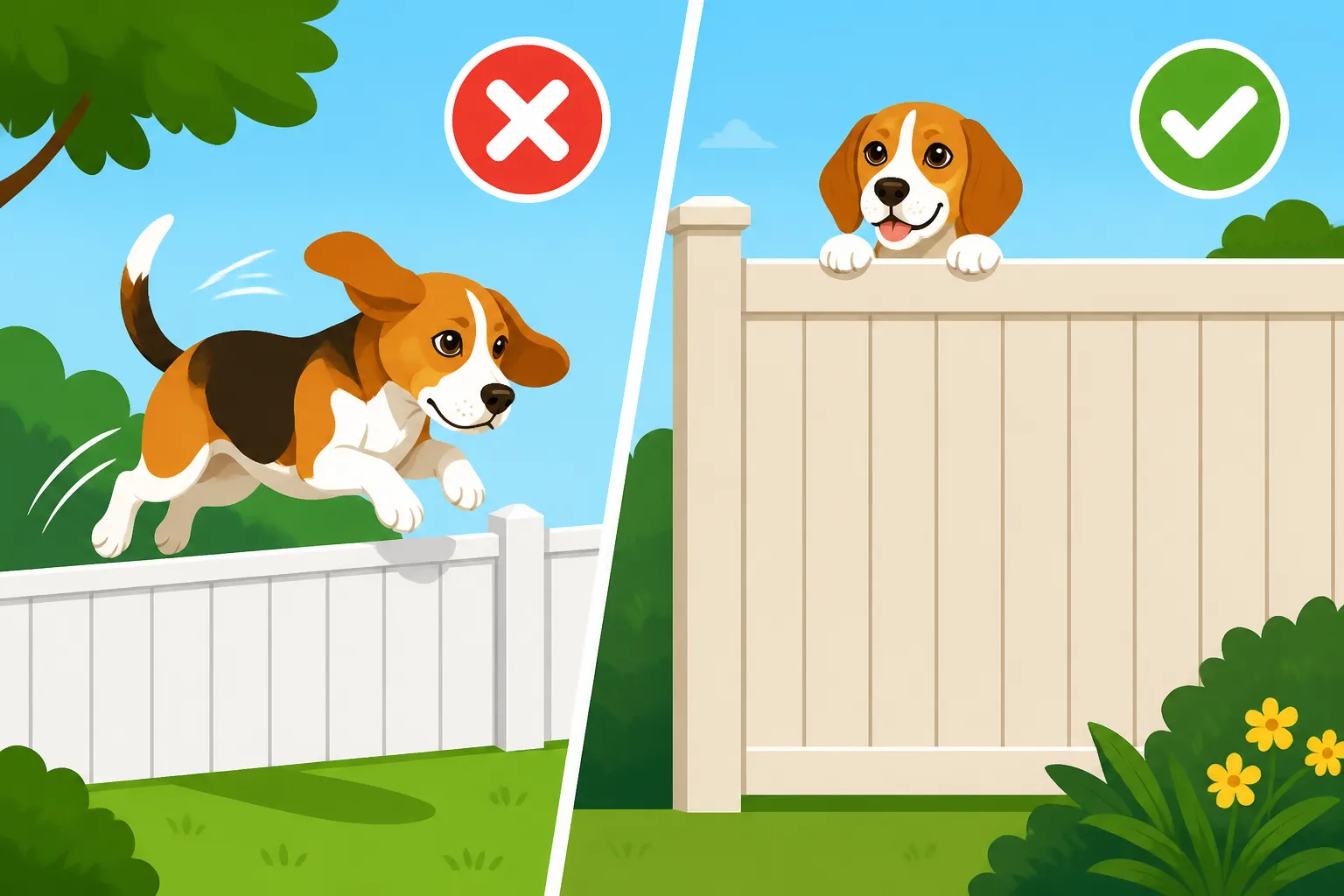
The Fence Height That Actually Holds a Beagle
If you've ever owned a Beagle, you know the heart-stopping moment of looking into your yard only to find it Beagle-less. It's a common, incredibly frustrating scenario. Despite what appears to be a perfectly adequate fence, your clever hound has once again vanished, nose to the ground, chasing an irresistible scent. This guide is here to help you understand the unique challenges Beagles pose to traditional fencing and how to build a perimeter that actually keeps your scent-driven escape artist safely at home.
The Unique Challenge of Containing a Beagle
Beagles weren't bred to sit politely in a perfectly manicured backyard. They were bred for the hunt, for following a scent trail with relentless determination. This deep-seated instinct means their brains are wired differently when it comes to fences. For many dogs, a fence is a clear boundary. For a Beagle, it's often just a temporary inconvenience, a puzzle to solve, or merely a suggestion to be ignored when the right scent hits their powerful nose. It's not stubbornness as much as it is pure, unadulterated instinct. Their incredible sense of smell, far superior to ours, can pull them away from even the most devoted owner.
Driven by an Irresistible Scent
Imagine being so utterly captivated by a smell that everything else—your name being called, the comfort of your home, even the promise of a treat—fades into the background. That's life for a Beagle on a scent trail. They possess approximately 220 million scent receptors, compared to our mere 5 million, and their olfactory bulb is significantly larger. This biological advantage means they literally experience the world through their nose, and a compelling scent can override learned behaviors in a heartbeat. You can read more about how their unique sensory world affects them in Training a Beagle Around 220 Million Scent Receptors.
This isn't about disrespect or a lack of love for you; it's about their heritage. They were bred for centuries to pursue game, often alone or in small packs, over vast distances. When a Beagle's nose locks onto something – a rabbit, a squirrel, or even the lingering scent of another dog – their instinct to follow that trail kicks in with an almost unstoppable force. A fence, to them, simply becomes an obstacle between them and the source of that captivating aroma. This intense focus makes them notoriously difficult to recall once they've caught a scent, and it fuels their determination to get past any barrier.
The Physical Prowess of a Determined Hound
Beyond their legendary noses, Beagles are surprisingly athletic and resourceful when it comes to escaping. They aren't massive dogs, but they are compact, muscular, and incredibly agile. Many owners underestimate their ability to jump, climb, and, perhaps most famously, dig. They are also incredibly persistent. A Beagle might spend hours testing a fence line, looking for the weakest point, a loose board, or a soft spot in the soil.
Their short, dense double coat, while great for weathering the elements during a hunt, can sometimes mask a surprisingly lean and strong body underneath. They can wedge themselves into surprisingly small spaces and squeeze through gaps you thought were impossible. What looks like a secure barrier to us can look like an open invitation to adventure for a highly motivated Beagle. We often hear stories of Beagles scaling chain-link fences or wriggling under gates, leaving their owners bewildered. It's this combination of powerful instinct and physical capability that makes "Beagle-proofing" a yard such a serious undertaking.
Recommended Fence Height for Beagles
When considering fence height for a Beagle, it's important to understand that standard recommendations for general dog breeds often fall short. What might deter a calmer, less scent-driven dog might barely slow down a determined Beagle. The goal isn't just to make it difficult; it's to make it impossible to jump or climb over, while also addressing digging.
Why Four Feet Often Isn't Enough
Many suburban homes come with a standard four-foot fence. For many medium-sized dogs, this height is perfectly adequate. However, for a Beagle, it can be an invitation to test their vertical limits. While Beagles aren't known for being champion jumpers like some sighthounds, their athleticism is often underestimated, especially when motivated by a captivating scent on the other side. A small, 13-inch Beagle might only stand a foot or so tall at the shoulder, but with a good running start and a strong push off, clearing a four-foot fence is entirely within the realm of possibility. I've heard countless stories from owners who were shocked to see their seemingly grounded Beagle suddenly launch itself over a fence that seemed tall enough.
Beyond jumping, a four-foot fence often presents easier climbing opportunities, especially if it's chain-link or has horizontal slats that offer paw holds. A desperate Beagle can "scramble" its way up and over surprisingly quickly. It’s important to acknowledge that your Beagle isn't doing this to spite you; they're simply responding to an instinctual drive that is far stronger than any obedience training in that moment. Relying solely on a four-foot fence for a Beagle is, unfortunately, often a recipe for anxiety and repeated escape attempts.
Aiming for Five to Six Feet
For true peace of mind, a fence height of five to six feet is generally recommended for Beagles. This height significantly reduces their ability to jump over and makes climbing far more challenging. A six-foot fence, in particular, often means that even if a Beagle does manage to get a foothold and try to climb, the sheer height and lack of a stable top edge will deter most attempts. It creates a much stronger psychological barrier, in addition to the physical one.
If you have a very small 13-inch Beagle, five feet might be sufficient, but for the larger 15-inch variety, or if your Beagle is particularly athletic and driven, leaning towards six feet is a much safer bet. This extra height buys you a crucial margin of safety. Remember, when a Beagle is in pursuit of a scent, their adrenaline is pumping, and they can achieve feats of athleticism that might surprise you. This investment in a taller fence can prevent countless moments of panic and ensure your beloved companion stays safe within your property boundaries.
Fortifying the Fence Line: Beyond Just Height
A tall fence is a great start, but it's only one piece of the puzzle when it comes to Beagle containment. Their ingenuity means you need to think about every angle of escape: under, through, and over. A truly Beagle-proof fence requires fortification along the ground and careful attention to any weak points. You'll want to think like a Beagle, constantly scanning for opportunities.
Preventing the Dig-Out
Beagles are natural diggers. They'll dig to find critters, to unearth interesting smells, or simply out of boredom and an urge to explore. A fence that doesn't extend below ground is, for a Beagle, merely a suggestion. They will test the fence line, looking for soft spots or areas where they can get a good purchase with their paws. A particularly motivated Beagle can excavate a surprising amount of dirt in a short amount of time. To combat this, you need to extend your barrier beneath the surface.
There are several effective ways to do this. One common method is to bury L-footings along the entire fence line. This involves attaching a section of wire mesh (like hardware cloth or a sturdy welded wire) horizontally to the bottom of your fence, extending it at least 18-24 inches into your yard, and burying it. When your Beagle tries to dig near the fence, they'll quickly encounter this buried barrier, which discourages them from continuing. Another option is to bury a section of chain link or sturdy wire mesh vertically, 12-18 inches deep, directly beneath the fence itself. This creates a solid underground wall. You can find many of the necessary supplies, from wire mesh to secure latches, at online retailers like Chewy, making it easier to gather what you need for this project.
Addressing the Climb-Over
While often underestimated, Beagles can be surprisingly good climbers, especially if the fence material offers paw holds. Chain-link fences are notorious for this, providing a ladder-like structure that some Beagles can scale with ease. Wooden fences with horizontal slats can also be a problem. Even a solid privacy fence might have ledges or nearby objects that offer a boost. To prevent climbing, you need to make the top of the fence inhospitable.
Roller bars or coyote rollers can be installed along the very top of the fence. These are essentially smooth, cylindrical pipes that spin freely, preventing a Beagle from getting a stable grip to pull themselves over. If they try to climb, their paws will slip, and they won't be able to get leverage. For solid fences, ensuring there are no convenient footholds is key. Trim any nearby bushes or trees that could offer a step-up or a branch to jump from. The goal is to create a slick, unstable surface at the top that offers no purchase for their determined paws.
Securing Gates and Weak Points
Even the most robust fence is only as strong as its weakest link, and more often than not, that weak link is the gate. Beagles are notoriously good at spotting and exploiting gaps, loose latches, or areas where the gate doesn't quite meet the fence line. A gate that sags, even slightly, can create a space wide enough for a determined Beagle to wriggle through. And a simple gravity latch? That's child's play for a Beagle with a few hours to figure it out.
You need to install double-latching mechanisms on all gates. A good quality, secure gate latch at the normal height, combined with a barrel bolt or slide lock installed either higher up or lower down, provides redundancy. Ensure both latches are secure and cannot be wiggled open. Furthermore, pay close attention to the bottom of the gate. Is there a gap between the gate and the ground? Just like with the fence line, a Beagle will exploit this to dig under. Consider adding a "sweep" or a flexible barrier along the bottom edge of the gate that extends to the ground, preventing digging. Regularly inspect your gate hinges, latches, and the surrounding fence for any signs of wear, sagging, or newly created gaps. Even a small crack in the concrete or a loose post can be the starting point for a Beagle's next grand adventure. For more on gate security, check out Gate Latches That Actually Hold a Beagle.
Layered Security: A Comprehensive Approach
A truly Beagle-proof yard isn't just about a single, impenetrable barrier. It's about a layered approach that combines physical security with smart technology, consistent training, and ample mental and physical enrichment. You're essentially creating multiple lines of defense, so if one fails, another is there to back it up.
GPS Trackers and Identification
Even with the most meticulously built fence, there's always a tiny chance your clever Beagle might find a way out. This is where modern technology can offer immense peace of mind. Investing in a high-quality GPS tracking collar is a game-changer for Beagle owners. These collars allow you to monitor your dog's location in real-time via a smartphone app, providing invaluable seconds or minutes to retrieve them before they get too far or into danger. While they shouldn't be relied upon as your primary containment method, they are an essential backup. You can compare options and prices for these helpful devices in Beagle GPS Tracking Collar Prices.
Beyond GPS, ensuring your Beagle has proper identification is crucial. A microchip is a permanent form of ID that greatly increases the chances of your dog being reunited with you if they're found and scanned by a vet or shelter. Always make sure your contact information associated with the microchip is current. Additionally, a sturdy collar with up-to-date ID tags that include your phone number is a simple yet effective first line of defense if your Beagle is found by a good Samaritan. You can learn more about how crucial these simple measures are in Beagle Microchips and Getting a Lost Dog Back.
Training, Enrichment, and Exercise
A tired Beagle is a good Beagle, and a mentally stimulated Beagle is a less mischievous Beagle. Many escape attempts stem from boredom, excess energy, or separation anxiety. While a fence is physical, addressing the underlying behavioral motivations for escape is just as important. Daily, structured exercise that goes beyond a simple potty break is essential. Scent walks, where your Beagle is allowed to follow their nose on a long line in a safe area, can be incredibly tiring and satisfying for them. You can find more information on appropriate leash lengths in The Long Line Length a Beagle Actually Needs.
Mental enrichment is also key. Puzzle toys, snuffle mats, and engaging chew toys can keep their minds busy and reduce the urge to "make their own fun" by trying to escape. Training sessions, even short ones, using high-value treats from brands like Ollie can build a stronger bond and reinforce positive behaviors. A Beagle that feels secure, loved, and adequately stimulated is less likely to feel the need to roam. If your Beagle's howling indicates potential separation anxiety when you leave, addressing this can also help mitigate escape attempts, as discussed in Beagle Howling, Baying and Barking Explained.
Why Invisible Fences Fall Short for Beagles
Many owners consider "invisible" or electronic fences as a solution, drawn by their lower cost and aesthetic appeal. However, for a Beagle, these systems are almost universally ineffective. An invisible fence works by delivering a static correction (a shock) when a dog crosses an underground wire. The problem is twofold for a Beagle. First, their drive to follow a scent is so incredibly powerful that many Beagles will simply "run through" the static correction, enduring the momentary discomfort to get to the irresistible smell on the other side. Once they've crossed, they often learn that coming back means another shock, which can lead to them staying outside the boundary, confused and lost.
Second, invisible fences offer no physical barrier against external temptations or dangers. A loose dog, a passing child, or a wild animal can easily enter your yard, and your Beagle has no physical protection. For a breed so driven by scent and so prone to ignoring discomfort for the sake of a chase, an invisible fence is simply not a reliable or safe containment method. You can delve deeper into this topic in Why Invisible Fences Fail With a Beagle. The peace of mind that comes with a robust physical fence is truly unmatched for a Beagle owner.
Comparing Fence Types for Beagle Containment
Choosing the right type of fence material is crucial. Each material has its pros and cons when it comes to containing a determined Beagle, and some are much more effective than others.
| Fence Type | Pros | Cons | Beagle Suitability |
|---|---|---|---|
| Chain Link | Relatively affordable, durable, allows visibility. | Easy to climb, often only 4-5 feet high, can rust. | Low. Requires significant modification (taller height, anti-climb rollers, buried wire) to be effective for Beagles. |
| Wood Privacy | Aesthetically pleasing, offers privacy, can be built tall. | Can be expensive, requires maintenance, small gaps can appear, can offer footholds. | Medium to High. Needs to be at least 5-6 feet, sealed at the bottom, and regularly inspected for gaps. |
| Vinyl Privacy | Low maintenance, durable, no climbing footholds if solid. | Can be expensive, repairs can be costly, can crack in extreme weather. | High. Excellent choice if built tall (5-6 ft) and installed with a buried barrier. |
| Wrought Iron | Very durable, attractive, high visibility. | Expensive, can be climbed if vertical bars are too wide apart, might have gaps at the bottom. | Medium. Needs vertical bars close enough to prevent squeezing through, adequate height, and a buried barrier. |
| Electric/Wire | Very low cost, easy to install. | No physical barrier, correction can be ignored by Beagles, dangerous for wildlife. | Very Low. Not recommended as a primary containment for Beagles due to their high scent drive. |
When making your choice, remember that the initial cost of a truly secure fence is an investment in your Beagle's safety and your own peace of mind. While a wooden or vinyl privacy fence built to at least 5-6 feet with a robust buried barrier might cost more upfront than a basic chain-link, it will save you countless headaches, worries, and potential vet bills from escape-related injuries. If you're concerned about unexpected vet costs from an adventurous Beagle, looking into pet insurance providers like Healthy Paws might be a good idea, as they can help cover a significant portion of emergency care.
Ultimately, containing a Beagle isn't about outsmarting them; it's about understanding their innate drives and designing an environment that works with those drives rather than against them. A secure fence allows your Beagle to enjoy the freedom of their yard without you constantly worrying about them disappearing over the horizon, nose to the ground.
Disclaimer
This article is for general informational purposes only and does not constitute professional advice. Laws, prices and regulations vary by location and change over time. Consult a qualified professional for guidance on your specific situation.