Hiking With a Beagle on a Long Line
Ah, the joy of hitting the trails with your beloved Beagle! It sounds idyllic, doesn't it? Crisp air, rustling leaves, the happy thump of a tail… until your Beagle catches a whiff of a rabbit that passed through three hours ago and transforms into a furry, unstoppable torpedo, dragging you headfirst into a thorny bush. If this scenario sounds painfully familiar, you're in the right place. This guide is all about embracing your Beagle's incredible nose while keeping everyone safe and happy on your adventures, specifically by mastering the art of hiking with a long line.
Understanding the Beagle's Scent-Driven Nature on the Trail
Let's be real: your Beagle isn't trying to be difficult when they glue their nose to the ground and seem to forget you exist. They're just doing what they were bred to do, and frankly, what they excel at! Understanding this fundamental aspect of their being is the first step to successful hiking.
Why a Standard Leash Just Doesn't Cut It for Hiking
A standard 4-foot or 6-foot leash is fantastic for a polite stroll around the block, navigating city sidewalks, or teaching basic obedience in a controlled environment. But when you step onto a nature trail, it quickly becomes a hindrance for a Beagle. Imagine trying to read a fascinating book, but someone keeps pulling it away from you every few seconds. That's what a short leash feels like to a Beagle whose entire world revolves around scent.
Their olfactory bulb is significantly larger than many other breeds, and they boast an astounding The 220 Million Receptors Behind a Beagle's Nose. This isn't just a fun fact; it means they perceive their surroundings primarily through smell. Every rustle of leaves, every patch of damp earth, every distant deer track tells a rich, compelling story that we humans can only guess at. When you keep them on a tight, short leash on a trail, you're preventing them from engaging with their world in the most natural and fulfilling way. This often leads to frustration, constant pulling, and a less enjoyable experience for both of you. They're trying to investigate, to follow the narrative, and you're inadvertently shutting down their primary sense. This can also lead to pent-up energy, making them harder to manage later.
The Allure of the Wild for a Beagle's Nose
The wild is a Beagle's wonderland. Every branch, every rock, every blade of grass holds a symphony of scents. From the faint lingering odor of a squirrel that dashed up a tree minutes ago to the distinct musk of a deer that passed through last night, these are all irresistible invitations for a Beagle to explore. It's not just about chasing prey; it's about the sheer joy of unraveling a complex tapestry of information. A Beagle will instinctively follow a scent trail for miles, completely oblivious to your calls, the direction you were headed, or even the delicious treat you're offering. This is why the common wisdom is Why a Beagle Should Never Be Off Leash Unfenced.
On a trail, your Beagle isn't being "stubborn" or "disobedient." They are being a Beagle. Their powerful instincts kick in, and the urge to investigate that tantalizing scent becomes paramount. This intense focus, while admirable in a hunting dog, can be a serious safety concern in a recreational hiking environment. A long line allows them to delve into these scent mysteries more deeply and naturally, fulfilling their innate drive, while still keeping them safely connected to you and preventing them from disappearing over the next ridge in pursuit of a phantom rabbit. It’s a compromise that respects their nature while maintaining your control.
Choosing and Using the Right Long Line
Once you understand why a long line is essential, the next step is to select the right one and learn how to handle it effectively. This isn't just about length; material, comfort, and technique all play a crucial role in making your hike enjoyable and safe.
Selecting the Ideal Length and Material
Long lines come in a variety of lengths and materials, and the best choice often depends on your specific hiking environment and your Beagle's temperament. Common lengths range from 15 feet to a whopping 50 feet.
- 15-20 feet: Great for trails where you need a bit more freedom than a standard leash but still want to keep your Beagle relatively close, perhaps due to narrow paths, other hikers, or dense undergrowth. It offers a good balance of freedom and manageability.
- 30 feet: A fantastic all-around choice for many hiking trails, offering a significant increase in sniffing range while still being somewhat manageable in terms of tangles. This length allows your Beagle to explore a wider radius, delve into brush, and feel like they're truly off-leash without the actual risks.
- 50 feet: Ideal for wide-open spaces, beaches, or very quiet trails where your Beagle can really stretch their legs and explore. This length requires more careful handling to avoid tangles and ensure you can reel them in quickly if needed. It can be cumbersome in heavily wooded areas.
When it comes to materials, you'll typically find nylon/webbing or biothane options.
| Feature | Nylon/Webbing Long Line | Biothane Long Line |
|---|---|---|
| Material | Woven nylon or polyester webbing | PVC-coated webbing |
| Feel | Soft, flexible, can absorb water and odor | Smooth, flexible, slightly "rubbery" feel |
| Grip | Good, but can cause rope burn if pulled fast | Excellent, even when wet or muddy |
| Weight | Lighter when dry, heavier when wet | Consistent weight, slightly heavier than dry nylon |
| Durability | Strong, but can fray, snag, or degrade with sun exposure | Extremely durable, resistant to wear, rot, UV |
| Water/Mud | Absorbs water, gets heavy, holds mud, can smell | Waterproof, easy to clean, doesn't absorb liquids or odors |
| Cleaning | Needs thorough washing, can take time to dry | Wipes clean with a damp cloth or rinse |
| Visibility | Various colors, some reflective options | Often brightly colored for high visibility |
| Cost | Generally more affordable upfront | Usually a higher initial investment, but long-lasting |
| Best Use | Drier conditions, less messy trails, budget-conscious | Wet, muddy, or rugged terrain, beach, all-weather |
For most hiking situations, especially if you anticipate mud or water, a biothane line is a superior choice. It's incredibly durable, easy to clean, and won't get waterlogged. You can find excellent options from pet supply retailers like Chewy or general online marketplaces like Amazon. Look for a line that's about 1/2 inch to 3/4 inch wide – wide enough to be strong but not so bulky that it's difficult to manage.
Attaching the Long Line Safely and Comfortably
This is a critical point that often gets overlooked. Never, ever attach a long line directly to your Beagle's collar. A sudden lunge at the end of a 20-foot line can cause severe neck injury, tracheal damage, or even slip a disc in their neck. Beagles are prone to Beagle Disc Disease and That Slightly Long Back, so protecting their spine is paramount.
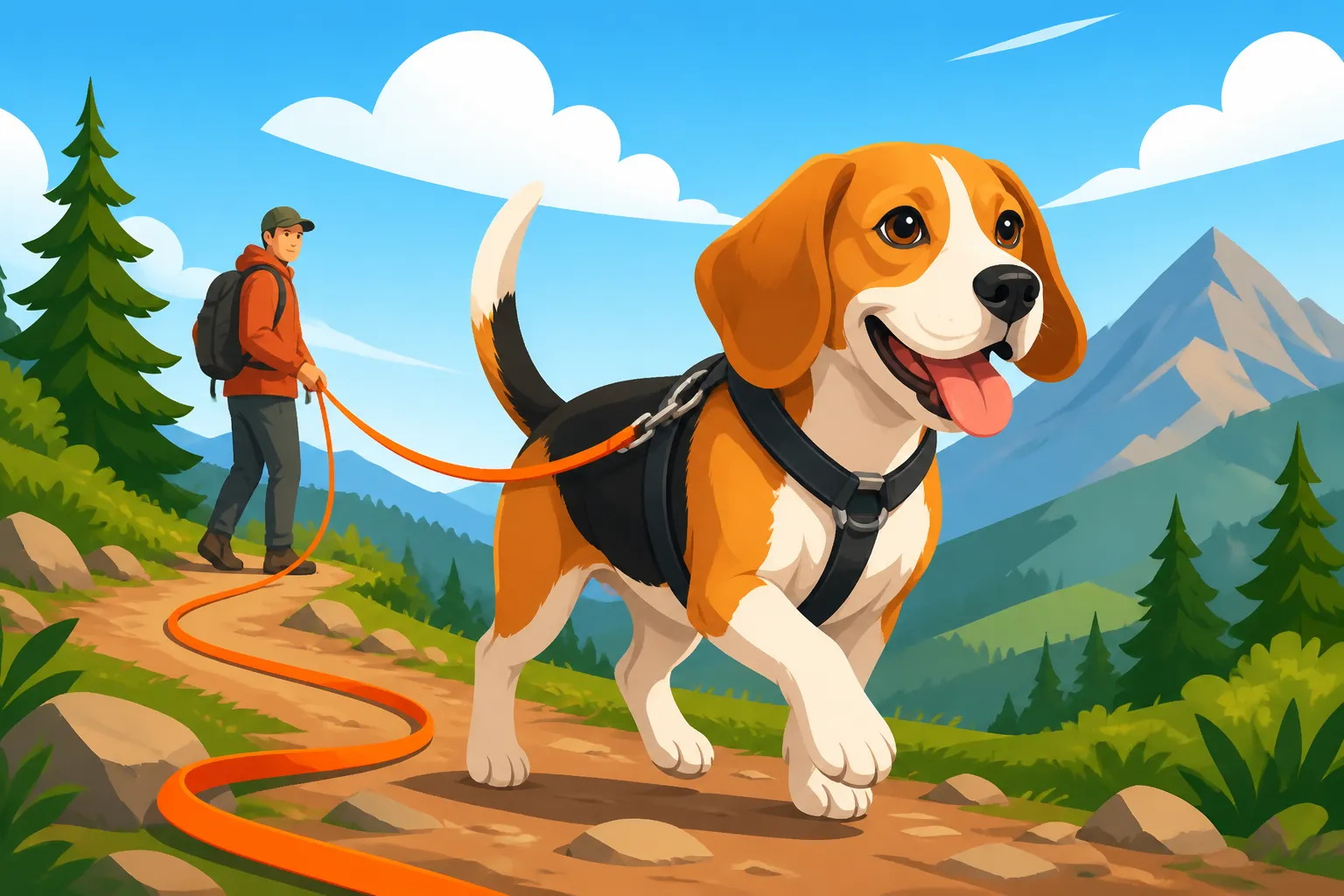
Instead, always use a well-fitting harness. Specifically, a front-clip harness is highly recommended for Beagles, especially those prone to pulling. A front-clip harness, where the leash attaches to a ring on the dog's chest, redirects their forward momentum when they pull, gently turning them to the side. This makes it much harder for them to put their full weight into a pull and offers better control without causing pain. It also distributes pressure across their chest and shoulders rather than their delicate neck. Look for harnesses with sturdy D-rings and buckles, and make sure it fits snugly but doesn't chafe. You should be able to comfortably slip two fingers under the straps. Brands like Blue-9 Balance Harness, Freedom No-Pull Harness, or Ruffwear offer good options that distribute pressure effectively. This simple choice drastically improves safety and comfort for your Beagle, and your arm!
Handling Techniques for a Long Line on Uneven Terrain
Handling a long line isn't quite like walking a dog on a short leash. It requires a bit of finesse and awareness of your surroundings.
- The "Figure-Eight" or "Accordion" Hold: Instead of letting the entire length of the line drag behind you, which leads to tangles and trips, learn to manage the slack. Hold one loop of the line in your dominant hand, and then gather the rest of the line into neat loops in your other hand, letting it out or taking it in as needed. Think of it like a coiled rope or an accordion. This prevents the line from snagging on branches or wrapping around your legs.
- Constant Awareness: Keep an eye on your Beagle and the terrain simultaneously. Anticipate their movements. If they're heading towards a dense thicket, start shortening the line. If you see another hiker or dog approaching, reel them in quickly.
- Preventing Rope Burn: If your Beagle suddenly bolts, do not let the line run through your bare hands. Always wear gloves, or hold the line securely but with enough slack to allow a controlled slip if necessary, rather than digging in your heels and risking injury to yourself. Many long lines have a loop at the end – you can step on this loop for added braking power if your Beagle makes a sudden lunge.
- "Line Management" Command: Teach your Beagle a cue, like "line up" or "come close," which means they need to come closer to you so you can shorten the line without a tug-of-war. Reward them generously when they respond.
- Environmental Awareness: Be mindful of trees, bushes, and rocks. A long line can get tangled surprisingly quickly. Try to steer your Beagle around obstacles, or walk around the obstacle yourself to untangle the line rather than letting it get wrapped tightly. This proactive approach saves a lot of frustration.
Training Your Beagle for Long Line Hiking Success
Having the right equipment is only half the battle. Training your Beagle to respect the long line and respond to your cues is what truly makes long line hiking a joyful experience for both of you. This involves patience, consistency, and a deep understanding of what motivates your Beagle.
Building Foundation Skills in a Controlled Environment
Before you head to a bustling nature preserve, it’s crucial to establish basic long line manners in a less distracting setting. Your backyard, a quiet park during off-peak hours, or an empty sports field are ideal starting points. The goal here is to teach your Beagle that even with more freedom, they still need to pay attention to you.
Start with simple recall. Let your Beagle sniff around on the long line, giving them enough slack to feel some independence. Then, with an excited voice, call their name and your chosen recall cue (e.g., "Max, Come!"). As they turn towards you, gently reel in the line while praising them enthusiastically. When they reach you, reward them with a high-value treat and lots of affection. Repeat this many, many times. Don't call them when they're fully absorbed in a scent at first; set them up for success by calling them when they're mildly distracted. As they get better, gradually increase the level of distraction. You're building reliable Beagle Recall That Works Before the Nose Wins even with the added freedom.
Another key skill is getting them used to the feel of the long line. Let them drag it around in a safe, fenced area (under supervision, never unsupervised!) so they learn it's just a part of them. They'll inevitably step on it, get tangled, and learn how to untangle themselves. This reduces panic if it happens on a trail.
Teaching "Check In" and "Leave It" on the Line
These two commands are absolute lifesavers on the trail.
- "Check In": Beagles are naturally independent scent hounds. "Check In" teaches them to periodically look back at you, even when exploring. Start by rewarding them whenever they voluntarily glance your way. Toss a treat near you or use a marker word ("Yes!") when they look at you. Once they're doing this reliably, start pairing it with a verbal cue like "Check in!" or "Look!" When hiking, occasionally call "Check in!" and when they turn their head or come a few steps closer, reward them lavishly. This builds a habit of keeping you in mind, even when their nose is busy. This constant engagement makes them feel like you're part of their pack, rather than just a tether.
- "Leave It": This command is non-negotiable for a Beagle, whose strong food drive means they’ll happily scavenge anything they find. From questionable fungi to leftover sandwich crusts, a Beagle’s mouth is a vacuum cleaner. To teach "Leave It," start indoors. Place a low-value treat on the floor, cover it with your hand, and say "Leave It." The moment your Beagle looks away from the treat (even for a split second), mark the behavior and reward them with a different, higher-value treat from your other hand. Gradually increase the temptation and duration. Once they're solid indoors, practice outside with various tempting items (leaves, sticks, safe edibles). On the trail, if you see them heading for something undesirable, use your "Leave It" cue and be ready to gently reel them in with the long line if they hesitate. The long line gives you the physical backup to enforce the command. High-value training treats are essential here – something truly enticing, perhaps a freeze-dried meat treat or a soft, smelly treat from a brand like Ollie. Remember, The Treats a Beagle Will Work Hardest For are often the stinky ones!
Managing Sniffing Versus Moving Forward
The entire point of a long line for a Beagle is to let them sniff. Don't fight it! However, you also want to actually hike and make progress. The trick is finding a balance.
- Designated Sniffing Time: Allow periods where your Beagle can just bury their nose and explore freely on the line. These "sniffing walks" are incredibly enriching and mentally tiring for them, just as much as physical exercise. You'll often find that Why a Scent Walk Tires a Beagle Faster Than Running.
- "Let's Go!" or "Hike!": Teach a command that means "time to move." When you give this cue, gently encourage them forward with the line. As they start moving, reward them. You want them to understand that sometimes we sniff, and sometimes we move. Don't expect them to move at a brisk human pace the whole time.
- Use the Line as a Gentle Guide: The long line isn't just for stopping them; it's for guiding them. A gentle, consistent tension, followed by release when they move in the right direction, is more effective than sudden jerks. If they're fixated on a scent and ignoring you, use the line to calmly walk past the scent, then reward them once they're moving with you.
- Vary Your Pace: Don't expect a steady pace. Embrace the "stop and sniff, then walk" rhythm. This is their hike as much as it is yours.
Safety and Trail Etiquette with a Long Line
Hiking with a long line is a fantastic way to give your Beagle freedom, but it comes with a responsibility to keep them, yourself, and others safe. Good trail etiquette ensures everyone can enjoy the outdoors.
Navigating Busy Trails and Wildlife Encounters
Even on a long line, your Beagle is still connected to you. This connection is your lifeline in unpredictable situations.
- Approaching Other Hikers and Dogs: This is where proactive management is key. As soon as you see another person or dog approaching, reel your Beagle in. Shorten the long line to a standard leash length (4-6 feet) and keep them close to your side. Step off the trail if possible to allow others to pass with ample room. A simple "Hello! We're just giving our hound some room" can go a long way in setting expectations. If your Beagle tends to be vocal or over-enthusiastic, a quick "He's friendly, but still learning his manners!" helps.
- Wildlife Sightings: A Beagle on a scent is one thing; a Beagle that sees a deer, rabbit, or squirrel is another entirely. Their prey drive can kick in instantaneously. If you spot wildlife before your Beagle does, quietly shorten the line and move them away from the area. If they do spot something and lunge, brace yourself, use your "Leave It" command, and hold firm. The harness will protect their neck, but the long line needs to be handled carefully to prevent rope burn. It's better to manage the situation preventatively than reactively. Always be aware of your surroundings, scanning ahead for potential triggers. Remember, you're hiking with a dog bred for hunting; their instincts are strong.
- Uneven Terrain and Obstacles: Be mindful of where the line is. Don't let it become a trip hazard for yourself or others. If the trail is narrow, rocky, or has steep drop-offs, shorten the line significantly to maintain tighter control. When traversing streams or crossing logs, keep your Beagle close and guide them carefully.
Being a Responsible Long Line Hiker
Being a responsible dog owner on the trail means adhering to some basic principles, whether you're using a long line or a short leash.
- Know and Obey Leash Laws: Even a long line is still considered a leash in most jurisdictions. Always check the specific regulations for the park or trail you're visiting. Some areas may have strict leash length limits, or prohibit long lines in certain crowded sections. Respecting these rules is paramount to ensuring trails remain open to dogs. Ignorance is rarely an excuse, and fines can be steep.
- Pack It In, Pack It Out: This goes without saying, but always carry plenty of poop bags and use them. Scoop your Beagle's waste and carry it out with you. Leaving bags on the side of the trail is not okay. This is a fundamental rule of trail etiquette and helps keep our natural spaces clean and accessible for everyone.
- Respect Nature and Wildlife: A long line gives your Beagle more freedom, but it doesn't give them carte blanche to harass wildlife or trample sensitive plants. Guide them away from bird nests, delicate flora, or areas where ground-nesting animals might be present. Teach your Beagle that while sniffing is good, directly approaching or bothering wildlife is not. Your role is to mediate their interactions with the natural world.
- Maintain Control: The primary purpose of the long line is control. If you find your Beagle consistently dragging you, ignoring commands, or becoming a nuisance to others, it means more training is needed in a less distracting environment, or a shorter long line is required for that specific trail. The goal is enjoyment, not chaos.
- Identification: Ensure your Beagle always wears a collar with up-to-date ID tags, and ideally, is microchipped. While the long line provides an extra layer of security, accidents can happen. Tags and chips drastically increase the chances of a reunion if they somehow slip their harness or the line breaks. Beagle Microchips and Getting a Lost Dog Back is a topic every Beagle owner should be familiar with.
Hiking with your Beagle on a long line can be a truly rewarding experience, allowing them to engage their incredible senses and enjoy the freedom of the outdoors, all while keeping them safe. It takes practice, the right gear, and an understanding of their unique Beagle nature, but the happy tail wags and tired snoozes after a fulfilling trail adventure make it all worthwhile.
Disclaimer
This article is for general informational purposes only and does not constitute professional advice. Laws, prices and regulations vary by location and change over time. Consult a qualified professional for guidance on your specific situation.