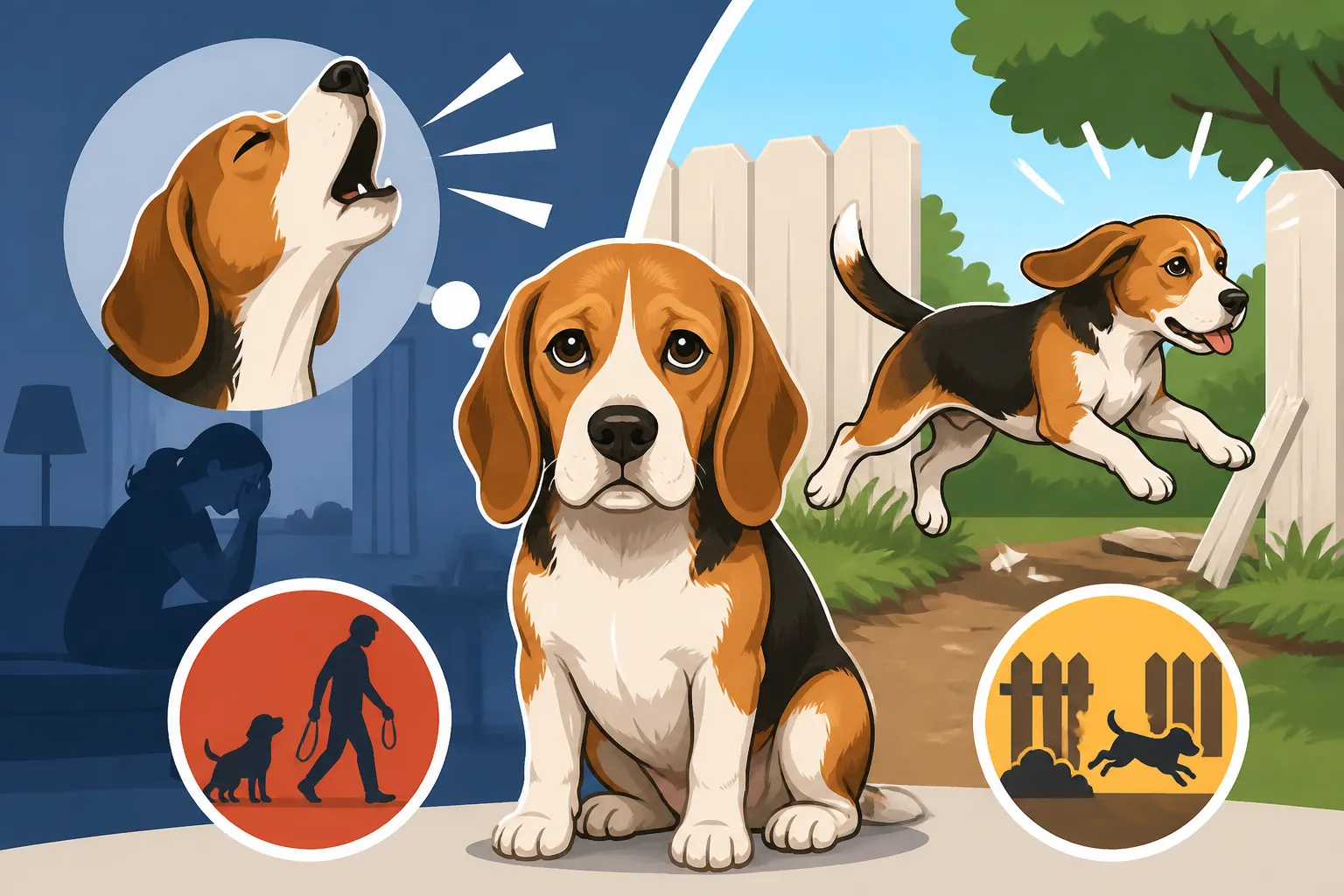
Why Beagles Get Surrendered for Howling and Escaping
It’s a heartbreaking reality that many Beagle owners face: despite their sweet faces and loving nature, Beagles are one of the most frequently surrendered breeds to shelters and rescues. Often, the reason boils down to two core behaviors – their undeniable talent for howling and their uncanny ability to escape. If you're struggling with these very issues, feeling overwhelmed and maybe even a little guilty, know that you're not alone. This guide aims to shed light on why Beagles exhibit these behaviors and, more importantly, what you can do to manage them, helping you understand your vocal, wanderlust-driven companion better.
The Inherent Nature of a Beagle's Voice: Howling and Baying
Let’s be honest, that soulful Beagle bay is part of their charm, right? But what happens when that charm turns into a persistent, piercing howl that echoes through the neighborhood? Many owners find themselves unprepared for the sheer volume and frequency of a Beagle’s vocalizations, leading to frustration and, sadly, surrender. It’s crucial to understand that their voice isn't a flaw; it's a fundamental part of who they are, bred into their very being for centuries.
A Legacy of Communication
Beagles were originally bred as pack hounds, specifically for hunting hares and rabbits. In a dense forest or across open fields, these dogs needed a way to communicate effectively with their fellow hounds and with the human hunters following on foot. Their unique, resonant vocalizations—the bay—served precisely this purpose. It wasn't just a random bark; it was a specific, deliberate signal to announce "I've found the scent!" or "The chase is on!" Imagine a whole pack of Beagles, all singing out in unison – it's an incredible sound in its intended environment, but in a quiet suburban home, it can be… a lot.
The distinction between a bark, a howl, and a bay is important. A bark is typically sharper, shorter, and often used for immediate alerts or greetings. A howl is usually a sustained, mournful sound, often associated with loneliness or response to certain high-pitched noises. Then there's the bay, which is a deep, drawn-out cry that usually happens when a Beagle is intensely focused on a scent or highly excited. It's a primal sound, designed to carry. You can learn more about these different sounds and their meanings in our article, Beagle Howling, Baying and Barking Explained. Understanding this ancestral imperative helps us realize that asking a Beagle not to use its voice is like asking a bird not to sing; it goes against their very nature.
Common Triggers for Vocalization
So, what sets off that impressive vocal range in a modern pet Beagle? Often, it’s a combination of instinct, environment, and emotional state.
One of the biggest culprits is separation anxiety. Beagles are pack animals through and through. They thrive on companionship and can become genuinely distressed when left alone. This distress often manifests as persistent howling, baying, and barking, especially when you first leave or throughout the duration of your absence. It's not about being "naughty"; it's a genuine expression of their discomfort and loneliness. Our deep dive into Beagle Separation Anxiety in a Pack Breed offers more insight into this challenging behavior.
Beyond loneliness, Beagles are highly responsive to their environment. Sirens, distant dog barks, neighborhood children playing, the mail carrier, or even a leaf blowing past the window can trigger a vocal response. Their keen senses, particularly their hearing, mean they pick up on sounds we might miss, and their instinct is to alert the "pack" (you) to anything unusual. Even music or television can set them off if it contains certain frequencies or sounds that mimic their prey or other dogs.
Finally, sheer boredom or lack of mental and physical stimulation can turn a quiet Beagle into a noisy one. A bored Beagle is a destructive Beagle, but it's often also a vocal Beagle. If they're not getting enough exercise or engaging scent work, they'll find other outlets for their energy, and often that outlet is their voice. They might pace, whine, and eventually begin to howl out of sheer frustration or an attempt to get attention.
Managing the Volume, Not Eradicating the Voice
Since you can't truly train the "bay" out of a Beagle, the goal is realistic management and understanding. It's about finding ways to reduce excessive vocalization to a manageable level, not eliminating it entirely.
Start with understanding the triggers. Keeping a diary of when and why your Beagle is vocalizing can provide invaluable clues. Is it only when you leave? Is it specific sounds outside? Once you identify the patterns, you can begin to address them. For separation anxiety, a multi-faceted approach is often needed, including gradual desensitization to your departure cues, providing high-value enrichment items only when you leave, and sometimes even medication prescribed by a vet. For external sounds, environmental management like white noise machines, calming music, or even closing curtains to reduce visual stimuli can help. Some owners have even explored minor soundproofing for rooms where their Beagle spends time, especially if they live in close quarters.
Training can also play a vital role. Teaching a "quiet" cue on command is possible, but it takes consistency and patience. The idea is to reward them for being quiet after they've vocalized and you've given the command, not to punish the vocalization itself. Positive reinforcement with high-value treats (perhaps even some of the delicious, human-grade options from brands like Ollie that dogs go crazy for) can be incredibly effective. Enrichment is also key: a tired Beagle is a quieter Beagle. Daily sniff walks, where they can fully engage their nose, are far more tiring and satisfying than a simple walk around the block. Puzzle feeders and scent games can provide much-needed mental stimulation indoors.
The Master Escape Artists: Why Beagles Bolt
Beyond the noise, the other major reason Beagles end up in shelters is their incredible talent for escape. A Beagle with a mission, driven by an irresistible scent, can overcome obstacles that would baffle other breeds. It’s not defiance; it’s instinct, pure and simple.
The Call of the Scent
A Beagle's nose is legendary. With around 220 million scent receptors, compared to our mere 5-6 million, their world is primarily one of scent. This extraordinary olfactory ability means that when a Beagle catches a tantalizing scent – a rabbit trail, a discarded sandwich, or even just the lingering smell of a squirrel – it becomes singularly focused. Everything else, including your voice, suddenly fades into the background. This intense focus is why building Beagle Recall and Why Your Voice Stops Registering is such a monumental task.
When a Beagle's nose hits a "hot" trail, they enter a state of complete absorption. It's like an irresistible mental puzzle that they are compelled to solve. Their brain is processing a wealth of information from that scent, mapping out where the creature went, how recently, and what direction it's headed. In this moment, the need to follow that trail overrides almost everything else – fear of cars, awareness of boundaries, and even their bond with you. This profound drive is why a Beagle should never be off leash unfenced. They will follow a scent for miles, becoming completely disoriented to their surroundings.
Common Escape Routes and Methods
Beagles are not just driven by scent; they are also incredibly clever and determined. They study their environment and will exploit any weakness in your containment efforts.
- Digging Under Fences: This is a classic Beagle move. If they can't go over, they'll go under. A tantalizing smell on the other side of a fence is often enough motivation for them to start digging, sometimes with surprising speed and efficiency. They'll test fence lines, looking for loose soil, gaps, or weak spots.
- Bolting Through Doors and Gates: A door left ajar for even a second is an invitation for a Beagle. They are quick, opportunistic, and will launch themselves through any opening if there's a perceived opportunity for adventure (or a good smell) outside. The same goes for gates that aren't securely latched. They can often figure out simple gate mechanisms or push through ones that aren't fully secured.
- Climbing and Jumping: While not generally known as climbers like some terriers, a motivated Beagle can surprise you. They might scale low fences, especially if there's something to use as a stepping stone on the other side. Some Beagles can jump surprisingly high if incentivized by a chase or an interesting discovery. They are also adept at squeezing through small openings you might not even notice.
- Why Invisible Fences Fail with a Beagle: This is a critical point. While invisible fences might deter some dogs, they are notoriously ineffective for Beagles. The allure of a strong scent completely overrides the discomfort of the electric shock. A Beagle will blast right through the boundary, propelled by its nose, and once outside, there's no deterrent to bring them back. Plus, an invisible fence does nothing to protect your Beagle from external threats like cars or other animals. To truly understand effective containment, read our guide on Fencing a Yard That a Beagle Cannot Escape.
Prevention and Containment Strategies
Given their innate drives, preventing escapes requires vigilance and robust strategies. Relying on an open yard or an unsecured perimeter is simply not an option for a Beagle.
First and foremost, secure physical fencing is non-negotiable. For many Beagles, a minimum of a six-foot fence is recommended, ideally with a "dig skirt" or buried wire along the bottom to prevent tunneling. Regularly inspect your fence line for any weaknesses, loose boards, or spots where your Beagle has started to dig. Double gates and secure latches are also essential. Remember, if there's a will, there's often a way for a determined Beagle.
Door and gate training is also crucial. Teach your Beagle to "wait" at every doorway or gate until released. This simple cue can prevent countless escapes. Always supervise your Beagle when outside, even in a fenced yard, as they can be surprisingly quick. Long lines, like the type you can find readily on Chewy or other pet supply retailers, are excellent tools for giving your Beagle more freedom in an open space while still maintaining control. Our article on The Long Line Length a Beagle Actually Needs can offer practical advice.
Finally, consider a GPS tracking collar. While not a substitute for physical containment, a reliable GPS collar can be a lifesaver if your Beagle does manage to escape. Brands like Fi or Tractive offer these devices, providing peace of mind and significantly increasing the chances of recovery. This is not about letting them run loose; it's an essential backup plan for a breed predisposed to wandering. If an escape does happen, knowing What to Do the Moment a Beagle Gets Loose can make all the difference.
The Heartbreaking Reality: Why Owners Surrender
It's easy to label a Beagle as "stubborn" or "difficult" when they're baying at the mailman for the tenth time or digging a tunnel under the fence. However, these behaviors are deeply rooted in their history and biology. The reality of surrender often stems from a fundamental mismatch between owner expectations and the Beagle's inherent nature, leading to inevitable frustration.
Unmet Expectations and Lifestyle Mismatches
Many people are drawn to Beagles for their adorable looks, friendly demeanor, and manageable size. What they often don't realize is the immense energy, vocal nature, and powerful scent drive that comes with the package. They might envision a quiet, easily trainable companion, only to find themselves with a dog whose nose dictates its world and whose voice can carry for blocks.
A common scenario involves owners who acquire a Beagle, perhaps as a cute puppy, without fully researching the breed's needs. They might underestimate the sheer amount of exercise and mental stimulation a Beagle requires to be a well-adjusted household member. A short walk around the block simply won't cut it for a breed designed to work for hours on end, following a scent trail. This leads to a build-up of unspent energy, which often translates into destructive behaviors, excessive vocalization, and increased escape attempts.
Living in an apartment building, for instance, can amplify the vocalization issue. What might be a tolerable bay in a rural setting becomes a significant source of conflict with neighbors in a densely populated area. Our article Living With a Beagle in an Apartment Building delves into these challenges. Without sufficient outlets for their instincts, Beagles can quickly become difficult to manage, and frustrated owners, feeling they've tried everything, often see surrender as the only option.
The Financial and Emotional Toll
Dealing with a howling, escaping Beagle isn't just mentally exhausting; it can also be financially draining. Regular escapes can lead to vet bills from injuries (getting hit by a car, fights with other animals, or cuts from fences), fines for loose dogs, and the significant cost of reinforcing fences or installing new, more secure ones. These unexpected expenses can quickly add up, especially if a serious incident occurs, potentially leading to emergency vet visits, which can be thousands of dollars. Having pet insurance, perhaps from a provider like Healthy Paws, can certainly help buffer some of these costs, but it doesn't cover the emotional toll.
The emotional impact on owners is profound. There's the constant worry about their Beagle escaping, the embarrassment of neighbor complaints about barking, and the sheer exhaustion of trying to manage a dog whose instincts are so powerful. Owners often feel a deep sense of guilt, believing they've failed their pet, even when they've tried their best within their knowledge and resources. This stress can erode the bond between dog and owner, making the situation feel insurmountable. It's a contributing factor to why many people explore Adopting a Beagle Already Diagnosed With Epilepsy or other conditions, realizing the financial commitment.
Finding Solutions Before Giving Up
The good news is that with understanding, patience, and the right strategies, these challenges can be managed. Surrender doesn't have to be the outcome. The key is proactive intervention and a commitment to meeting your Beagle's unique needs.
One of the best investments you can make is in professional training. A good trainer can help you understand your Beagle's motivations, teach you effective communication methods, and work through specific behavioral issues. They can guide you on everything from recall training in a distracting environment to managing excessive vocalization. Utilize high-value treats (like those from Ollie) for positive reinforcement, as Beagles are incredibly food-motivated.
Beyond obedience, focus on enrichment that taps into their natural instincts. Scent work, tracking games, or even just allowing them extended sniff walks can fulfill their innate drive and tire them out mentally far more effectively than physical exercise alone. Puzzle feeders, snuffle mats, and engaging toys can keep them occupied indoors, reducing boredom-induced howling.
If you are struggling, reach out for support. Many local animal shelters and breed-specific rescues, such as those listed in Beagle Rescue Groups Across the Country, offer resources, advice, and even training recommendations. There are also online communities of Beagle owners who share tips and empathize with the struggles. Remember, these behaviors are not a reflection of your Beagle being "bad," but rather a reflection of their strong breed traits. With the right approach, you can turn potential frustrations into a fulfilling partnership.
Here’s a quick overview of some common behaviors, their root causes, and practical solutions:
| Behavior | Root Cause | Practical Solutions |
|---|---|---|
| Excessive Howling/Baying | Pack instinct, separation anxiety, boredom, response to external stimuli, alerting | Increase mental/physical exercise (especially scent work), address separation anxiety with training/vet consult, use white noise, teach "quiet" command, soundproof living areas. Ensure ample daily stimulation with toys from Chewy. |
| Escaping/Bolting | Strong scent drive, opportunistic behavior, lack of proper containment, boredom, unspent energy | Install secure 6ft fence with dig-proof barriers, teach "wait" at doors/gates, use long lines for outdoor freedom, microchip and use GPS collar (e.g., Fi tracker; often covered partially by insurance like Healthy Paws), never leave unsupervised outside, practice Beagle Recall That Works Before the Nose Wins. |
| Destructive Chewing/Digging | Boredom, excess energy, anxiety, teething (puppies) | Provide appropriate chew toys, increase exercise/mental enrichment, consider crate training, address underlying anxiety, rotate toys, offer puzzle feeders. |
| Counter Surfing/Food Stealing | Strong food drive, opportunistic behavior, lack of impulse control training | "Leave It" training, keep counters clear, secure trash cans, use baby gates to block kitchen access, ensure sufficient meal sizes, consider food portioned specifically for their weight, like Ollie. |
| Leash Pulling | Excitement, scent drive, lack of leash training | Use a front-clip harness, practice loose-leash walking in low-distraction environments, reward for walking nicely, incorporate sniff breaks on walks to satisfy scent drive. |
Disclaimer
Please remember that this guide offers general information and recommendations. Every Beagle is an individual, and what works for one may not work for another. Always consult with a qualified veterinarian or certified professional dog trainer for personalized advice and to rule out any underlying medical conditions contributing to behavioral issues.