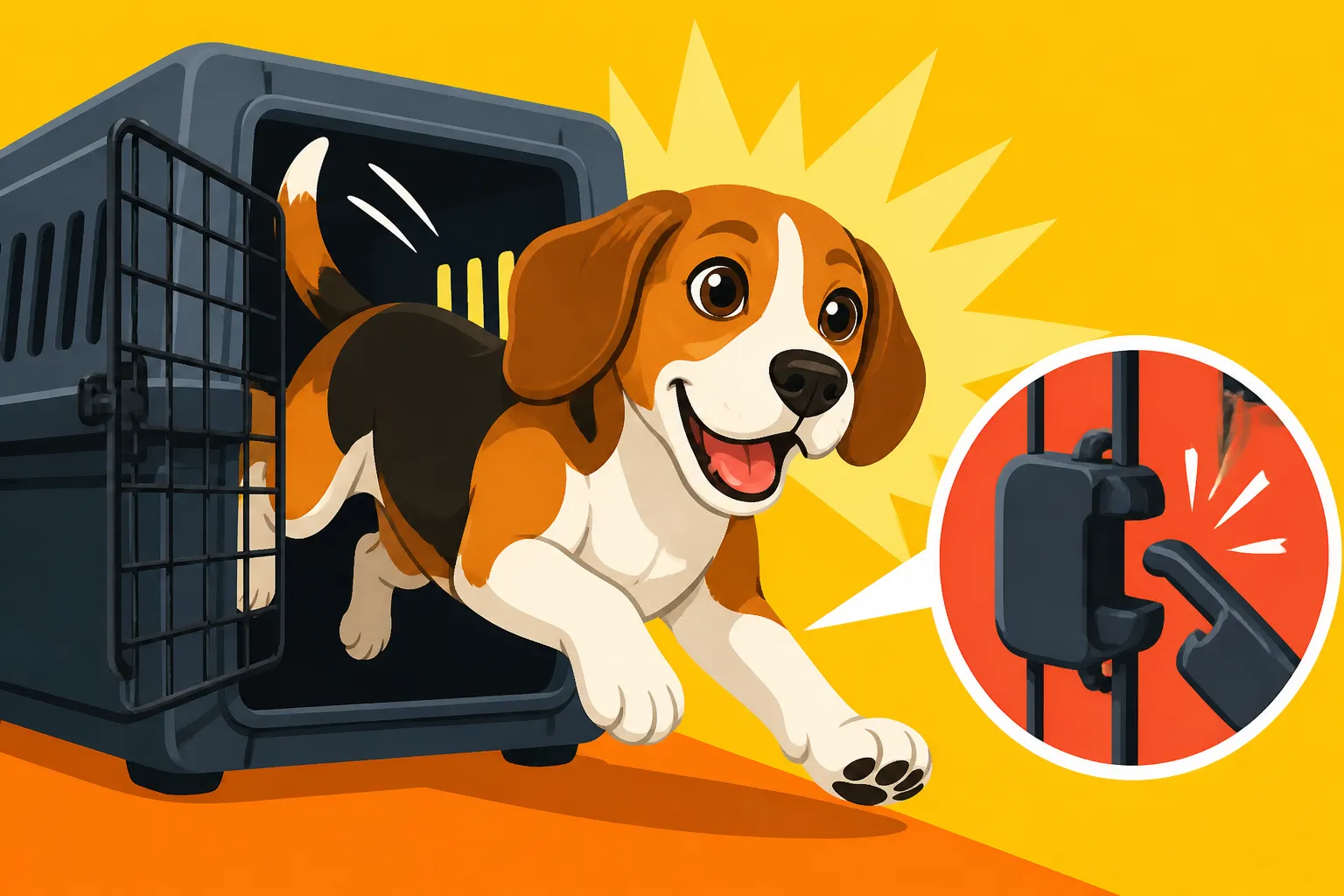
Beagle Crate Escapes and Failing Latches
Oh, the sheer frustration of walking into a room only to find your supposedly secure Beagle standing triumphantly outside their crate, tail wagging, with the door either ajar or somehow completely disassembled. It's enough to make you tear your hair out! Many Beagle owners know this unique brand of despair, wrestling with crates that seem built for lesser dogs, not the furry Houdinis we adore. This guide is here to shed some light on why your clever Beagle is escaping their crate and, more importantly, what you can actually do to keep them safely and comfortably contained.
Why Your Beagle Becomes a Crate Escape Artist
Let's face it, Beagles are smart. Really smart. And they're driven. When they set their minds to something, whether it's tracking a distant scent or figuring out how to bypass a flimsy latch, they tend to achieve it. Understanding what fuels this escape artistry is the first step in outsmarting them.
The Masterminds Behind the Bars: Beagle Intelligence and Determination
It’s easy to feel like your Beagle is deliberately trying to thwart your efforts, and in a way, they are! Their intelligence isn't always about understanding complex commands; it's often about problem-solving. A Beagle left alone in a crate with nothing to do, yet a burning desire to investigate the kitchen counter or the cat's litter box, will apply its formidable intellect to its immediate environment. They'll push, pull, chew, and rattle every part of that crate until they find a weakness. They don’t just give up after one try; they’ll work at it with an almost scientific persistence, learning from each failed attempt. This isn't naughtiness; it's simply a high-drive, intelligent dog being resourceful. If your Beagle figures out how a latch works, even if it's a multi-step process, they'll remember it for next time. It's a testament to their cleverness, even if it’s inconvenient for us.
Scent Drive: The Irresistible Call of the Outside World
Beyond intelligence, a Beagle's primary motivator is their nose. With 220 million scent receptors, their world is an intoxicating tapestry of smells. Imagine being locked in a room while the most delicious aroma drifts from another room – that’s what every faint scent of squirrel in the backyard, crumbs on the floor, or even just the smell of freedom represents to a Beagle in a crate. This overwhelming drive to follow a scent overrides almost everything else. If they detect a tempting smell, they will work relentlessly to get to it. This instinct is what makes Why a Beagle Should Never Be Off Leash Unfenced such crucial advice, and it's the same instinct that powers their crate escape attempts. The desire to investigate, to track, to simply be outside and follow that invisible trail, can give them boundless energy to break free. It’s not a lack of love for you; it’s an ancient, powerful instinct taking over.
Common Crate Weaknesses and Failing Latches
Now that we understand the "why," let's look at the "how." Most crate escapes aren't due to supernatural powers but rather a combination of a determined Beagle and a crate that simply isn't up to the task.
The Flimsy Latch Problem: Where Many Crates Fall Short
This is perhaps the most common culprit. Many standard wire crates come with surprisingly simple, often spring-loaded or single-point sliding latches. For a less determined dog, these might suffice. For a Beagle, they're often seen as a puzzle to be solved. A clever Beagle will quickly learn to nudge, paw, or even chew at the latch mechanism. Spring-loaded latches, especially, can be vulnerable to a strong nudge from the inside, causing the spring to give just enough for the latch pin to disengage. Some Beagles learn to stand up and lean against the door, applying pressure that can spring open weaker designs. Others will use their teeth to pry at gaps around the latch. It’s not always brute force; sometimes it’s a delicate, practiced manipulation. These are the moments you find yourself thinking, "How did they do that?" The answer is usually a combination of observation, persistence, and a latch that wasn't designed for a dog with a Ph.D. in escapeology.
Wire Strength and Construction: Bending and Breaking Points
It’s not just the latch. The overall construction of the crate plays a huge role. Many economy wire crates are made with thinner gauge wire, which is perfectly fine for containing a calm, non-chewing dog. A Beagle, however, especially a younger one going through its Beagle Puppy Teething and Hard Mouthing phase, can easily bend these wires, creating gaps large enough to squeeze through or compromising the structural integrity of the door. Over time, repeated pushing, shaking, or chewing can weaken solder points, causing bars to break or panels to detach. Some Beagles will discover that if they push hard enough at a certain spot, particularly near the top or bottom of the door, they can create enough leverage to pop a wire out of its frame. I've even seen cases where Beagles have completely dismantled the door, separating it from the hinges by sheer will and repeated pressure.
Crate Placement and Environment: Giving Them an Edge
Sometimes, we inadvertently help our Beagles escape. Where you place the crate and what's around it can offer a determined Beagle an advantage. If a crate is pushed right up against a wall, a Beagle might use the wall for leverage to push against the crate door or sides. If there are items nearby – a chair, a table, a shelf – a particularly agile Beagle might find a way to climb onto the crate and push down on the roof or even attempt to climb out if the top isn't securely fastened. Even a soft, thick crate pad can give them just enough height to reach a weak point in the roof or a high latch. Boredom is also a huge factor. A Beagle left alone in a crate for long periods without adequate mental or physical stimulation is far more likely to focus its energy on escaping. Their clever minds need a job, and if you don't provide one, escaping becomes their new project.
Fortifying Your Beagle's Crate: Solutions and Strategies
The good news is that you don't have to surrender to your Beagle's escape prowess. There are plenty of ways to beef up your containment strategy, ensuring their safety and your peace of mind.
Upgrading to a More Secure Crate Type
For Beagles who are true escape artists, a standard wire crate often simply won't cut it. It might be time to invest in a heavy-duty option.
- Impact Crates: These are often made from high-strength aluminum or steel, designed for maximum security and durability. They typically feature heavy-duty latches that are far more resistant to manipulation and solid, unbendable construction. They're built like tanks and are incredibly difficult for even the most determined Beagle to breach.
- Heavy-Duty Wire Crates: Some manufacturers produce wire crates with significantly thicker gauge wire and more robust welding, making them much harder to bend or break. Look for crates advertised as "escape-proof" or "heavy-duty" rather than just "standard."
- Plastic Airline-Style Kennels: For some Beagles, the enclosed nature of a sturdy plastic kennel can feel more den-like and less like a cage to be broken out of. These often have secure bolt-and-nut assemblies rather than flimsy latches, making them tough to dismantle. The key here is sturdy plastic – thin, cheap models can still be chewed through.
When considering an upgrade, think about what part of the previous crate failed. Was it the latch? The wire strength? The overall construction? This will help you choose the right type of fortifying solution.
Reinforcing and Securing Existing Crates
You don't always need to buy a brand-new crate. Often, existing crates can be made more secure with a few simple additions from a place like Amazon or your local hardware store.
- Carabiners or Bolt Snaps: These are your best friends. Instead of relying solely on the crate's latch, use heavy-duty carabiners or bolt snaps to secure the crate door to the crate itself. Attach one or two to the door's wire, looping them through a horizontal or vertical bar on the crate body. This provides a secondary (or even primary) locking mechanism that's incredibly hard for a Beagle to manipulate. Look for climbing-grade carabiners for extra strength.
- Zip Ties: For areas where your Beagle is bending wires or finding gaps, heavy-duty zip ties can be a temporary or even long-term solution. Use them to reinforce weak points, secure panels that might be coming loose, or even cinch parts of the door more tightly to the frame. Just be sure to trim the excess tail of the zip tie so your Beagle can't chew on it.
- Crate Covers: While not a security measure in themselves, a dark, breathable crate cover can help reduce external stimuli that might trigger your Beagle's escape attempts. It creates a more den-like, calming environment, making it feel less like a prison and more like a safe haven. This can sometimes reduce the motivation to break out.
Remember, the goal is not to punish your Beagle, but to prevent them from hurting themselves or getting into trouble while you're away.
Training for Crate Comfort and Acceptance
A secure crate is only half the battle. If your Beagle views the crate as a punishment, they will be endlessly motivated to escape. Positive reinforcement training is crucial to making the crate a positive, safe space.
- Start Slow and Positive: Reintroduce the crate as a happy place. Feed meals inside, toss high-value treats in there, and use a cheerful voice. Never use the crate for punishment.
- Short, Positive Sessions: Begin with very short periods, even just seconds, with the door closed, and gradually increase the duration. Always reward calmness generously.
- High-Value Rewards: Only use the absolute best treats when your Beagle is in the crate. This builds a strong positive association. You can also use a company like BAXTER & Bella for online training guidance to help you make crate time a good experience.
- Kong or Puzzle Toys: Stuff a Kong with frozen peanut butter or cream cheese, or use a chew toy designed for extended engagement. This occupies your Beagle while in the crate, associating it with delicious, long-lasting rewards. Indoor Enrichment for a Rainy Beagle Week can give you more ideas for keeping them occupied.
- "Crate Games": Play games around the crate where your Beagle chooses to go in and out freely, getting rewarded each time. This builds their agency and makes the crate their choice, not just your command. For more specific guidance, check out our post on Crate Training a Beagle Bred to Sleep in a Pack.
Prevention Beyond the Bars: Managing the Escape Instinct
Beyond the physical security of the crate, addressing the underlying reasons for your Beagle's escape attempts is key to long-term success.
Adequate Exercise and Mental Stimulation
A tired Beagle is a good Beagle, and a mentally stimulated Beagle is a less destructive Beagle. These two elements are paramount in preventing crate escapes. If your Beagle is bursting with pent-up energy, they will channel it into finding a way out. Make sure they get plenty of physical exercise before being crated. This means vigorous walks, playtime in a secure yard, or even a good run. But don't forget mental exercise! For a Beagle, this often means leveraging their incredible sense of smell. Engage them in scent work games, scatter their kibble in the grass, or try out Scent Work as the Job a Beagle Was Built For. A Beagle that has spent an hour deeply engaged in sniffing and tracking will be far more inclined to settle down and rest in their crate than one who has been under-stimulated. This combination tires their body and their mind, reducing the drive to "do" something, like escaping.
Addressing Separation Anxiety
Sometimes, crate escape attempts aren't just about boredom or curiosity; they're a symptom of deeper distress. Beagles are pack animals, traditionally bred to live and work in groups. Being left alone can trigger significant anxiety in some individuals, especially if they haven't been properly acclimated to solitude. Beagle Separation Anxiety in a Pack Breed is a real and heartbreaking issue. If your Beagle exhibits other signs of distress when left alone, such as excessive barking or howling (and a Beagle's howl can carry!), destructive chewing (even outside the crate), house soiling, or frantic behavior upon your return, then separation anxiety might be at play. In these cases, simply fortifying the crate isn't enough; you need to address the anxiety itself. This might involve counter-conditioning, desensitization, and potentially even consultation with a professional trainer or veterinary behaviorist. A secured crate only contains the physical manifestation of anxiety; it doesn't resolve the underlying emotional distress. Our article on Beagle Howling the Moment You Leave delves deeper into managing vocalization related to alone time.
Smart Crate Setup and Location
Revisiting your crate setup can make a big difference.
- Remove Leverage Points: Ensure there's nothing near the crate that your Beagle can use to climb on or brace against. This includes walls, furniture, or even large toys.
- Secure the Bottom: If your Beagle is a digger, they might try to dig out of a wire crate. Consider placing a heavy-duty mat or even a piece of plywood cut to size at the bottom, underneath the crate, to deter digging down.
- Consider a Cover: As mentioned, a dark, breathable cover can help block out stimulating sights and create a calm, den-like atmosphere. This can make the crate feel safer and reduce the urge to escape to investigate.
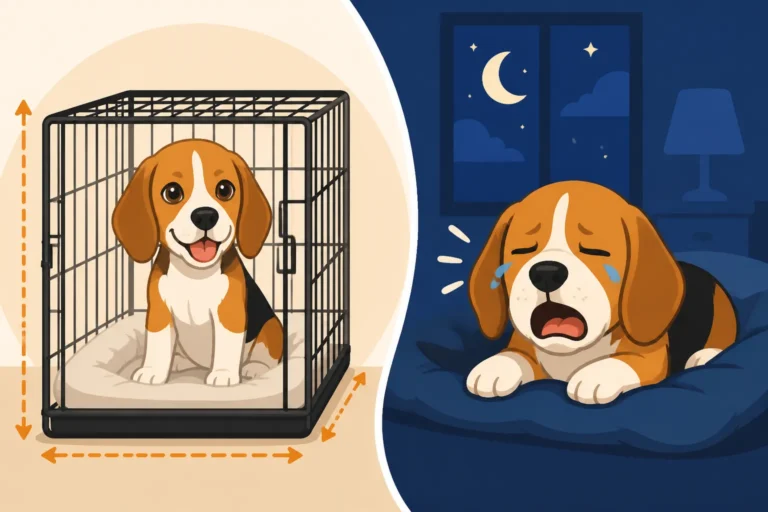
- Appropriate Size: The crate should be large enough for your Beagle to stand up, turn around, and lie down comfortably, but not so large that they can use one end as a "bathroom" and the other as a living area. Too large can sometimes make a dog feel less secure.
- Monitor and Adjust: Every Beagle is different. What works for one might not work for another. Observe your Beagle's escape attempts – where do they focus their efforts? This information is gold and can help you target your reinforcements. If they continuously try to push the door, reinforce the latch. If they chew bars, look into thicker gauge wire.
Remember, the goal is always to keep your Beagle safe and happy, not just contained. A well-exercised, mentally stimulated, and positively trained Beagle is far less likely to turn into a desperate escape artist.
| Crate Type | Pros | Cons | Ideal for |
|---|---|---|---|
| Standard Wire Crate | Affordable, good visibility, collapsible, good airflow | Flimsy latches, bendable wires, easily manipulated by clever Beagles | Beagles that are already crate-trained and calm, mild escape attempts |
| Heavy-Duty Wire Crate | Thicker gauge wire, more robust construction, better latches | Heavier, more expensive than standard, still wire (can be chewed), may not solve extreme cases | Determined Beagles that bend wires or break standard latches |
| Plastic Airline Kennel | Den-like feel, solid construction, often uses secure nuts/bolts | Less visibility, can be hot if not well-ventilated, some plastics can be chewed, not collapsible | Anxious Beagles who prefer enclosed spaces, moderate chewers, good for travel |
| Impact/Aluminum Crate | Extremely strong, virtually escape-proof, durable, secure latches | Very expensive, very heavy, no visibility, often not collapsible, less airflow | Extreme escape artists, powerful chewers, dogs with severe separation anxiety |
Disclaimer
This article is for general informational purposes only and does not constitute professional advice. Laws, prices and regulations vary by location and change over time. Consult a qualified professional for guidance on your specific situation.