Front-Clip Harnesses for a Beagle That Pulls Toward Scent
If you've ever found yourself being dragged down the street by your beloved Beagle, leash stretched taut, while they follow an invisible (to you) scent trail with laser focus, you know the struggle is real. It's not just annoying; it can be downright dangerous for both you and your furry friend. This guide is here to walk you through why front-clip harnesses can be a game-changer for managing that incredible Beagle nose and making walks enjoyable again.
The Frustration of a Scent-Driven Puller
Let's be honest: walking a Beagle that's constantly pulling can feel like a losing battle. You want to enjoy your time outdoors together, but instead, you're bracing yourself, your shoulder aches, and you're worried about losing your grip entirely. This isn't a reflection of your training skills or your Beagle's intelligence; it's simply a testament to their extraordinary design and powerful instincts.
Understanding the Beagle's Nose and Its Power
The reason your Beagle pulls so hard isn't out of spite or a desire to disrespect you; it's because their nose is an absolute superpower, and the world is an intoxicating buffet of smells. Beagles are bred to hunt by scent, to follow a trail relentlessly, often for miles, with an intensity that completely overrides everything else around them. They possess around 220 million olfactory receptors, dwarfing our mere 5 million. Their olfactory bulb, the part of the brain that processes smells, is also significantly larger. When a Beagle's nose hits a fascinating scent, it's like a siren song, pulling them forward with an irresistible force. To them, ignoring that scent is like trying to ignore your favorite song playing loudly – it's practically impossible. This incredible drive means that on a walk, every single leaf, every blade of grass, every faint whiff of squirrel or distant rabbit is a compelling adventure waiting to be explored. You might notice they walk with Why a Beagle Walks With Its Nose to the Ground.
This makes training challenging, to say the least. You might feel like you're constantly fighting against their natural inclination, and that can be incredibly disheartening. Many owners report feeling exhausted and frustrated after just a short walk, simply because the pulling is so relentless. It's easy to get discouraged when your dog seems to forget all their manners the moment they step outside.
Why Traditional Collars Often Fail
For a dog with such a powerful prey drive and scent focus, traditional flat collars often provide little to no effective control against pulling. When a Beagle lunges forward, a flat collar simply concentrates all that pressure on their throat and neck. Not only is this uncomfortable and potentially damaging for your dog, but it also does little to deter the pulling itself. Think about it: if they're focused on that amazing scent, a little pressure on their neck isn't going to stop them. They'll just keep leaning into it, gasping and potentially causing themselves harm. It can lead to a lot of coughing and choking, which is scary for both of you.
Even more severe corrective collars, like choke chains or prong collars, while sometimes used to exert more control, can be detrimental in the long run. They can cause physical injury to the delicate structures of the neck, including the trachea, thyroid, and even the eyes if pressure is applied incorrectly or too harshly. For a breed already prone to issues like Beagle Neck Pain and a Head Held Low or Beagle Back Problems and Intervertebral Disc Disease due to their slightly longer backs, adding undue strain to the neck area is a serious concern. Beyond the physical risks, these types of collars can also create negative associations with walks, making your Beagle more anxious or reactive, rather than solving the underlying pulling behavior. The goal is to redirect their energy and focus, not to cause pain or fear.
How Front-Clip Harnesses Work for a Beagle
So, if traditional collars aren't the answer, what is? Enter the front-clip harness, a design that has revolutionized leash training for many owners, especially those with strong, scent-driven breeds like Beagles. It offers a kinder, more effective way to manage pulling without causing discomfort or potential injury.
The Mechanics of Redirecting Pulling
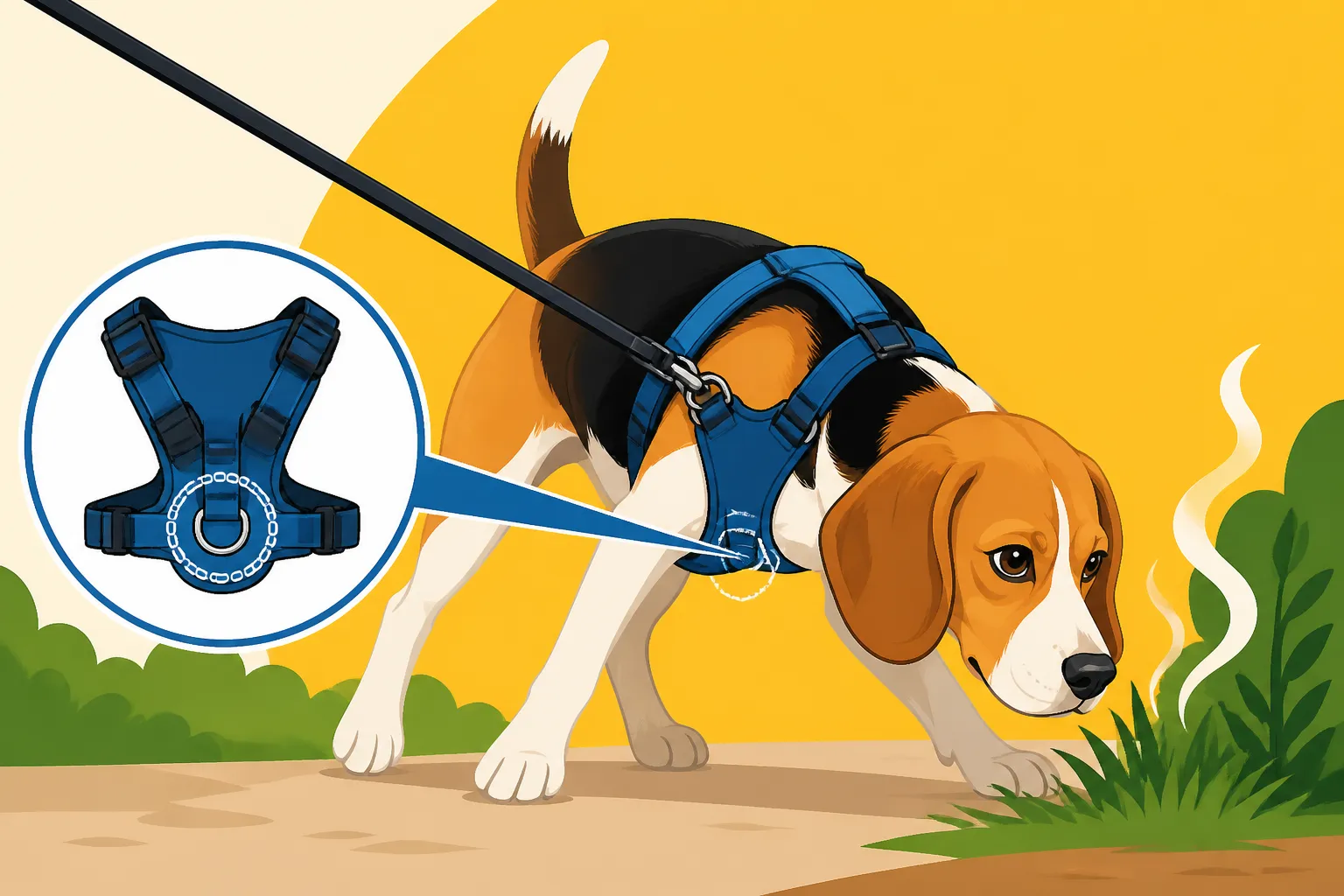
The magic of a front-clip harness lies in its simple yet ingenious design. Unlike a traditional harness that clips on the back, or a flat collar that puts pressure on the neck, a front-clip harness features a D-ring or attachment point located on your dog's chest. When your Beagle attempts to pull forward, the leash pressure is applied to this chest ring. Instead of allowing them to lean into the pull and gain momentum, this pressure gently redirects their momentum to the side, causing them to turn back towards you.
Imagine trying to push a shopping cart that has a loose wheel – every time you try to go straight, it veers off. That's essentially what happens with a front-clip harness. When your Beagle pulls, they're not able to get that forward leverage. Each pull naturally pivots their body, disrupting their forward motion and encouraging them to look back at you for direction. This makes it incredibly difficult for them to maintain a strong, consistent pull, and instead, they learn that pulling actually makes them turn around, which is the opposite of where they want to go. It's a subtle but powerful change in physics that works with your dog's natural movement, rather than against it.
Benefits Beyond Just Less Pulling
While the primary benefit of a front-clip harness is undoubtedly reducing pulling, its advantages extend far beyond that. For starters, it significantly reduces the risk of injury to your Beagle's neck and throat. With the pressure distributed across their chest and shoulders, there's no choking or gagging, even if they do lunge unexpectedly at an irresistible scent. This is crucial for their long-term health, especially for breeds like Beagles who can be prone to certain physical ailments.
Furthermore, these harnesses offer much better control for you, the handler. When your dog is constantly pulling, you feel like you're losing control of the walk. A front-clip harness gives you a gentler but more effective way to guide your dog, making sudden directional changes easier and allowing you to prevent them from bolting towards a perceived rabbit or a fascinating patch of grass. This added control can make you feel more confident and relaxed, which in turn helps your Beagle feel more relaxed on walks. It transforms the experience from a tug-of-war into a cooperative stroll. They still get to enjoy their Letting a Beagle Sniff on Every Single Walk, but on your terms, at your pace. This also means you're less likely to be yanked off your feet, a concern for many owners of strong, determined hounds.
Choosing the Right Front-Clip Harness for Your Scent Hound
Not all front-clip harnesses are created equal, and finding the perfect one for your Beagle involves considering a few key factors. Because Beagles come in two size varieties (13-inch and 15-inch), and their chests can be quite broad, a good fit is paramount for both comfort and effectiveness.
Key Features to Look For
When you're shopping for a front-clip harness, keep these features in mind:
- Material and Durability: Look for strong, durable webbing that can withstand regular use. Nylon or polyester are common and effective. Padded straps, especially around the chest and under the armpits, are a huge plus for comfort. Beagles have relatively short coats, and rubbing can quickly lead to chafing, especially if the harness doesn't fit well.
- Adjustability: This is critical. A good harness will have multiple adjustment points – usually around the neck/chest, girth, and sometimes even the front strap connecting the neck and girth. This allows you to achieve a snug, secure fit that prevents slipping or twisting, while still allowing for full range of motion. Beagles can be quite barrel-chested, so ample adjustment is necessary.
- Chest Ring Placement: The front clip should be positioned centrally on your Beagle's chest. If it's too high, it can put pressure on their throat; too low, and it might interfere with their gait. A well-placed ring maximizes the redirecting effect without causing discomfort. Some harnesses offer different types of clips, from metal D-rings to reinforced fabric loops.
- Ease of Use: You want a harness that's easy to put on and take off, especially if your Beagle gets excited about walks. Buckles that snap easily and clearly marked straps can save you a lot of fumbling. You might find a style that goes over the head and buckles around the girth easier than one that requires threading legs through loops.
Finding the Perfect Fit
The fit of the harness is absolutely crucial. A poorly fitting harness can be uncomfortable, cause chafing, or even allow your Beagle to slip out. Here's how to ensure a good fit:
- Measure Carefully: Before you even think about buying, measure your Beagle's chest girth (the widest part behind their front legs) and their neck circumference. Compare these measurements to the sizing chart provided by the manufacturer. Remember that every brand can size slightly differently.
- Two-Finger Rule: Once the harness is on, you should be able to comfortably slip two fingers under all the straps. If it's too tight, it will rub and restrict movement; if it's too loose, your Beagle could back out of it, or the harness could shift and chafe.
- Check for Chafing Points: Pay special attention to the areas behind the front legs. This is a common spot for chafing if the harness is too tight or the material is rough. Walk your Beagle in the harness for a short period, then check their skin for any redness or irritation.
- Observe Movement: Watch your Beagle walk and run in the harness. It shouldn't impede their natural gait or restrict their shoulder movement. They should be able to move freely and comfortably. An ill-fitting harness can put stress on their joints, potentially worsening issues like Beagle Arthritis Arriving in Middle Age.
Brands and Where to Find Them
There are many excellent brands that offer front-clip harnesses, and what works best can sometimes come down to your Beagle's specific build and your personal preference. When you're ready to start looking, online retailers like Chewy and Amazon offer a vast selection, often with detailed sizing guides and customer reviews that can be incredibly helpful. You might even find some options from Ollie, though they are primarily known for their fresh dog food, they sometimes carry accessories. Local pet stores are also great for trying harnesses on your Beagle in person, which can be invaluable for ensuring a proper fit before you commit.
Consider popular options known for their durability and design:
| Harness Type | Key Feature | Beagle Suitability | Pros | Cons |
|---|---|---|---|---|
| Front-Clip (Y-shaped) | Chest-mounted leash attachment, Y-front | Excellent for reducing pulling, protects neck/trachea | Redirects pulling, comfortable, reduces chafing if fitted well | Can sometimes twist on very narrow-chested dogs if not snug |
| Back-Clip (Traditional) | Back-mounted leash attachment | Good for dogs that don't pull, or for car safety | Easy to put on, doesn't interfere with leg movement | Encourages pulling, can put pressure on neck if dog pulls hard |
| Head Halter (Gentle Leader) | Muzzle loop, neck strap | Strongest no-pull control, used for very strong pullers | Immediate control, redirects head, often stops pulling fast | Can be uncomfortable for some dogs, requires careful introduction |
When browsing, look for brands that prioritize both effectiveness and comfort. Read reviews from other Beagle owners if possible, as they often share insights on how specific harnesses fit their unique body types.
Training and Transitioning Your Beagle to a Front-Clip Harness
A front-clip harness is a fantastic tool, but it's not a magic bullet. For the best results, it should be introduced positively and used in conjunction with consistent, positive reinforcement training. Remember, your Beagle is incredibly smart, but also incredibly scent-driven!
Introducing the Harness Positively
The first step is to make the harness a positive experience for your Beagle. Don't just clip it on and head out the door.
- Familiarization: Let your Beagle sniff the harness, praise them, and give them a small, high-value treat. Repeat this a few times over a day or two.
- First Wear: Gently place the harness on your Beagle, but don't buckle it all the way or attach the leash. Just let them wear it for a minute or two inside the house, showering them with praise and treats. Take it off before they get annoyed.
- Short Sessions: Gradually increase the time they wear it inside, always pairing it with positive reinforcement. Play a quick game, give them their favorite chew, or feed them a small meal while they're wearing it.
- Leash Introduction: Once they're comfortable wearing the harness, attach the leash for short periods indoors. Practice walking a few steps, praising and treating for a loose leash.
- First Walk: Start with a very short walk in a low-distraction environment. Keep it positive and end on a good note. If they start to pull, simply stop walking. The moment the leash slackens, even for a second, praise and reward, then continue. This teaches them that a loose leash gets them where they want to go. This ties directly into Building Beagle Recall Before the Nose Takes Over.
Practical Tips for Walking with a Front-Clip Harness
Using a front-clip harness effectively means adapting your walking technique slightly.
- Keep the Leash Loose: The harness works best when the leash is relatively loose. If you're constantly yanking, you're not allowing the harness to do its job of redirecting.
- Short, Frequent Walks: Especially in the beginning, focus on shorter, more structured walks. This allows your Beagle to learn the new sensation and the new rules without getting overwhelmed by too many enticing scents.
- Reward Loose-Leash Walking: Every time your Beagle walks beside you with a loose leash, mark that behavior with a verbal cue ("yes!" or "good!") and a high-value treat. Consistency is key here. Your Beagle will quickly learn that staying close and not pulling earns them rewards.
- Change Direction: If your Beagle starts to pull relentlessly towards a scent, simply change direction. This disorients them momentarily and forces them to re-engage with you. The front-clip harness will naturally guide them in the new direction.
- Combine with Recall Training: Continue to work on your Beagle Recall and Why Your Voice Stops Registering even with the harness. A strong recall is a vital safety net, and a loose-leash walk builds the foundation for better communication.
- Be Patient and Consistent: Beagles are intelligent, but their instincts are incredibly strong. It will take time and consistency for them to fully understand and adapt to walking without pulling. Every walk is a training opportunity. Don't get discouraged if you have setbacks; just calmly return to your training methods.
Remember, the goal isn't to stop your Beagle from sniffing, because Why a Scent Walk Tires a Beagle Faster Than Running and is a vital part of their enrichment. It's about teaching them how to sniff politely, giving you the control to navigate walks safely and comfortably, allowing you both to enjoy the adventure. A front-clip harness is a powerful tool in your training arsenal, empowering you to manage that incredible Beagle nose and forge an even stronger bond with your companion.
Disclaimer
This article is for general informational purposes only and does not constitute professional advice. Laws, prices and regulations vary by location and change over time. Consult a qualified professional for guidance on your specific situation.