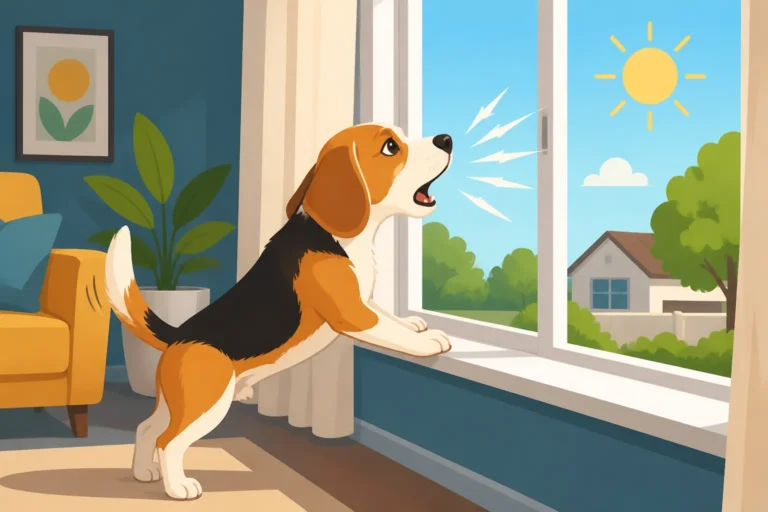
What Makes a Beagle Bay Sharper Than a Bark
If you've ever owned a Beagle, or even just lived near one, you know their vocalizations are something truly special – and sometimes, quite a lot to handle! It's not just a simple bark; there's a whole symphony of sound that comes from those deep chests and soulful eyes. Many owners often wonder why that distinct, drawn-out bay sounds so different, and often so much 'sharper' or more piercing, than a typical dog's bark. This guide is here to unravel the unique vocal qualities of our beloved Beagles, helping you understand the difference between their various sounds and why their bay has such a distinctive edge.
The Vocal Symphony of a Beagle: More Than Just Barking
Beagles are talkers, plain and simple. They're not just making noise; they're communicating, just as their ancestors did in the field for centuries. Understanding the nuances of their vocal repertoire is key to understanding your Beagle's temperament and needs. It's a journey into the very essence of what makes a Beagle a Beagle.
Decoding the Beagle's Ancestral Voice
Imagine a pack of Beagles, winding through dense underbrush, noses to the ground, hot on the scent of a rabbit. How would they tell their human companions, or each other, that they've found the trail, or that the chase is on? A sharp, quick bark might get lost in the wind and foliage. What they needed was a sustained, carrying sound – a vocal beacon – and that's precisely what the bay became. Why a Beagle Was Originally Bred to Hunt explains this heritage in depth.
Their strong vocal cords and impressive lung capacity, honed over generations of selective breeding for hunting, contribute directly to these powerful sounds. Unlike many breeds where a bark is primarily an alert, a Beagle's vocalizations are often about collaboration and direction. The bay tells a story over distance: "I'm here! I've got the scent! Follow me!" It's less about startling a threat and more about broadcasting information to a dispersed group. This deep-seated instinct means that trying to train the bay completely out of a Beagle is often a losing battle, and many owners quickly learn that Why You Cannot Train the Bay Out of a Beagle is a hard truth.
The Anatomy of a Beagle's Sound
It's not just about what they want to say, but how their bodies are built to say it. A Beagle's distinctive vocalizations are deeply rooted in their physical anatomy, specifically their skull structure and the configuration of their larynx. Their medium-sized, sturdy build, combined with a relatively long muzzle and deep chest, creates a natural resonator for sound. Think of it like a finely crafted instrument; the shape and materials determine the timbre and projection.
Compared to, say, a terrier with a shorter, sharper skull and a more compact body, a Beagle has more internal space to allow sound to reverberate and build. Their larynx and vocal cords are designed to produce a sustained airflow, essential for the long, drawn-out notes of a bay. The floppy, long ears also play a role, not in producing the sound, but perhaps in how they perceive and process their own vocalizations, tuning into the sound of their pack. This anatomical predisposition means that even a quiet Beagle will likely have a voice capable of that distinctive bay, even if they don't use it often.
Understanding the Distinct Sound of a Beagle's Bay
The bay is arguably the Beagle's signature sound. It's what makes them instantly recognizable, even to those unfamiliar with the breed. It's a sound that evokes images of open fields and pursuit, a truly ancient and primal form of communication.
The Purpose and Character of the Bay
When a Beagle bays, they're not just randomly making noise; they're fulfilling an ancient purpose. The bay is a long, drawn-out, mournful, yet often musical sound. It starts with a deep inhale, a building of anticipation, and then projects a resonant, sustained note that can rise and fall in pitch. It's designed to carry over significant distances, through varied terrain, allowing other hounds and hunters to track the progress of a chase. You might find yourself wondering, A Beagle Howl Measured in Decibels, just how loud it can actually be.
Contrast this with a typical dog's bark, which is often short, sharp, and repetitive. A bark is generally an alarm, a demand, or an expression of excitement. "Someone's at the door!" "Feed me now!" "Let's play!" are all things a bark communicates. The bay, however, is a narrative: "I've caught the scent of something interesting, and I'm following it!" or "I'm alone and I want my pack!" The bay is less about an immediate, sharp warning and more about sustained communication, announcing a specific event or need that requires a response over time or distance. It's why that sound can feel so piercing; it's engineered for maximum reach and recognition.
Factors Influencing the Bay's Sharpness
What gives the Beagle's bay its particular "sharpness" or penetrating quality? It's a combination of several acoustic factors. Firstly, the sustained airflow and resonance within their deep chest create a powerful, fundamental tone. This isn't a staccato burst of sound; it's a column of air vibrating through their vocal apparatus, sustained for several seconds. Secondly, the specific harmonics and overtones produced by their laryngeal structure give the bay its characteristic timbre, making it distinct from a simple howl or bark. It’s what gives it that slightly mournful, yet undeniably powerful, quality.
The projection of the sound also plays a huge role. Beagles often throw their heads back when they bay, directing the sound upwards and outwards, further enhancing its ability to travel. This, combined with a higher fundamental frequency than many other large hounds, allows the sound to cut through ambient noise. When a Beagle lets loose that signature bay, it's designed to grab attention and carry, whether it's through a dense forest or, much to the chagrin of neighbors, across a quiet suburban street. Many owners report Beagle baying that carries three houses down. This unique acoustic signature is what allows it to feel "sharper" – it's designed to be heard, no matter what.
What Sets a Beagle's Bark Apart
While the bay might be their most famous vocalization, Beagles do bark, and their bark serves a very different purpose. It's a more common, everyday sound that most dog owners are familiar with, but even here, there are nuances to understand.
The Beagle Bark: A Direct Communication
A Beagle's bark is typically shorter, more abrupt, and often more insistent than its bay. It's used for immediate, close-range communication. Think of it as the difference between sending a long, detailed letter (the bay) and a quick text message (the bark). When your Beagle barks, they're usually trying to get your attention right now, or alert you to something in their immediate environment. It might be a rapid succession of barks, building in intensity, especially if they feel ignored or highly stimulated.
Common scenarios for a Beagle bark include announcing visitors at the door, demanding a treat or playtime, expressing frustration when left alone, or reacting to something sudden and startling. The acoustic properties are different too: less resonance, more percussive, and a higher pitch in many cases compared to the deep, rolling tones of a bay. It's meant to be startling and attention-grabbing, rather than a sustained broadcast.
Common Triggers for Beagle Barks
Beagles, like all dogs, bark for a variety of reasons, and recognizing the trigger is the first step in managing excessive barking. What Sets Off a Beagle Bay Indoors might cover baying, but barking has its own set of common culprits.
Here are some typical triggers:
- Alert Barking: This is the classic "someone's here!" bark. The doorbell ringing, a knock on the door, someone walking past the window, or even a leaf blowing across the yard can set off an alert bark. Beagles are naturally vigilant, and their keen senses make them excellent, if sometimes overly enthusiastic, watchdogs.
- Attention-Seeking Barking: Your Beagle wants something, and they want it now. This could be food, a walk, a toy, or just a good old belly rub. This bark is usually directed squarely at you, often accompanied by insistent nudging or pawing.
- Boredom or Frustration: A Beagle with too much energy and not enough mental or physical stimulation is a prime candidate for barking. They might bark at nothing in particular, just to release pent-up energy, or out of sheer boredom. This is where investing in puzzle feeders and engaging toys from places like Amazon can really make a difference.
- Fear or Anxiety: While howling or baying can signify separation anxiety, barking can also be a sign of fear or discomfort, especially if directed at something new, strange, or perceived as threatening.
- Excitement: Pure, unadulterated joy can also lead to barking – think of the enthusiastic barks when you grab their leash for a walk or come home after a long day.
Understanding why your Beagle is barking is crucial before you can address the behavior effectively. Ignoring it or scolding them without addressing the root cause rarely works and can sometimes even worsen the issue.
Here's a quick comparison of the Beagle's main vocalizations:
| Vocalization | Primary Purpose | Acoustic Characteristics | Common Triggers |
|---|---|---|---|
| Bay | Long-distance communication, announcing a scent trail, seeking pack. | Long, sustained, resonant, melodic, often rising and falling pitch. | Scent of prey, feeling alone, hearing other hounds. |
| Bark | Immediate alert, attention-seeking, frustration, excitement. | Shorter, sharper, more abrupt, repetitive, higher pitch than bay. | Doorbell, visitors, wanting food/attention, perceived threats. |
| Howl | Long-distance communication (similar to bay but often more mournful), response to sounds. | Long, sustained, often melancholic, uniform pitch (less variation than bay). | Sirens, music, feeling isolated, echoing other howls. |
Managing Beagle Vocalizations in the Home
Living with a Beagle means embracing their vocal nature, but it doesn't mean you have to endure constant noise. There are plenty of strategies to encourage appropriate vocalization and manage nuisance barking and baying. It's all about understanding their needs and channeling their instincts.
Training for Appropriate Vocalization
Training is fundamental when it comes to managing a Beagle's vocalizations. You can't train the bay out of them completely, as it's so deeply ingrained, but you can teach them when it's acceptable and when it's not. The goal isn't silence, but rather controlled communication.
One of the most effective methods is teaching a "Quiet" or "Enough" cue. Start by triggering a bark (e.g., ringing the doorbell), let them bark a few times, then hold a high-value treat near their nose. The moment they stop barking to sniff the treat, say "Quiet" and reward them. Gradually increase the duration of silence before the reward. Consistency is key here. Every family member needs to be on board with the training.
For Beagles prone to baying when left alone, addressing the underlying separation anxiety is paramount. This can be a complex issue, and resources like Beagle Separation Anxiety in a Breed Bred to Packs offer further insights. Online training platforms, such as those offered by BAXTER & Bella, can provide structured courses and support for tackling specific behavioral challenges like excessive vocalization and separation distress, guiding you step-by-step through positive reinforcement techniques. Remember, positive reinforcement works wonders with Beagles because they are so food-motivated! High-Value Food and How Fast a Beagle Learns is definitely true for these pups.
Environmental Management and Enrichment
Beyond direct training, managing your Beagle's environment and ensuring they are sufficiently enriched can drastically reduce unwanted vocalizations. A bored Beagle is often a noisy Beagle.
- Exercise, Exercise, Exercise: Beagles need a lot of physical activity. A good sniff walk, where they can indulge their powerful nose, is often more tiring than a simple run around the block. Scent Walks That Wear a Beagle Out explains why this is so effective. A physically and mentally tired Beagle is a quiet Beagle. Aim for at least 60-90 minutes of vigorous activity spread throughout the day.
- Mental Stimulation: Their incredible noses aren't just for hunting; they're also a source of endless entertainment. Scent work, puzzle toys, and interactive feeders (you can find a fantastic array of these on Amazon) can keep their minds engaged and prevent boredom-induced barking. Even simple games like hiding treats around the house can provide valuable mental exercise. Consider exploring Beagle scent work classes for a structured outlet for their natural talents.
- Addressing Triggers: If your Beagle barks excessively at things outside the window, try management strategies like privacy film, blinds, or even a crate positioned away from the window during peak activity times. For doorbell barking, combine desensitization (repeatedly ringing the bell without letting anyone in, rewarding quiet) with the "Quiet" cue.
- Comfort and Security: Ensure your Beagle has a comfortable, safe space, like a crate, where they can retreat and feel secure. This is especially important for Beagles prone to anxiety.
- Noise Control: If your Beagle reacts strongly to outside noises, consider using white noise machines or keeping a radio or TV on low to mask sudden sounds, especially if you have to leave them alone. If noise is a serious issue for your household or neighbors, Soundproofing One Room for a Vocal Beagle might be a consideration.
By combining consistent training with a thoughtful approach to their environment and exercise needs, you can help your Beagle channel their remarkable vocal talents in ways that are enjoyable for everyone.
Disclaimer
This article is for general informational purposes only and does not constitute professional advice. Laws, prices and regulations vary by location and change over time. Consult a qualified professional for guidance on your specific situation.