The Daily Calorie Target for a Twenty Pound Beagle
It can feel like a constant battle, can't it? You've got this wonderful, energetic, utterly charming twenty-pound Beagle, but it seems like their internal appetite switch is permanently stuck on "ON." You measure out their food, you try to resist those soulful eyes, yet you still wonder if you're hitting the mark or accidentally setting them up for unwanted weight gain. It's tough to strike that balance between satisfying their hound hunger and keeping them at a healthy weight, especially when every resource seems to give you a different number. This guide is here to demystify the daily calorie target for your twenty-pound Beagle, breaking down the factors that truly matter.
Understanding Your 20-Pound Beagle's Baseline Calorie Needs
When you're trying to figure out how many calories your twenty-pound Beagle needs, it's easy to get overwhelmed by numbers and formulas. But think of it this way: every dog has a basic energy requirement just to exist, to keep their heart beating, their lungs breathing, and their body warm. This is the foundation upon which all other calorie needs are built. For a Beagle, with their natural propensity to be, well, a little pudgy, understanding this baseline is step one in responsible weight management.
The Riddle of the Resting Energy Requirement (RER)
The Resting Energy Requirement, or RER, is the amount of energy your Beagle needs if they were just lying around all day, literally resting. It's the absolute minimum to keep their essential bodily functions running. You might look at your active Beagle and think, "Resting? My dog doesn't know the meaning of the word!" and you'd be right to a degree. However, RER is a foundational number that veterinary nutritionists use as a starting point. It feels a bit like math homework when all you really want to do is know how much kibble to scoop, but bear with me – it's crucial.
To calculate RER, you'd typically convert your dog's weight from pounds to kilograms (a 20-pound Beagle is roughly 9.1 kg) and then use a formula. A common simplified version is (Body Weight in kg x 30) + 70, or a more precise one that uses an exponential factor (body weight in kg to the power of 0.75 times 70). For a 20-pound Beagle (9.1 kg), the approximate RER would be in the range of 340-360 calories per day. Now, remember, this is just for resting. Your Beagle is not a couch potato, no matter how much they might try to convince you otherwise after a long walk! This number is simply the starting block.
Activity Levels and Metabolic Modifiers
Once you have the RER, you then apply a "metabolic modifier" or activity factor to get closer to their actual daily needs. This is where your Beagle's lifestyle truly comes into play. Is your twenty-pound Beagle a true working dog, out in the field tracking scents for hours? Or are they a beloved family pet with a couple of good walks and some backyard playtime? Most Beagles fall somewhere in the middle.
For an average adult pet Beagle that gets regular exercise – say, two good walks a day, some play, and a fair bit of sniffing around the yard – you're likely looking at a modifier between 1.4 and 1.6 times their RER. If they are truly sedentary, perhaps an older Beagle or one recovering from an injury, it might be closer to 1.2. On the flip side, a very active Beagle, maybe one involved in scent work competitions or daily long runs, could need a multiplier of 1.8 or even 2.0. Think about your own Beagle's daily routine. Does it feel like Exercise That Actually Burns Beagle Calories or more like a leisurely stroll? It's really important to be honest here; a Beagle's idea of "active" might just be intense sniffing, which while engaging, isn't always calorie-burning cardio. Many owners find their Beagles fall into that "moderately active" category, meaning they need more than RER but not as much as a high-performance athlete.
Factors That Adjust Calorie Requirements Beyond the Formula
Calculating a baseline RER and then applying an activity multiplier is a fantastic start, but it's rarely the full picture. Our Beagles are individuals, and just like us, their calorie needs can fluctuate based on a whole host of personal circumstances. Ignoring these additional factors is where many well-meaning owners accidentally lead their Beagles towards an expanding waistline.
Age, Spay/Neuter Status, and Health Conditions
One of the biggest game-changers for a Beagle's calorie needs is their life stage and whether they've been spayed or neutered. Puppies, for example, are little calorie furnaces, burning through energy for growth and boundless play. Their needs are significantly higher per pound of body weight than an adult. As they mature, those needs drop. Then, once they hit their senior years, often after the age of ten, their metabolism typically slows down, and their activity naturally decreases, meaning they require even fewer calories. This is where guides like Senior Beagle Care After the Age of Ten become so helpful.
The moment your Beagle is spayed or neutered, their metabolism takes a noticeable dip. Many vets will tell you that a spayed or neutered dog can require 20-30% fewer calories than their intact counterparts. This is a critical adjustment point that many owners miss, leading to gradual weight gain. It feels counterintuitive, perhaps, because their appetite often remains just as robust! This is precisely why Why a Neutered Beagle Needs Fewer Calories is such a common and important topic. Beyond that, underlying health conditions can drastically alter metabolic rates. A Beagle with Beagle Hypothyroidism and Sudden Weight Gain will typically need fewer calories because their body isn't processing energy efficiently. Conversely, conditions like Beagle Diabetes and Blood Sugar Control require very careful dietary management, where consistent calorie intake is key. Always consult your vet if you suspect a health condition is influencing your Beagle's weight.
The Calorie Density of Different Foods
It's easy to assume that a "cup" of dog food is always the same, but oh, how wrong that assumption can be! The calorie density of different dog foods varies wildly, even within the same brand. Premium kibbles, especially those geared towards active dogs, can pack a lot more calories into a single cup than a budget-friendly option. Wet foods generally have fewer calories by volume because of their high moisture content, but you're usually feeding more volume. Fresh food options, like those from Ollie, often have their calorie counts precisely measured and portioned, but their density can still surprise you compared to kibble.
This is a huge source of frustration for owners: "I'm feeding the same amount of food, but the weight keeps creeping up!" You might have switched from a lower-calorie kibble to a more nutrient-dense one, or perhaps to a different type of food from a retailer like Chewy or Amazon, without realizing the caloric difference. Always, always check the label for the "kcal/cup" or "kcal/kg" information. This number tells you exactly how many calories are in a standard measure of that specific food. It’s like comparing a handful of almonds to a handful of lettuce – both are food, but vastly different in caloric impact. That small change can make a big difference for a twenty-pound Beagle.
Treats and Counter Surfing Calories
Let's be honest, those Beagle eyes are masters of manipulation, especially when there's food involved. It's incredibly hard to resist giving a little extra treat here and there. But for a small dog like a twenty-pound Beagle, every single treat adds up faster than you might realize. That tiny piece of cheese, that extra bite of kibble as a reward, the "accidentally" dropped crumb from the counter (which your Beagle considers a victory, not an accident) – these are all calorie contributions that can derail a carefully planned diet. The Beagle Food Drive That Empties Your Counters is a force to be reckoned with, and it's something every Beagle owner battles.
A good rule of thumb is that treats should make up no more than 10% of your Beagle's total daily calorie intake. If your twenty-pound Beagle needs, say, 400 calories a day, then only 40 of those calories should come from treats. This means those bigger dog biscuits might need to be broken into much smaller pieces, or you might need to swap them for very low-calorie options like plain green beans or small pieces of carrot. It's truly tough to say no to that pleading face, but it's one of the most impactful changes you can make to manage their weight effectively.
Practical Steps for Calorie Management in a 20-Pound Beagle
So, you've got a better handle on the theory. Now, how do you put it into practice to keep your twenty-pound Beagle at a healthy, happy weight? It's all about consistency, accuracy, and being observant. It's not about being rigid, but rather about being mindful of how every bite impacts their overall health and energy levels.
Accurate Measurement and Consistent Feeding
This is probably the most crucial step, and often the one owners overlook the most. We tend to use standard measuring cups for dog food, and while they seem accurate, they often aren't. Depending on how you scoop, whether you pack it down, or how dense the kibble is, a "cup" can vary by as much as 20% in calorie content. For a twenty-pound Beagle, that small difference can mean the difference between maintaining weight and slowly gaining it.
This is why many veterinarians and nutritionists advocate for weighing your dog's food with a digital kitchen scale. It's a game-changer! Suddenly, a precise number of grams of food means a precise number of calories every single time. It might feel a bit excessive at first, but once you get into the habit, it takes just seconds and eliminates all guesswork. You can pick up a reliable kitchen scale from Amazon or Chewy without much fuss. Measuring Beagle Food by Weight Rather Than Cups genuinely removes a huge variable from your feeding routine. Beyond accuracy, consistency in feeding times also helps. Beagles thrive on routine, and knowing when their meals are coming can help manage that constant begging instinct between meals.
Monitoring Body Condition and Adjusting as Needed
Here's the secret: calorie targets are always starting points. Every Beagle is an individual, and their metabolism can vary from the average. What works perfectly for one twenty-pound Beagle might lead to weight gain or loss in another. This is why regular monitoring of your Beagle's body condition is essential. You can't just rely on the number on the scale; you need to feel your dog.
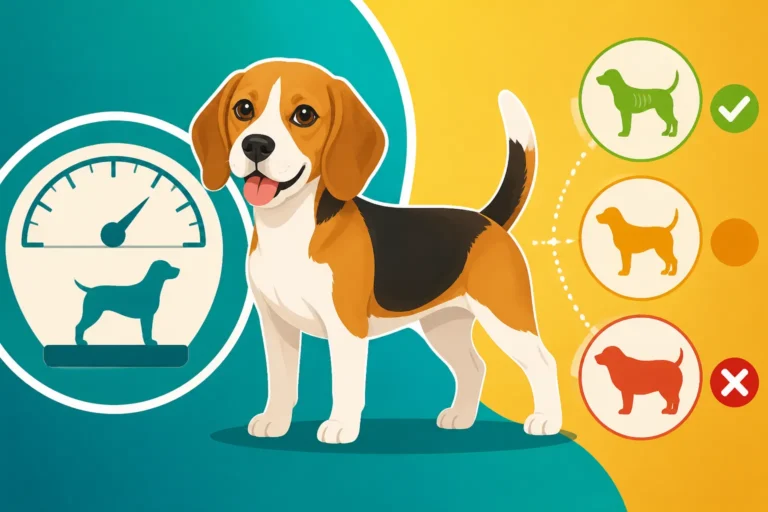
Learn to Feeling for a Beagle's Ribs and Waistline. You should be able to easily feel your Beagle's ribs when you run your hands along their sides, much like feeling the back of your hand. You shouldn't see them, but they shouldn't be hidden under a thick layer of fat either. Look for a visible waistline when viewed from above, and a slight tuck-up in their belly when viewed from the side. If you're finding it harder to feel those ribs, or their waistline is disappearing, it's time to gently reduce their daily calories. If they seem too lean, or you can see too much of their bone structure, a slight increase might be in order. Your vet is also a fantastic resource here and can help you establish a goal weight for your Beagle's frame. Don't be afraid to adjust their intake by small increments (e.g., 5-10% less or more) and observe for a few weeks before making another change.
| Factor | Impact on Daily Calorie Needs (for a 20lb Beagle) | Example Adjustment |
|---|---|---|
| Resting Energy | Baseline requirement to function | ~350 kcal |
| Activity Level | Increases with exercise, decreases with inactivity | +50-200 kcal |
| Spay/Neuter Status | Reduces metabolic rate | -20-30% |
| Puppy (Growing) | Higher energy for growth | +100-200% RER |
| Senior (Low Activity) | Slower metabolism, less movement | -10-20% |
| Hypothyroidism | Slower metabolism due to condition | -10-20% |
| Treats | Added calories, subtract from meal portions | 10% of total daily |
Leveraging Puzzle Feeders and Enrichment for Slow Eating
A common frustration for Beagle owners is that their dog inhales their food in thirty seconds flat and then immediately starts begging for more. This isn't just a behavior quirk; it's a deeply ingrained trait from their hunting ancestry, where food competition meant eating fast or missing out. But in a modern home, it contributes to feelings of dissatisfaction and sets them up for weight gain. The good news is you can harness that food drive for good by making mealtime a mental exercise.
Puzzle feeders, slow feeder bowls, and snuffle mats are fantastic tools. Instead of gobbling down a meal from a regular bowl, your Beagle has to work for each piece of kibble. This slows them down considerably, extending mealtime from seconds to minutes. It provides mental stimulation, which is just as important as physical exercise for a smart hound like a Beagle, and it can help them feel more satisfied because they've "worked" for their meal. You can find a huge variety of these products on platforms like Amazon or Chewy. It turns mealtime into a scavenger hunt, tapping into their natural instincts and giving them a job, even if it's just Puzzle Feeders That Genuinely Slow a Beagle. This simple change can make a surprising difference in managing their overall calorie intake and preventing that immediate post-meal begging.
Disclaimer
This article is for general informational purposes only and does not constitute professional advice. Laws, prices and regulations vary by location and change over time. Consult a qualified professional for guidance on your specific situation.