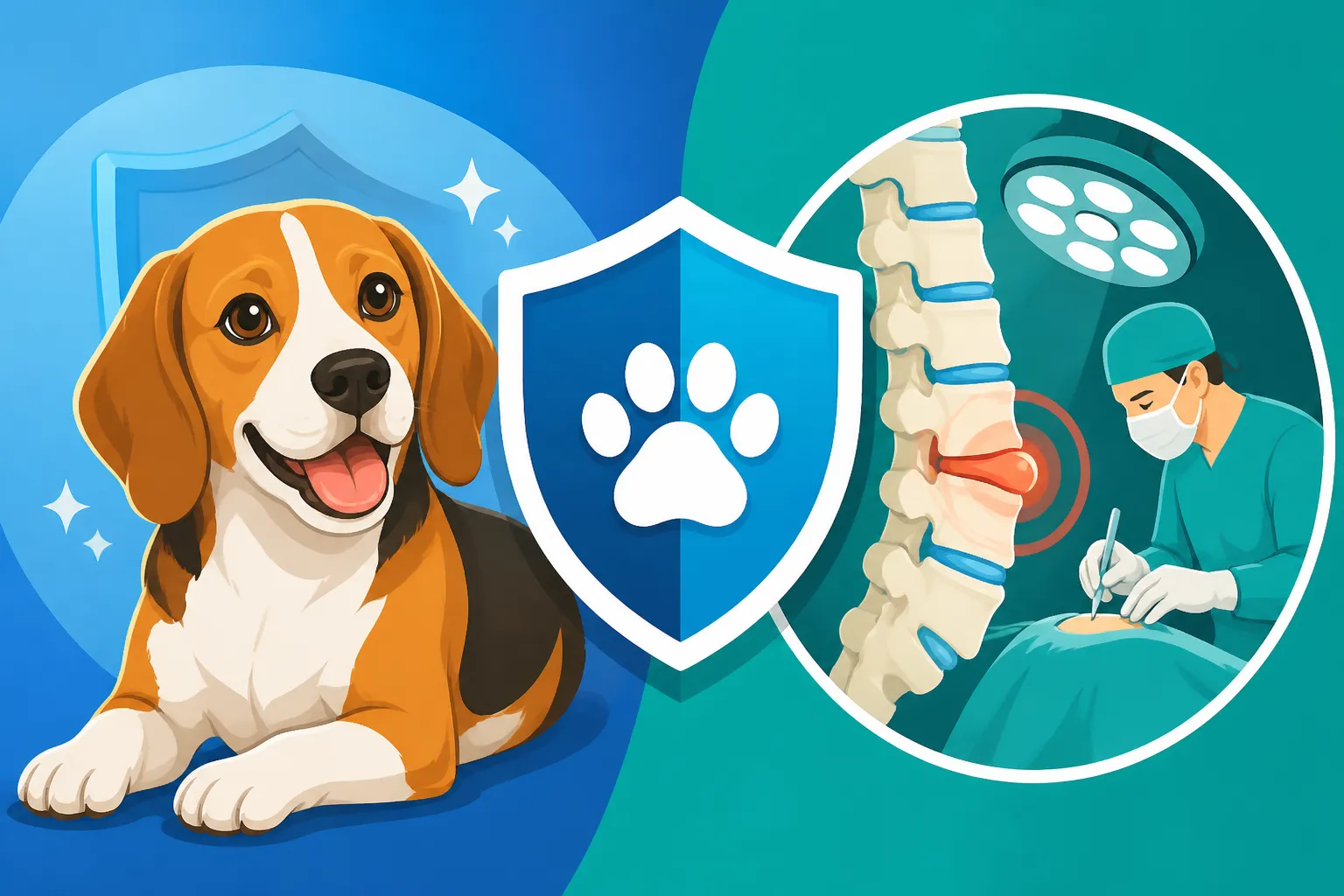
Whether a Beagle Policy Limit Covers Disc Surgery
The thought of your beloved Beagle suddenly struggling with back pain, unable to jump or even walk properly, is a nightmare for any owner. When Intervertebral Disc Disease (IVDD) strikes, the sudden need for expensive diagnostics and potentially life-saving surgery can throw your finances into a tailspin, leaving you wondering if your pet insurance policy will actually cover the monumental costs. This guide will walk you through the intricacies of pet insurance policy limits, specifically in the context of Beagle disc surgery, so you can understand what to expect and how to prepare.
Understanding Beagle Disc Disease and Its Financial Impact
Beagles, with their endearing personalities and incredible noses, are also unfortunately predisposed to certain health challenges, and one of the most concerning is Intervertebral Disc Disease. This condition can be incredibly painful and costly, making pet insurance a crucial consideration.
What Beagle Disc Disease Looks Like
Beagle disc disease, often referred to as IVDD, happens when the cushions between the vertebrae in your Beagle's spine either bulge or burst, pressing on the spinal cord. It's not just a minor ache; it can range from mild pain to complete paralysis. You might first notice your Beagle being reluctant to jump on the couch, showing a hunched back, or crying out when touched. Sometimes, the signs can be subtle, like a slight change in gait, which can lead to bigger problems if not addressed. You might observe them holding their head low if it's a neck disc issue, a particularly heartbreaking sight. Getting an early diagnosis is key, but those initial vet visits, X-rays, and possibly an MRI to truly pinpoint the problem, start adding up very quickly. If you've ever seen a Beagle suddenly refusing to use stairs or struggling to get up, you know the panic that sets in. Early signs of trouble with their back can often be missed, but knowing what to look for, such as those subtle changes in movement or demeanor, can make a huge difference. For more detailed information, consider reading about Beagle Back Pain Warning Signs.
The Staggering Cost of Diagnosis and Treatment
When a Beagle is diagnosed with IVDD, the financial burden can be immense. The diagnostic process itself often includes consultations, radiographs, pain medications, and crucially, an MRI, which can easily run into several thousand dollars on its own. The MRI is vital for surgeons to visualize the exact location and severity of the disc herniation. Once diagnosed, treatment options vary. For milder cases, strict crate rest and medication might be prescribed. However, many Beagles require specialized surgery to decompress the spinal cord. This surgery, often performed by a veterinary neurologist, can cost anywhere from $3,000 to $10,000, or even more, depending on the severity, location, and the specifics of the veterinary hospital.
Post-operative care is also a significant expense, including hospitalization, further medication, and often physical therapy sessions. Many owners will continue with long-term rehabilitation to help their Beagle regain strength and mobility. It’s not just a one-time bill; it's a series of substantial costs that can truly strain a household budget. When facing something like Beagle Disc Surgery and the Odds of Recovery, the financial aspect is often as stressful as the medical one.
Why Beagles Are Prone to Disc Issues
Beagles are classified as a chondrodystrophic breed, which means they have a genetic predisposition to abnormal cartilage development. This characteristic is what gives them their distinctive short legs and slightly longer back. While adorable, this body type makes their intervertebral discs more susceptible to degeneration and herniation than many other breeds. The discs in chondrodystrophic breeds tend to calcify and harden prematurely, making them brittle and prone to rupturing with even a seemingly innocuous movement.
The everyday activities of a typical, energetic Beagle – jumping off furniture, leaping down stairs, or even just twisting rapidly during play – can put immense stress on their already vulnerable spines. Even something as simple as gaining a little too much weight can drastically increase the pressure on their spinal discs. This is why managing How Extra Weight Raises Beagle Disc Pressure is so important for their overall well-being. Knowing this breed-specific risk is crucial when considering pet insurance, as it's not a matter of if a disc issue might arise, but often when.
How Pet Insurance Works for Major Medical Events
Understanding the various components of pet insurance policies is vital when dealing with high-cost treatments like disc surgery for your Beagle. Not all policies are created equal, and the fine print truly matters.
Policy Limits: Annual, Per-Incident, and Lifetime
When you're looking at pet insurance for your Beagle, you'll inevitably come across the concept of "policy limits." These limits are the maximum amount of money your insurance company will pay out for veterinary care. They come in a few different flavors, and understanding the distinctions is critical, especially for conditions like IVDD which can be incredibly expensive.
- Annual Limits: This is the most common type of limit. It's the total amount of money your policy will reimburse you within a single policy year (usually 12 months from when your policy renews). If your Beagle has an annual limit of $10,000, and their disc surgery and recovery costs $8,000, you'd still have $2,000 left for any other covered incidents during that year. However, if their surgery and follow-up care total $12,000, you'd be responsible for the $2,000 that exceeds your annual limit.
- Per-Incident Limits: Less common but very impactful, a per-incident limit caps the payout for a single specific condition for the entire lifetime of your pet. So, if your Beagle has a per-incident limit of $5,000 for IVDD, and they need surgery that costs $8,000, you'd hit that limit quickly and be responsible for the remaining $3,000. This can be particularly problematic for chronic or recurring conditions.
- Lifetime Limits: Some older or more comprehensive policies might have a lifetime limit, which is the absolute maximum amount the insurer will pay out over your pet's entire life, regardless of how many conditions or years of coverage. While seemingly generous, a very large, complex case could potentially hit even a high lifetime limit.
For a significant and often recurring issue like Beagle Back Problems and Intervertebral Disc Disease, a policy with a high annual limit, or ideally, unlimited annual payouts, is often the most beneficial. It prevents you from running out of coverage if treatment extends over multiple years or if other serious issues arise.
Deductibles and Reimbursement Rates
Beyond the policy limits, two other critical factors that determine your out-of-pocket costs for Beagle disc surgery are your deductible and reimbursement rate.
Your deductible is the amount you must pay upfront out of your own pocket before your insurance coverage kicks in. Think of it like your car insurance deductible. Pet insurance deductibles can be annual (you meet it once per year, regardless of the number of incidents) or per-incident (you meet it for each new condition). For a major event like disc surgery, an annual deductible is generally more favorable because you only have to satisfy it once, even if your Beagle needs multiple treatments or has other unrelated issues in the same year. Deductibles can range from $100 to $1,000 or more. Choosing a deductible that suits a Beagle's potential health needs and your budget is crucial.
The reimbursement rate is the percentage of the covered veterinary bill that your insurance company will pay back to you after you've met your deductible. Common reimbursement rates are 70%, 80%, or 90%. So, if your reimbursement rate is 80% and you have a $5,000 bill after meeting your deductible, the insurance company will pay you $4,000, and you'll be responsible for the remaining $1,000. A higher reimbursement rate means less out-of-pocket expense for you.
Let's say your Beagle needs a $7,000 disc surgery. If you have a $500 annual deductible and an 80% reimbursement rate:
- You pay the first $500 (deductible).
- The remaining bill is $6,500 ($7,000 – $500).
- The insurance reimburses you 80% of $6,500, which is $5,200.
- Your total out-of-pocket cost is $500 (deductible) + $1,300 (20% of the remaining bill) = $1,800.
This combination of deductible and reimbursement rate can significantly impact the final cost you bear, even within your policy's overall limits.
Waiting Periods and Pre-Existing Conditions
These two terms are perhaps the most important, and often the most frustrating, aspects of pet insurance, especially when dealing with a condition like IVDD.
A waiting period is the amount of time you must wait after purchasing your policy before certain conditions become eligible for coverage. Most policies have a general waiting period for accidents (often a few days) and a longer one for illnesses (typically 14-30 days). However, many policies also have extended waiting periods for orthopedic conditions, including hip and elbow dysplasia, and crucially, IVDD or disc-related issues. These can sometimes be 6 months or even a year long. This means if your Beagle shows signs of disc disease before this extended waiting period is over, it likely won't be covered.
Pre-existing conditions are any illnesses or injuries that your pet showed signs of (or was diagnosed with) before your policy started, or before the waiting periods were fulfilled. This is where many owners get caught out. If your Beagle has so much as limped or had a reported "back stiffness" on a vet record before your insurance policy was active and past its waiting periods, any future disc-related issues might be deemed pre-existing and excluded from coverage. Some policies might cover "curable" pre-existing conditions after a certain symptom-free period, but chronic conditions like IVDD are rarely considered curable. This makes it incredibly important to get pet insurance for your Beagle as early as possible, ideally when they are a puppy, to ensure conditions like Beagle Disc Disease and the Policy Waiting Period are not excluded.
Navigating Policy Limits for Beagle Disc Surgery
Choosing the right pet insurance policy for your Beagle's potential disc surgery needs requires a careful look at how different policy limits will apply when those large bills hit.
Comparing Annual vs. Per-Incident Limits
When faced with the prospect of a high-cost procedure like Beagle disc surgery, the type of policy limit your plan has can make a monumental difference to your bank account.
An annual limit resets every year. This means that if your Beagle needs disc surgery in March costing $7,000 against a $10,000 annual limit, you’d have $3,000 remaining for the rest of that policy year. If, by some unfortunate turn, they needed a second surgery for a different disc issue or had another major medical problem later that year, that remaining $3,000 would be available. Once the policy renews, the full $10,000 (or whatever your annual limit is) becomes available again. This structure is generally more favorable for conditions like IVDD, which can sometimes recur or lead to other secondary issues over time. Even if the disc problem is chronic, as long as it wasn't pre-existing, you can tap into the annual limit year after year for ongoing care or follow-up surgeries.
A per-incident limit, on the other hand, puts a cap on how much the insurer will pay for a specific condition over your pet's entire lifetime. So, if your policy has a $5,000 per-incident limit for IVDD, and your Beagle's initial surgery costs $7,000, you've already exceeded that limit and will pay the remaining $2,000 out of pocket, plus any future IVDD-related costs. This type of limit can be incredibly restrictive and financially devastating for chronic, recurring, or particularly expensive conditions like disc disease. You might hit that limit very quickly, leaving you with no further coverage for that specific condition, ever. Given the potential for multiple disc events in a chondrodystrophic breed like a Beagle, an annual limit, or ideally, an unlimited annual payout, offers far greater peace of mind and financial protection.
When a Lifetime Limit Can Be a Lifesaver
While less common in newer policies, some insurance plans, particularly those designed for lifelong coverage or high-risk breeds, might still feature a lifetime limit. This limit represents the absolute maximum amount your insurer will pay out for all covered conditions over your Beagle's entire life.
For complex, chronic conditions that can incur significant costs over many years, a high lifetime limit can indeed be a lifesaver. Consider a Beagle that develops IVDD relatively young, perhaps at five years old, and requires multiple surgeries and ongoing physical therapy over the next several years, perhaps reaching their Beagle Lifespan and the Twelve to Fifteen Year Range. If an annual limit policy caps payouts at $10,000 a year, and your Beagle incurs $8,000 in costs one year, and then $6,000 the next, and so on, an annual limit usually resets and continues to cover. However, if costs for various conditions eventually accumulate to, say, $100,000 over a decade, a policy with a $50,000 lifetime limit would stop paying once that threshold is met.
Conversely, some modern policies offer unlimited annual and lifetime payouts. These are often considered the gold standard for comprehensive coverage, especially for breeds with known predispositions to expensive conditions. For instance, reputable providers like Healthy Paws often pride themselves on offering unlimited annual payouts, which effectively act as unlimited lifetime payouts for ongoing covered conditions, providing maximum security against unforeseen medical bills. This gives you the best protection against not just disc surgery, but potentially other issues that might arise as your Beagle ages, such as Beagle Arthritis Arriving in Middle Age.
Real-World Scenarios and Coverage Gaps
Let's look at a couple of hypothetical scenarios to really drive home how policy limits can play out when your Beagle needs disc surgery.
Scenario 1: Limited Annual Policy
Imagine your Beagle, Buster, suddenly shows signs of severe back pain. You rush him to the vet, and after X-rays and an MRI, he's diagnosed with IVDD. The surgery and initial hospitalization cost $8,000. Your policy has a $100 deductible and an 80% reimbursement rate, with an annual limit of $7,500.
- You pay the $100 deductible.
- The remaining bill is $7,900.
- Your insurance covers 80% of $7,900, which is $6,320.
- However, your annual limit is $7,500, but you only received $6,320 in reimbursement. The issue here isn't the limit per se but your out-of-pocket share.
- Your total out-of-pocket is $100 (deductible) + $1,580 (20% of the remaining bill) = $1,680. This is well within your $7,500 annual limit.
Now, let's say a few months later, Buster needs intensive physical therapy costing $2,000, and then, unfortunately, a different disc in his spine herniates, requiring another $6,000 surgery within the same policy year.
- For the physical therapy, the insurer would pay 80% of $2,000 ($1,600).
- Your total reimbursement so far for the year is $6,320 + $1,600 = $7,920.
- This already exceeds your $7,500 annual limit. The policy would only pay out up to $7,500 for the year, meaning you're now paying for the extra $420 ($7,920 – $7,500) from the physical therapy, plus the entire $6,000 for the second surgery.
- This is a significant coverage gap that highlights the importance of higher annual limits, or ideally, unlimited ones.
Scenario 2: Per-Incident Limit Policy
Let's consider your Beagle, Daisy, whose policy has a per-incident limit of $5,000 for any spinal conditions, an annual deductible of $250, and a 90% reimbursement rate. Her first disc surgery costs $6,000.
- You pay the $250 deductible.
- Remaining bill: $5,750.
- The insurer would calculate 90% of $5,750, which is $5,175.
- However, the per-incident limit for spinal conditions is $5,000. The insurance will only pay out $5,000.
- Your out-of-pocket cost is $250 (deductible) + $750 (the remaining portion of the bill after the $5,000 reimbursement) = $1,000.
- Crucially, if Daisy ever needs any other treatment related to her back or spine in the future, her $5,000 per-incident limit for spinal issues has been exhausted. You would be responsible for 100% of those future costs.
These scenarios illustrate that even with pet insurance, you can still face substantial out-of-pocket expenses if your policy limits are too low or structured unfavorably for conditions common in Beagles. This is why thorough research and asking pointed questions before you enroll are so important.
Choosing the Right Policy for Your Beagle's Back
Selecting the ideal pet insurance policy for your Beagle is a critical decision that can save you significant stress and expense down the line, especially with the breed's predisposition to disc issues.
Brands with Strong High-Limit Coverage
When it comes to covering major medical events like disc surgery, choosing an insurance provider known for generous policy limits is paramount. Many pet owners find themselves in a tough spot when their beloved Beagle needs expensive care, only to discover their policy cap is too low.
Providers like Healthy Paws are often praised for their unlimited annual and lifetime payout options, which means you don't have to worry about hitting a cap if your Beagle faces a severe or chronic condition like IVDD. They typically offer high reimbursement rates too, which, when combined with unlimited payouts, provides robust coverage for those unexpected, high-cost vet bills. This comprehensive approach can offer immense peace of mind.
Other popular providers may also offer high annual limits, sometimes up to $15,000, $20,000, or even more, but explicitly unlimited options are typically the safest bet for expensive conditions. While brands like Chewy also offer pet insurance plans through various underwriters, it's always essential to scrutinize the specific policy details – particularly the annual maximums and how they handle orthopedic conditions and pre-existing issues. What sounds good in a general overview might have fine print that doesn't quite fit your Beagle's specific risks. Remember, a robust policy aims to mitigate the overwhelming Beagle Medical Costs for Epilepsy and Thyroid Disease, and disc disease costs fall right into that category of potentially overwhelming expenses.
Asking the Right Questions Before You Enroll
Don't be shy about contacting insurance providers directly and asking very specific questions tailored to your Beagle's breed risks. This is not the time to assume anything.
Here’s a checklist of questions you should absolutely ask:
- "Does your policy have an annual limit, a per-incident limit, or a lifetime limit? What are those specific limits?" Prioritize policies with high annual limits or, ideally, unlimited annual payouts. Avoid per-incident limits for conditions like IVDD.
- "What is your waiting period for orthopedic conditions, specifically Intervertebral Disc Disease?" Confirm if there's an extended waiting period for back issues that differs from general illness waiting periods. This is crucial to avoid having a disc issue deemed pre-existing before coverage can even begin.
- "How does your policy define a 'pre-existing condition,' particularly concerning disc issues?" Understand if a prior vet visit mentioning "back stiffness" or "lameness" will automatically disqualify future IVDD claims. Ask if there's a "curable" pre-existing clause and if IVDD would ever fall under it (unlikely, but worth asking).
- "Are diagnostics like MRIs and CT scans covered, and at what rate?" These are essential for diagnosing IVDD and can be very expensive.
- "Is specialist care (e.g., veterinary neurologists, orthopedic surgeons) covered?" Disc surgery is almost always performed by a specialist.
- "Does coverage include physical therapy, rehabilitation, and long-term pain management post-surgery?" These ongoing costs can be substantial.
- "Can you provide me with a sample policy document so I can read the full terms and conditions?" Don't rely solely on verbal assurances. Read the actual policy.
Comparing multiple quotes and thoroughly understanding the terms will empower you to choose the best protection for your Beagle's potentially vulnerable back.
Proactive Care to Mitigate Risks
While pet insurance is a vital safety net, proactive care can help reduce the likelihood or severity of disc problems for your Beagle. Prevention is always better than cure, and often less expensive in the long run.
One of the most significant factors is weight management. An overweight Beagle puts immense strain on its spine. Regular, appropriate exercise and a carefully portioned diet are crucial. Brands like Ollie, while primarily a fresh dog food service, emphasize portion control and balanced nutrition, which can contribute to maintaining a healthy weight. Keeping your Beagle lean means less pressure on those sensitive intervertebral discs. You can learn more about Beagle Obesity Treated as a Health Problem to understand the full impact.
Secondly, managing their environment is key. Prevent your Beagle from jumping on and off high furniture or repeatedly using stairs. Investing in dog ramps or steps for beds and couches, and even for accessing vehicles, can significantly reduce spinal impact. Installing Ramps and Steps That Protect a Beagle Spine is a relatively small investment that can have a huge preventative effect.
Finally, using a harness instead of a neck collar for walks is strongly recommended. A collar can put pressure on the neck and spine, especially if your Beagle pulls excitedly on scent. A well-fitting harness distributes pressure across the chest and shoulders, protecting their delicate neck and back. Regular, controlled exercise on a leash, allowing for plenty of sniffing (which is great mental enrichment and less jarring than high-impact activities), helps maintain muscle tone around the spine without excessive strain.
Disclaimer
This article is for general informational purposes only and does not constitute professional advice. Laws, prices and regulations vary by location and change over time. Consult a qualified professional for guidance on your specific situation.